Channel Catfish
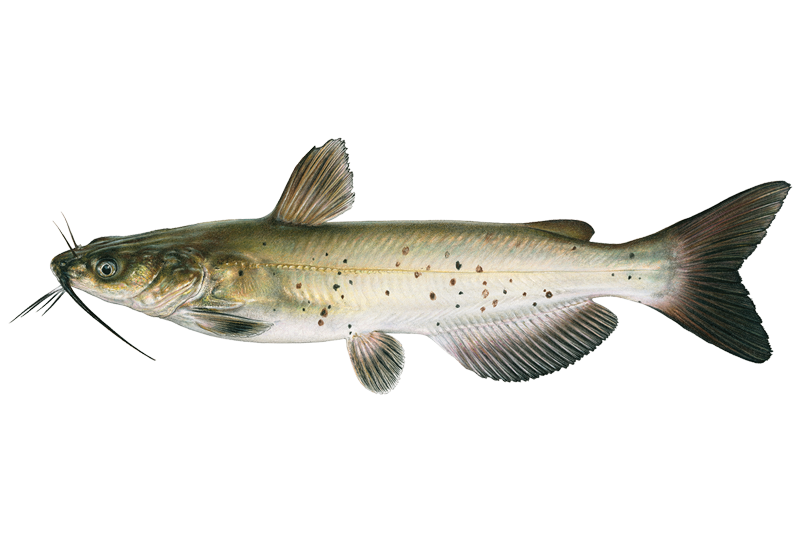
The most widely distributed catfish in the country, channel cats live in nearly every kind of warm fresh water from farm ponds to the lower Mississippi.
They're the species that introduces most Americans to catching catfish — willing biters, found everywhere, and capable of growing past 20 pounds in productive river systems.
Scientific Name: Ictalurus punctatus
Also known as Channel cat, Fiddler, Spotted cat, Speckled cat, Willow cat, Lady cat, Graceful catfish, Chucklehead cat
- Deeply forked tail is the giveaway — bullheads and flatheads have rounded or squared tails. The rounded (convex) anal fin with 24–29 rays separates them from blue catfish, which have a straight anal fin with 30–36 rays.
- Scaleless, smooth-skinned, slate-blue to olive-brown above with a silvery-white belly; coloration shifts with water clarity, running nearly black in clear water and yellowish in turbid water.
- Scattered dark spots dot the back and sides of juveniles and most adults, though they often fade or disappear on the largest old fish. Eight barbels around the mouth, with the long corner barbels darker than the chin pair.
- Most caught fish run 15–24 inches and 2–10 pounds; a 20-pounder is a genuine trophy in productive river systems, and the all-tackle world record stands at 58 pounds from Santee-Cooper Reservoir, South Carolina.
What to know
Habitat Distribution
- Native to the Mississippi, Great Lakes, and Gulf drainages between the Rockies and Appalachians, but stocked so widely for sport and food that they now live in essentially all 48 contiguous states.
- Warm-water generalists — preferring water around 70°F, feeding shuts down below 50°F, and they survive temperatures up to about 95°F. Equally at home in clear streams or muddy rivers.
- Sand, gravel, and rubble bottoms hold them more reliably than dense weed beds. Big rivers with low-to-moderate gradient and large impoundments are the heart of the fishery, but they thrive in ponds and creeks too.
- Tolerate brackish water up to about 11 ppt, so they show up in upper estuaries as well as pure freshwater.
Specific Spots
- By day, adults hold in deep pools tucked against submerged logs, drift piles, undercut banks, and rock cover — slow water with overhead shelter.
- After dark they push up onto riffles and into pool tails to feed, which is why the hour after sunset is so consistently productive.
- River bends, creek mouths, cove edges, and the slack water below dams collect drifting food and concentrate fish on natural feeding lanes.
- In winter and during summer heat in reservoirs, fish slide to deeper, thermally stable water sheltered from current — feeding drops sharply but fish stack up tight.
Channel Catfish FAQ
Answers from onWater's species guide.
What are the best lures and bait for Channel Catfish?
Prepared stinkbaits and fibered punch baits fished on a bare treble are the top numbers producer nationwide, they exploit the channel cat's chemosensory system better than anything else.
What flies work for Channel Catfish?
Clouser Minnows in tan/white or chartreuse/white imitate baitfish and ride hook-up to dodge bottom snags, the most-cited fly for channel cats in current.
What do Channel Catfish eat?
Adults eat almost anything organic, fish, crayfish, aquatic insects, mollusks, frogs, worms, even seeds and plant material. One Des Moines River study pulled insects from 50 different families out of channel cat stomachs.
Where do Channel Catfish live?
Native to the Mississippi, Great Lakes, and Gulf drainages between the Rockies and Appalachians, but stocked so widely for sport and food that they now live in essentially all 48 contiguous states.
See it in the app
Most maps show you water.
onWater shows you Channel Catfish.



- 01 · Species map filter
Map every Channel Catfish water
Pick Channel Catfish and the map zeroes in on the waters they call home. No more guessing which lake holds them.
- 02 · Waterbody species
Tap any water. See what lives there.
Species, behavior and seasonal patterns for every lake, river and pond, before you leave the driveway.
- 03 · Angler Intelligence
Ask how to catch Channel Catfish
Tactics, gear and timing from onWater's AI fishing guide, tuned to the species and the water you're on.
Stop guessing where Channel Catfish are.
Open the map, filter by Channel Catfish, and head to water that holds them. Download onWater and plan your next trip in minutes.
- Species map filter
- Angler Intelligence
- Fishing journal
Explore other species
Trout, bass, salmon, panfish and everything in between. Each guide unpacks the behavior, seasons, and tactics that put fish in the net.
No species information available.
Smarter Fishing Starts in the App.
onWater Fish gives you everything you need to plan smarter, fish better, and own every trip from first cast to last.