Smallmouth Bass
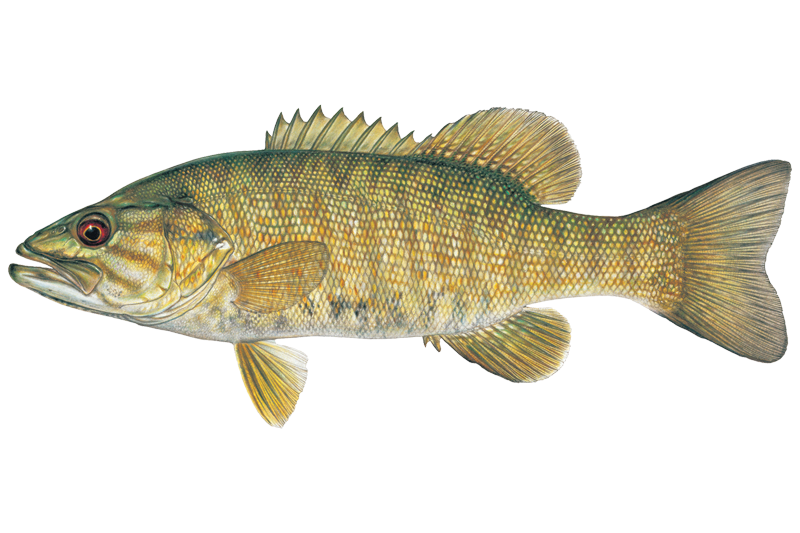
A cool, clear-water river and lake fish native to the St. Lawrence, Great Lakes, and Mississippi basins, now established in nearly every state outside Florida and Louisiana.
Bronze-flanked, acrobatic, and tightly tied to rocky bottoms and crayfish — the fish Dr. James Henshall once called the gamest that swims, and the description still holds.
Scientific Name: Micropterus dolomieu
Also known as Bronzeback, Brown Bass, Smallie, Brownie, Bareback Bass
- Olive to bronze-brown above with 8–16 dark vertical bars on the sides — the single most reliable mark separating it from largemouth, which carry a horizontal stripe.
- Upper jaw stops at the middle of the eye (largemouth's runs past the eye), and the spiny and soft dorsal fins are continuous rather than visibly split.
- Dark radiating lines run from the snout and back of the eye across the gill cover; eyes are typically red or red-brown. River fish run long and slender; lake fish are deeper-bodied.
- Most caught fish run 12–16 inches and around 2 lbs; 4–6 lb fish are trophies. The IGFA all-tackle record stands at 11 lbs 15 oz, set at Dale Hollow Lake in 1955.
What to know
Habitat Distribution
- Native through the Great Lakes, St. Lawrence, and Mississippi drainages from the upper Midwest south to northern Alabama and eastern Oklahoma; introduced almost everywhere else in the lower 48 except Florida and Louisiana.
- A clear-water specialist that demands cooler temperatures than largemouth — peak activity falls in the 65–75°F window, with dissolved oxygen above 5 ppm needed for healthy populations.
- Both river and lake fish: streams wider than about 30 feet with pool-and-riffle structure, and lakes with rocky shoals, gravel substrate, and depths past 30 feet. Soft, muddy systems hold few fish.
- Sensitive to sedimentation and pollution — their presence is widely treated as an indicator of decent water quality.
Specific Spots
- In rivers, behind boulders, along current seams, and in the deeper pools below riffles — fish hold out of the main flow and pick off prey drifting through the seam.
- Rocky points, submerged boulder fields, gravel flats, and steep drop-offs in lakes, especially where crayfish are abundant. Smallmouth show strong site fidelity and return to the same structure season after season.
- Through summer stratification, fish stack 20–30 feet down near the thermocline during bright midday hours and slide shallow at dawn, dusk, and after dark to hunt.
- In reservoirs, work rocky humps, channel ledges, secondary points, and submerged road beds — anywhere a clean rock-to-gravel transition meets deeper water.
Smallmouth Bass FAQ
Answers from onWater's species guide.
What are the best lures and bait for Smallmouth Bass?
Soft plastics carry the load: tube jigs hopped along rocky bottom, Ned rigs on a light mushroom head, drop-shots with finesse worms or minnow imitations, and craw-pattern plastics. Natural colors, green pumpkin, brown, smoke, white, fish best in clear water.
What flies work for Smallmouth Bass?
Deer-hair and foam poppers (Bob's Banger, Sneaky Pete) are the signature smallmouth fly, fish them along boulder seams and shorelines at dawn and dusk and the takes are violent and visual.
What do Smallmouth Bass eat?
Crayfish are the cornerstone forage in most waters, often 40–90% of an adult's diet, which is why tube jigs, craw-pattern soft plastics, football jigs, and Clouser Crayfish flies all work, they're all imitating the same thing on the rocks.
Where do Smallmouth Bass live?
Native through the Great Lakes, St. Lawrence, and Mississippi drainages from the upper Midwest south to northern Alabama and eastern Oklahoma; introduced almost everywhere else in the lower 48 except Florida and Louisiana.
See it in the app
Most maps show you water.
onWater shows you Smallmouth Bass.



- 01 · Species map filter
Map every Smallmouth Bass water
Pick Smallmouth Bass and the map zeroes in on the waters they call home. No more guessing which lake holds them.
- 02 · Waterbody species
Tap any water. See what lives there.
Species, behavior and seasonal patterns for every lake, river and pond, before you leave the driveway.
- 03 · Angler Intelligence
Ask how to catch Smallmouth Bass
Tactics, gear and timing from onWater's AI fishing guide, tuned to the species and the water you're on.
Stop guessing where Smallmouth Bass are.
Open the map, filter by Smallmouth Bass, and head to water that holds them. Download onWater and plan your next trip in minutes.
- Species map filter
- Angler Intelligence
- Fishing journal
Explore other species
Trout, bass, salmon, panfish and everything in between. Each guide unpacks the behavior, seasons, and tactics that put fish in the net.
No species information available.
Smarter Fishing Starts in the App.
onWater Fish gives you everything you need to plan smarter, fish better, and own every trip from first cast to last.