Muskellunge
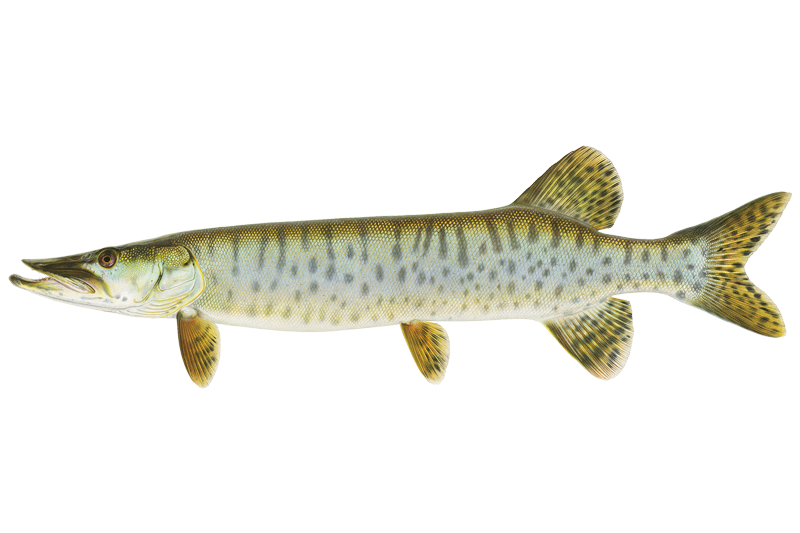
The largest member of the pike family, muskellunge are a coolwater predator of the Great Lakes, upper Mississippi, and St. Lawrence drainages, with stocked populations reaching into Appalachian rivers and southern reservoirs.
Long stretches of nothing punctuated by the sight of a 40-inch shadow tracking your lure to the boat — that's muskie fishing in one sentence.
Scientific Name: Esox masquinongy
Also known as Muskie, Musky, 'Lunge, Ski, Maskinonge, Masquinonge, Milliganong, Great Pike, Northern Muskellunge
- Light silver-to-green flanks marked with dark vertical bars or spots over a white-to-cream belly, on a long, moderately compressed body with a duckbill snout. Markings can be faint or absent in some lakes.
- The cleanest way to separate from northern pike: muskies have dark markings on a light background; pike have light markings on a dark background. Muskies also show 6-9 sensory pores under the lower jaw versus 5 or fewer on pike.
- Tail lobes come to a sharper point than pike, dorsal and anal fins are pointed rather than rounded, and the lower half of the gill cover is unscaled — pike are fully scaled there.
- Adults commonly run 28-48 inches and 15-36 pounds; fish over 50 inches and 40 pounds are the trophy class. The IGFA all-tackle record stands at 67 lb 8 oz from 1949.
What to know
Habitat Distribution
- Native to the St. Lawrence-Great Lakes basin and upper Mississippi, with three recognized subspecies — the spotted Great Lakes form, the clear/unbarred form of inland northern lakes, and the barred Ohio River form found through Appalachian drainages.
- Stocking has pushed the range well beyond native waters into Appalachian rivers, mid-Atlantic and southern reservoirs, and parts of the Northeast where harvest is encouraged to protect resident trout and salmon.
- A coolwater fish at its best in clear water around 67-72°F, with optimal growth near 77°F. Because muskies hunt by sight, persistently turbid systems don't hold them well.
- Lives in oligotrophic and mesotrophic lakes and large, low-gradient rivers; rarely found in rivers steeper than 10 feet per mile unless backwater pools provide refuge.
Specific Spots
- The deep edge of cabbage and other broadleaf weed beds where shallow flats break into the basin holds the classic ambush fish, especially on outside turns and points.
- Submerged timber, dock pilings, creek mouths, and rocky reefs adjacent to deep water all produce; on Canadian Shield-type lakes with little vegetation, windswept rock points replace the weedline as primary structure.
- Larger summer fish often suspend in open water, following cisco or sucker schools along thermal breaks rather than staying tight to cover.
- In rivers, slack water behind current breaks, eddy seams, and deep bend pools — anywhere a fish can sit out of the current and watch passing forage.
Muskellunge FAQ
Answers from onWater's species guide.
What are the best lures and bait for Muskellunge?
Bucktail and inline spinners burn water in spring and stained conditions, glide baits draw follows into strikes with side-to-side action, and big jerkbaits and soft-plastic swimbaits cover the rest of the column. Working size runs 5-10 inches with trophy hunters going to 12-15+ inches.
What flies work for Muskellunge?
Multi-jointed articulated streamers 6-14 inches on 1/0-8/0 hooks, built from deer hair, EP fibers, rabbit strip, and synthetics, do the heavy lifting, these are baitfish profiles imitating suckers, creek chubs, perch, and juvenile pike. Topwater poppers and sliders take over for surface work.
What do Muskellunge eat?
Soft-rayed forage like suckers, ciscoes, and yellow perch makes up the core of the adult diet, though muskies will eat any fish available, bass, walleye, smaller muskies.
Where do Muskellunge live?
Native to the St. Lawrence-Great Lakes basin and upper Mississippi, with three recognized subspecies, the spotted Great Lakes form, the clear/unbarred form of inland northern lakes, and the barred Ohio River form found through Appalachian drainages.
See it in the app
Most maps show you water.
onWater shows you Muskellunge.



- 01 · Species map filter
Map every Muskellunge water
Pick Muskellunge and the map zeroes in on the waters they call home. No more guessing which lake holds them.
- 02 · Waterbody species
Tap any water. See what lives there.
Species, behavior and seasonal patterns for every lake, river and pond, before you leave the driveway.
- 03 · Angler Intelligence
Ask how to catch Muskellunge
Tactics, gear and timing from onWater's AI fishing guide, tuned to the species and the water you're on.
Stop guessing where Muskellunge are.
Open the map, filter by Muskellunge, and head to water that holds them. Download onWater and plan your next trip in minutes.
- Species map filter
- Angler Intelligence
- Fishing journal
Explore other species
Trout, bass, salmon, panfish and everything in between. Each guide unpacks the behavior, seasons, and tactics that put fish in the net.
No species information available.

Smarter Fishing Starts in the App.
onWater Fish gives you everything you need to plan smarter, fish better, and own every trip from first cast to last.