Redbreast Sunfish
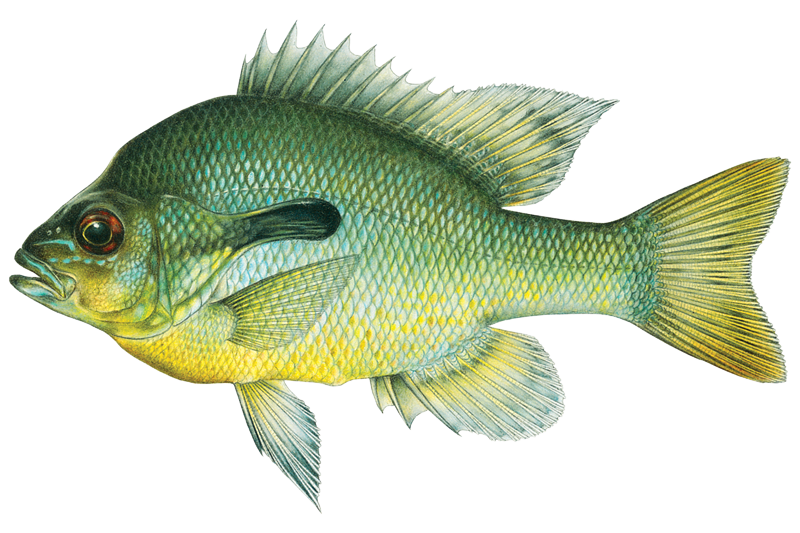
The river bream of the Eastern coastal plain — a sunfish that belongs to moving water rather than farm ponds.
Native to Atlantic and Gulf Slope drainages from New Brunswick south to central Florida, with introduced populations now established as far west as Texas.
In Southeastern blackwater rivers and spring-fed streams it's the dominant panfish, drawing dedicated canoe and wade anglers.
Scientific Name: Lepomis auritus
Also known as Yellowbelly Sunfish, Sun Perch, Redbreast Bream, Robin, River Bream, Redbelly
- The giveaway is the ear flap: an exceptionally long, narrow, all-black opercular flap that extends well past the eye, with no light border on its rear margin.
- Olive-green to dark-brown back fading to blue-green sides and a belly that runs orange-yellow on females to a deep orange-red on breeding males, with bright blue iridescent vermiculations on the cheeks and blue streaks across the upper lip.
- Body is more elongated and shallower than other Lepomis, with a small mouth and faint vertical bars that intensify near the lateral line.
- Average adult runs about 4 inches; a 10-inch fish is a good one and anything over a pound is a genuine trophy. The IGFA all-tackle record stands at 1 lb 12 oz.
What to know
Habitat Distribution
- Native to Atlantic and Gulf Slope drainages from New Brunswick south to central Florida, west only as far as the Apalachicola and Choctawhatchee systems — concentrated in rivers draining east of the Appalachians.
- Stocking has established populations well outside the native range, including parts of the interior South and as far west as the Pecos drainage in West Texas.
- More tied to flowing water than other sunfish — cool to warm rivers, spring-fed streams, and slow coastal-plain creeks are the core habitat, though it also turns up in lake margins and beaver ponds.
- A visual feeder that needs reasonably clear water with moderate current; extended turbidity and water that's too acidic or too alkaline both knock populations back hard.
Specific Spots
- Hugs bank structure — overhanging branches, undercut banks, fallen logs, root tangles, and woody debris that shade the water and concentrate insects washing past.
- Outside of spawning, holds in calmer, deeper pools tucked against fallen trees or large rocks rather than in fast riffles, often stacked on a single piece of cover.
- Spawning beds appear in 6–18 inches over sand or fine gravel, usually right next to a snag or log; nests can be solitary or in colonies of 80-plus fish.
- In cold months, fish drop into the deepest pools available and school up; once water climbs past about 50°F they spread back into the shallows.
Redbreast Sunfish FAQ
Answers from onWater's species guide.
What are the best lures and bait for Redbreast Sunfish?
Live bait carries the day: earthworms, crickets, grasshoppers, waxworms, and nightcrawlers fished on a size 8–12 hook under a bobber or free-lined into bank cover.
What flies work for Redbreast Sunfish?
Subsurface flies do the heavy lifting: small Woolly Buggers (generic baitfish/leech imitations), soft-hackle wet flies, and rubber-legged nymphs like Prince Nymphs, Copper Johns, and Hare's Ears (mayfly and stonefly nymph imitations) on size 8–14 hooks, dead-drifted or slowly stripped past cover.
What do Redbreast Sunfish eat?
Mayfly, caddisfly, dragonfly, and damselfly nymphs make up the bulk of the diet, which is exactly why size 10–14 Hare's Ear, Pheasant Tail, and Prince Nymph patterns, all generic mayfly/caddis nymph imitations, are deadly drifted near cover.
Where do Redbreast Sunfish live?
Native to Atlantic and Gulf Slope drainages from New Brunswick south to central Florida, west only as far as the Apalachicola and Choctawhatchee systems, concentrated in rivers draining east of the Appalachians.
See it in the app
Most maps show you water.
onWater shows you Redbreast Sunfish.



- 01 · Species map filter
Map every Redbreast Sunfish water
Pick Redbreast Sunfish and the map zeroes in on the waters they call home. No more guessing which lake holds them.
- 02 · Waterbody species
Tap any water. See what lives there.
Species, behavior and seasonal patterns for every lake, river and pond, before you leave the driveway.
- 03 · Angler Intelligence
Ask how to catch Redbreast Sunfish
Tactics, gear and timing from onWater's AI fishing guide, tuned to the species and the water you're on.
Stop guessing where Redbreast Sunfish are.
Open the map, filter by Redbreast Sunfish, and head to water that holds them. Download onWater and plan your next trip in minutes.
- Species map filter
- Angler Intelligence
- Fishing journal
Explore other species
Trout, bass, salmon, panfish and everything in between. Each guide unpacks the behavior, seasons, and tactics that put fish in the net.
No species information available.

Smarter Fishing Starts in the App.
onWater Fish gives you everything you need to plan smarter, fish better, and own every trip from first cast to last.