Lake Trout
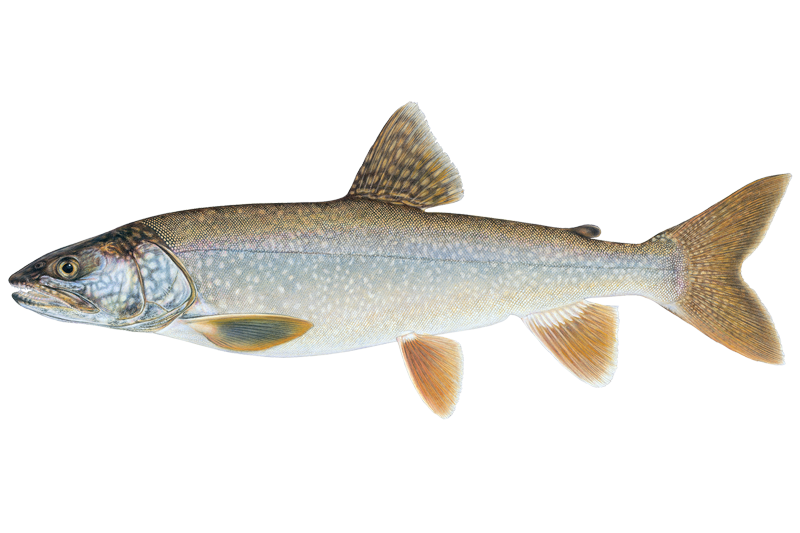
The largest of North America's freshwater chars, a cold-water fish of deep, clean lakes from Alaska across the Great Lakes basin and into New England, with introduced populations scattered through western reservoirs and high-elevation lakes.
Anglers chase them for their size — 10-pound fish are common in good water, 30- and 40-pounders show up regularly — and for the deep, piston-like fight that feels more like a saltwater pull than anything else in freshwater.
Scientific Name: Salvelinus namaycush
Also known as Mackinaw, Laker, Togue, Gray Trout, Namaycush, Siscowet
- Slate-grey to greenish body covered in cream or pale yellow irregular spots running across the head, sides, dorsal fin, and tail; lower fins are orange-red with a thin white leading edge.
- The deeply forked tail is the giveaway — every other char in the lake (brook trout especially) has a much squarer tail. Look there first to confirm an ID.
- Lacks the black stripe on the front edge of the pelvic and anal fins that brook trout carry, and lacks the pink spotting and red breeding flush of Dolly Varden and Arctic char.
- Typical sport-caught fish run 3 to 10 pounds, with 15 to 40 pounds not unusual in prime water; the IGFA all-tackle record is 72 pounds, and these fish can live 60-plus years.
What to know
Habitat Distribution
- Native to Alaska, the Great Lakes basin, the Finger Lakes, Lake Champlain, and a handful of glacial-relict lakes in northwest and southwest Montana; introduced widely across western reservoirs and high-altitude lakes, where they're often called mackinaw.
- A cold-water obligate that needs water below about 55°F and high dissolved oxygen — the only major native sportfish adapted to the deep, low-nutrient lakes of the northern tier.
- Most populations live in lakes deeper than 50 feet, and fish are routinely found over 200 feet down. They also use deep tributary rivers connected to large lake systems.
- In far-northern lakes they stay relatively shallow year-round; at the southern edge of the range they're forced into deep summer refugia and only come within reach of casting tackle in spring and fall.
Specific Spots
- Steep drop-offs adjacent to flats, where alewives, smelt, ciscoes, and chubs school up — lakers hold below or beside the bait and rise to feed.
- Right at ice-out, big fish push into shallow rocky bays and onto wave-washed points to hunt baitfish under disintegrating ice; this is the prime window for casting a fly or a jig.
- In summer, fish concentrate at whatever depth holds 50-55°F water — often 100 to 300 feet in big southern impoundments and the lower Great Lakes — sitting just off the bottom near structure.
- Fall pre-spawn fish stage on clean rubble, cobble, and boulder shoals in 3 to 40 feet of water, with males arriving first to fan silt off the rocks.
Lake Trout FAQ
Answers from onWater's species guide.
What are the best lures and bait for Lake Trout?
Heavy metal spoons in 3/8 to 1+ ounces, Swedish Pimples, Hopkins, Crippled Herring, Williams Whitefish, in silver, brass, and gold for both jigging and trolling. Step up the weight as you go deeper.
What flies work for Lake Trout?
Big baitfish streamers carry the day: Clouser Deep Minnows (which imitate baitfish with a jigging action from their dumbbell eyes) are widely considered the single most reliable laker fly. Lefty's Deceivers up to 5 inches and Woolly Buggers in black or olive cover the rest.
What do Lake Trout eat?
Adults are fish-eaters above all else: alewives, smelt, sculpins, and chubs in the Great Lakes; whitefish, grayling, sticklebacks, and sculpins up north. Match the local baitfish with a 3- to 6-inch streamer, tube jig, spoon, or swimbait and you've covered most days.
Where do Lake Trout live?
Native to Alaska, the Great Lakes basin, the Finger Lakes, Lake Champlain, and a handful of glacial-relict lakes in northwest and southwest Montana; introduced widely across western reservoirs and high-altitude lakes, where they're often called mackinaw.
See it in the app
Most maps show you water.
onWater shows you Lake Trout.



- 01 · Species map filter
Map every Lake Trout water
Pick Lake Trout and the map zeroes in on the waters they call home. No more guessing which lake holds them.
- 02 · Waterbody species
Tap any water. See what lives there.
Species, behavior and seasonal patterns for every lake, river and pond, before you leave the driveway.
- 03 · Angler Intelligence
Ask how to catch Lake Trout
Tactics, gear and timing from onWater's AI fishing guide, tuned to the species and the water you're on.
Stop guessing where Lake Trout are.
Open the map, filter by Lake Trout, and head to water that holds them. Download onWater and plan your next trip in minutes.
- Species map filter
- Angler Intelligence
- Fishing journal
Explore other species
Trout, bass, salmon, panfish and everything in between. Each guide unpacks the behavior, seasons, and tactics that put fish in the net.
No species information available.

Smarter Fishing Starts in the App.
onWater Fish gives you everything you need to plan smarter, fish better, and own every trip from first cast to last.