Arctic Grayling
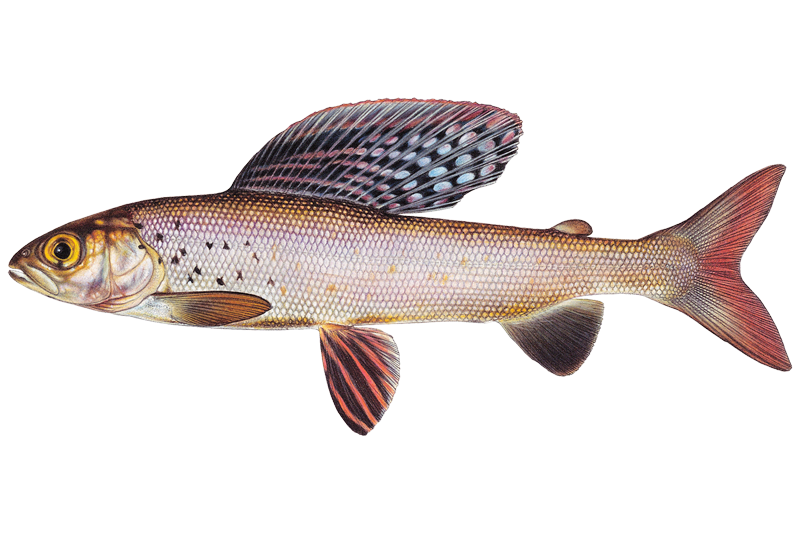
That sail-like dorsal fin — iridescent, spotted with red, aqua, and purple — makes the Arctic Grayling unlike anything else in cold, clear northern rivers and lakes.
Native to Arctic and Pacific drainages across northern North America and Siberia, with small remnant and introduced populations farther south, grayling rise eagerly to dry flies and hit small spinners with a willingness that rewards light-tackle fishing in some of the most remote water on the planet.
Scientific Name: Thymallus arcticus
- The oversized dorsal fin is the unmistakable field mark — no other North American salmonid carries one this large, and on bigger fish it flares with iridescent red, aqua, and purple spots.
- Slender, silver-sided body with coarse scales; back is typically dark, sides can shift from black to gold to blue, with a gold band separating the sides from a white belly.
- A black slash marks each side of the lower jaw — a subtle but consistent ID detail when the fin is folded.
- Most fish run 13–16 inches; exceptional individuals reach 20 inches and around 3 pounds, with rare specimens recorded to 30 inches and over 8 pounds.
What to know
Habitat Distribution
- A cold-water specialist native to Arctic and Pacific drainages across northern North America — Alaska, Canada, and Siberia — where it remains widespread and abundant in both rivers and lakes.
- In the contiguous United States, native river populations are now extremely limited; introduced, largely lake-dwelling populations exist in high-elevation mountain systems across the western interior.
- Needs clear, cold water sustained at roughly 46–52°F (8–11°C) with high dissolved oxygen — conditions found in high-elevation lakes and the upper reaches of cold-water river systems.
Specific Spots
- Larger fish hold in the cooler upstream reaches of rivers, often just off the main current where they can intercept drifting insects without fighting heavy flow.
- Deep pools are critical overwintering and refuge habitat — in rivers, look for the slowest, deepest water that stays unfrozen through winter.
- During summer, grayling station themselves along current seams and below riffles where surface insects concentrate, making them visible and predictable risers.
- In lakes, fish cruise shallow, rocky shorelines and inlet areas, especially when insects are hatching near the surface.
Arctic Grayling FAQ
Answers from onWater's species guide.
What are the best lures and bait for Arctic Grayling?
Small inline spinners in sizes #0 to #3, Mepps and Panther Martin are the classic choices, with red-and-gold combinations producing consistently; the flash and vibration trigger the same response as a fleeing insect or small fish.
What flies work for Arctic Grayling?
Dry flies are the signature approach: Elk Hair Caddis (imitating adult caddisflies) and Black Gnats (imitating midges and small dark flies) are reliable across the range, grayling are enthusiastic dry-fly targets when anything is hatching.
What do Arctic Grayling eat?
Adults eat primarily surface and subsurface insects, mayflies, caddisflies, midges, which is why dry flies and nymphs are the go-to approach; when fish are visibly rising, match whatever is hatching on the surface.
Where do Arctic Grayling live?
A cold-water specialist native to Arctic and Pacific drainages across northern North America, Alaska, Canada, and Siberia, where it remains widespread and abundant in both rivers and lakes.
See it in the app
Most maps show you water.
onWater shows you Arctic Grayling.



- 01 · Species map filter
Map every Arctic Grayling water
Pick Arctic Grayling and the map zeroes in on the waters they call home. No more guessing which lake holds them.
- 02 · Waterbody species
Tap any water. See what lives there.
Species, behavior and seasonal patterns for every lake, river and pond, before you leave the driveway.
- 03 · Angler Intelligence
Ask how to catch Arctic Grayling
Tactics, gear and timing from onWater's AI fishing guide, tuned to the species and the water you're on.
Stop guessing where Arctic Grayling are.
Open the map, filter by Arctic Grayling, and head to water that holds them. Download onWater and plan your next trip in minutes.
- Species map filter
- Angler Intelligence
- Fishing journal
Explore other species
Trout, bass, salmon, panfish and everything in between. Each guide unpacks the behavior, seasons, and tactics that put fish in the net.
No species information available.

Smarter Fishing Starts in the App.
onWater Fish gives you everything you need to plan smarter, fish better, and own every trip from first cast to last.