White Perch
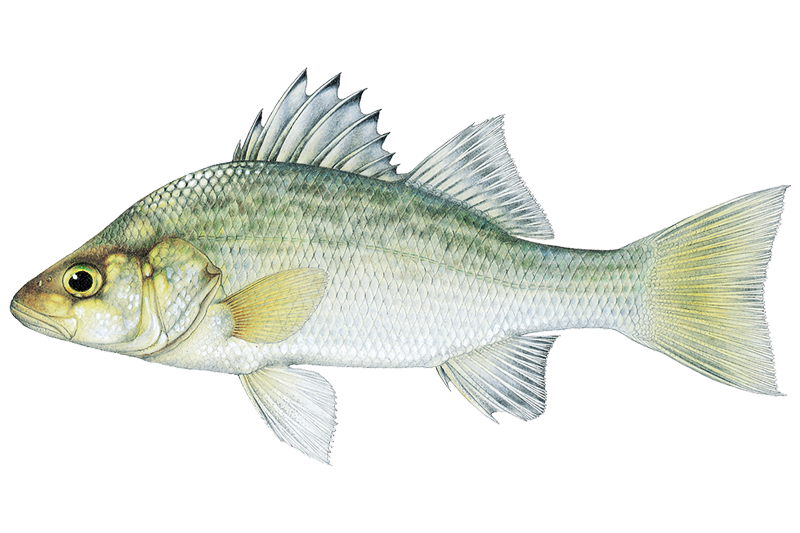
A small temperate bass — not a true perch — native to Atlantic Slope estuaries from the St. Lawrence drainage south to the Carolinas, and now established well inland after spreading through the Great Lakes and into reservoirs across the Midwest and Northeast.
Schooling, willing to bite, and consistently rated as some of the best-eating panfish on the East Coast.
Scientific Name: Morone americana
Also known as Silver Bass, Black-back, Sea Perch, Gray Perch, Bluenose Perch
- Silvery-white to silvery-green sides with a grayish-green or dark olive back and no horizontal stripes — the cleanest way to separate them from white bass and stripers.
- Body is deep and laterally compressed, deepest just ahead of the front dorsal fin, giving older fish a humpbacked profile. The two dorsal fins are joined by a thin membrane rather than fully separated.
- No teeth on the tongue (white bass has one patch, striper has two) — the definitive in-hand ID. Pelvic and anal fins often show a rosy tint, and spawning fish can flush pink to purple under the jaw.
- Most fish run 7–12 inches and under a pound; the species tops out around 19 inches and 2–3 pounds, with brackish-water fish typically larger and stockier than stunted inland populations.
What to know
Habitat Distribution
- Native to Atlantic coastal drainages from the St. Lawrence south to the Pee Dee in South Carolina, with strongholds in the Hudson, Chesapeake and Delaware Bay systems, the Finger Lakes, and Long Island Sound.
- Introduced and self-sustaining throughout all five Great Lakes and in scattered interior reservoirs across the Midwest, Northeast, and parts of the Southeast — often spread by bait-bucket releases and canal connections.
- Euryhaline and adaptable: equally at home in salt, brackish, and fresh water. Coastal fish are semi-anadromous, dropping back to bays in summer and running tidal freshwater rivers to spawn; landlocked fish stay put year-round.
- Classified as a prohibited invasive in some states because of its impact on walleye and yellow perch recruitment — possession of live fish outside the native range is often illegal.
Specific Spots
- Open water over mud, silt, or sand is the default — these aren't structure-hugging fish. Schools roam, so locating them with electronics or by reading bird and bait activity matters more than casting to cover.
- Drop-offs and contour breaks in 15–25 feet, often just outside weed edges in lakes, hold suspended schools through the warmer months.
- In tidal water, work oyster bars, creek mouths, bridge pilings, and grassy edges on a moving tide; on slack or low water the same fish slide into channel edges and deeper holes.
- Winter fish stack in the deepest parts of bays and creek holes in a near-dormant state — vertical jigging directly over them is the play.
White Perch FAQ
Answers from onWater's species guide.
What are the best lures and bait for White Perch?
Live and cut bait carries the day for many anglers: minnows early in the season, grass shrimp year-round, and bloodworms, nightcrawlers, peeler crab, or clam strips fished on a bottom rig, drop-shot, or under a float.
What flies work for White Perch?
Small streamers in the 1–2 inch range are the primary fly: Clouser Minnows in white/chartreuse or white/olive imitate the small baitfish, smelt, and juvenile herring that adults eat.
What do White Perch eat?
Diet shifts hard with size: zooplankton and copepods as fry, then aquatic insects and small crustaceans, then mostly small fish, minnows, smelt, killifish, alewife, once they push past about nine inches.
Where do White Perch live?
Native to Atlantic coastal drainages from the St. Lawrence south to the Pee Dee in South Carolina, with strongholds in the Hudson, Chesapeake and Delaware Bay systems, the Finger Lakes, and Long Island Sound.
See it in the app
Most maps show you water.
onWater shows you White Perch.



- 01 · Species map filter
Map every White Perch water
Pick White Perch and the map zeroes in on the waters they call home. No more guessing which lake holds them.
- 02 · Waterbody species
Tap any water. See what lives there.
Species, behavior and seasonal patterns for every lake, river and pond, before you leave the driveway.
- 03 · Angler Intelligence
Ask how to catch White Perch
Tactics, gear and timing from onWater's AI fishing guide, tuned to the species and the water you're on.
Stop guessing where White Perch are.
Open the map, filter by White Perch, and head to water that holds them. Download onWater and plan your next trip in minutes.
- Species map filter
- Angler Intelligence
- Fishing journal
Explore other species
Trout, bass, salmon, panfish and everything in between. Each guide unpacks the behavior, seasons, and tactics that put fish in the net.
No species information available.

Smarter Fishing Starts in the App.
onWater Fish gives you everything you need to plan smarter, fish better, and own every trip from first cast to last.