Chinook Salmon
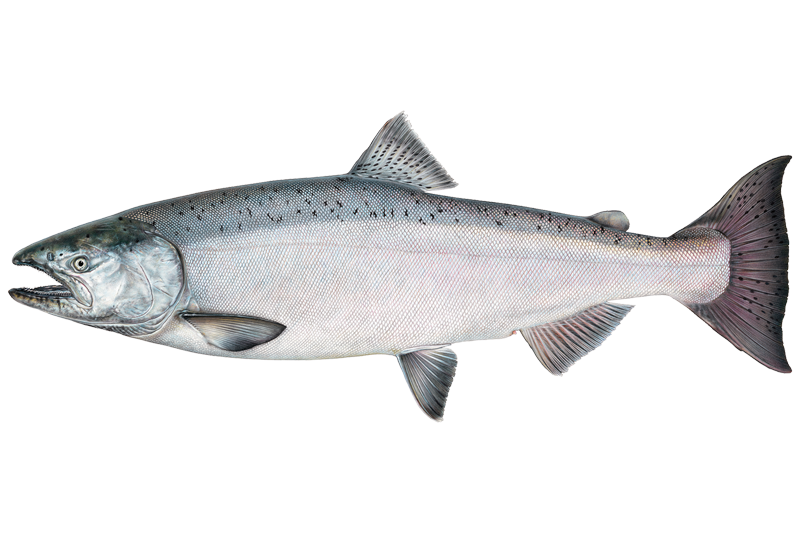
The largest of the Pacific salmon, Chinook are anadromous fish native to West Coast drainages from southern California to northern Alaska, and introduced to all five Great Lakes since 1967.
Mature fish commonly run 20-30 pounds with the biggest pushing past 90, and they're the heaviest gamefish most freshwater anglers will ever tangle with.
Scientific Name: Oncorhynchus tshawytscha
Also known as King Salmon, Blackmouth, Tyee, Quinnat, Spring Salmon, Tule
- Ocean-phase fish are blue-green over the back with silvery sides, white bellies, and irregular black spots on the upper body, dorsal fin, and both lobes of the tail.
- The defining ID mark is a fully black gum line — no other Pacific salmon has it, and it separates them at a glance from coho (white gums, spots only on the upper tail lobe).
- Spawning adults turn olive brown to red or purplish; older males develop a humped 'ridgeback' and a hooked kype, while females hold a torpedo shape with a blunt nose.
- Typical mature fish run about 36 inches and 30+ pounds; the IGFA all-tackle record stands at 97 lbs 4 oz from Alaska's Kenai River, with documented fish over 120 pounds.
What to know
Habitat Distribution
- Native Pacific range stretches from the Ventura River in southern California north through coastal Alaska to Kotzebue Sound, with major runs in the Yukon, Kuskokwim, Copper, Kenai, and Columbia systems.
- Introduced to all five Great Lakes starting in 1967 to control invasive alewife; most basins remain stocking-dependent, though Lake Huron supports significant natural reproduction.
- A cold-water obligate — preferred holding and feeding temperatures run 45-60°F, with 54°F often cited as the sweet spot. Summer fish in big water sound to find that thermocline, often 80-200 feet down.
- Spawning requires clean, well-oxygenated gravel; eggs are highly sensitive to fine sediment, warm water, and low oxygen, which is why dams and habitat degradation have erased Chinook from roughly 40% of their historic range outside Alaska.
Specific Spots
- Migrating river fish stack in deep runs and pools 4-20 feet deep with moderate-to-fast current — enough flow for cover but not so much that holding burns energy. They sit close to bottom, especially in spring.
- In salt water and the Great Lakes, Chinook are the deepest-holding salmon — work thermal breaks at 80-200+ feet, and stay alert for bait schools concentrating along structure or current edges.
- Ocean fish ambush along kelp edges and at the seam where eddy water rejoins the main flow, where baitfish get pinned and disoriented.
- In small clear rivers, fresh-run fish drop into the deepest, slowest available holding water at first, then get more competitive and aggressive as new fish push in on the tide.
Chinook Salmon FAQ
Answers from onWater's species guide.
What are the best lures and bait for Chinook Salmon?
Cured salmon roe is the top river bait coast-to-coast, fished under a float or drifted along bottom; sand shrimp, prawns, and ghost shrimp also produce. The presentation needs to be in the bottom foot or two of the water column.
What flies work for Chinook Salmon?
Large attractor wet flies and Spey-style patterns on size 4 to 2/0 stout hooks, swung downstream on a tight line. Color choice runs from somber black and purple in clear water to fluorescent pink, chartreuse, flame, and orange when water dirties or rises, these flies don't imitate anything specific, they provoke.
What do Chinook Salmon eat?
Saltwater and lake adults eat forage fish almost exclusively, herring, sand lance, anchovies, smelt, alewife in the Great Lakes, which is why trolled baitfish imitations like cut-plug herring, flasher-and-hoochie rigs, chrome spoons, and large diving plugs are the core saltwater arsenal.
Where do Chinook Salmon live?
Native Pacific range stretches from the Ventura River in southern California north through coastal Alaska to Kotzebue Sound, with major runs in the Yukon, Kuskokwim, Copper, Kenai, and Columbia systems.
See it in the app
Most maps show you water.
onWater shows you Chinook Salmon.



- 01 · Species map filter
Map every Chinook Salmon water
Pick Chinook Salmon and the map zeroes in on the waters they call home. No more guessing which lake holds them.
- 02 · Waterbody species
Tap any water. See what lives there.
Species, behavior and seasonal patterns for every lake, river and pond, before you leave the driveway.
- 03 · Angler Intelligence
Ask how to catch Chinook Salmon
Tactics, gear and timing from onWater's AI fishing guide, tuned to the species and the water you're on.
Stop guessing where Chinook Salmon are.
Open the map, filter by Chinook Salmon, and head to water that holds them. Download onWater and plan your next trip in minutes.
- Species map filter
- Angler Intelligence
- Fishing journal
Explore other species
Trout, bass, salmon, panfish and everything in between. Each guide unpacks the behavior, seasons, and tactics that put fish in the net.
No species information available.

Smarter Fishing Starts in the App.
onWater Fish gives you everything you need to plan smarter, fish better, and own every trip from first cast to last.