Paddlefish
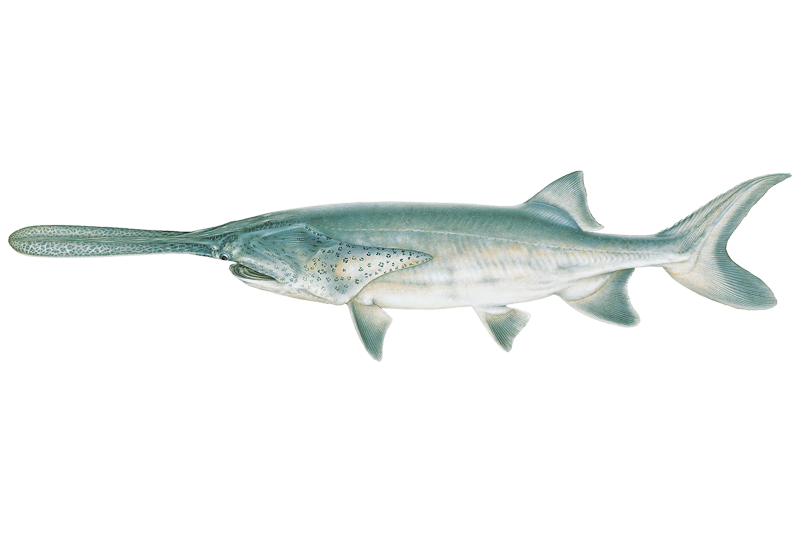
A living relic of the Mississippi River basin, the paddlefish is one of North America's oddest freshwater fish — a smooth, scaleless, shark-tailed filter feeder with a flat paddle-shaped snout that can run a third of its body length.
Adults commonly hit 5 feet and 60-plus pounds. Because they eat only zooplankton and won't strike a bait, snagging is the only way anglers pursue them, and that fishery is concentrated in the big rivers and reservoirs of the central US.
Scientific Name: Polyodon spathula
Also known as Spoonbill, Spoonbill catfish, Spoonbill cat, Spadefish, Shovelfish, Duck-billed cat, American paddlefish, Mississippi paddlefish
- The broad, flat rostrum running roughly a third of total body length is the giveaway — no other North American freshwater fish has anything like it.
- Smooth scaleless gray skin over an almost entirely cartilaginous skeleton, with a deeply forked, asymmetrical shark-style tail where the spine extends into the upper lobe.
- The rostrum and head are studded with tens of thousands of electroreceptor pores used to detect zooplankton swarms; eyes are tiny, gill rakers are long and comb-like, and there are no teeth.
- Typical fish run 10-60 lb at around 5 feet; trophies push past 100 lb, and the snagging world record stands at 164 lb 13 oz from Lake of the Ozarks in 2024.
What to know
Habitat Distribution
- Native to the Mississippi River basin from the Northeast to central Montana and south to Louisiana, plus Gulf slope drainages from Mobile Bay to Galveston Bay; gone from the Great Lakes basin and much of the eastern periphery.
- Currently resident across roughly 22 states in the Midwest, Great Plains, and South, with many central reservoir populations sustained by hatchery stocking rather than natural reproduction.
- Lives in big, deep, slow-moving rivers, their backwaters and oxbows, and large reservoirs — anywhere with abundant zooplankton and access to a free-flowing river reach with clean gravel for spawning.
- Strictly a freshwater fish; doesn't tolerate brackish water, and shifts into the deepest available water (often well past 10 feet, sometimes 100-plus) in late fall and winter.
Specific Spots
- Tailwaters immediately below major dams are the headline locations — migrating fish stack up against the obstruction before pushing upstream, and that's where the season's best snagging happens.
- Outside of migration, adults sit in slow, deep water: side channels, backwater lakes, oxbows, and the deep main-channel troughs of reservoirs, avoiding strong current.
- In winter, fish concentrate in the deepest reservoir holes; guides regularly mark them on sonar at 100-plus feet before locking them in for the spring.
- Spawning happens on silt-free gravel bars in flowing river reaches that get inundated by spring high water — usually shallow, exposed structure most of the year.
Paddlefish FAQ
Answers from onWater's species guide.
What are the best lures and bait for Paddlefish?
No lures, no baits, the only terminal hardware is a large, razor-sharp barbless treble used as a snag hook. Sharpen with a file before fishing and touch up through the day; factory edges aren't sharp enough to drive through paddlefish hide reliably.
What do Paddlefish eat?
Obligate filter feeders. They cruise with mouth gaping, straining zooplankton, mostly daphnia and other microcrustaceans, through long comb-like gill rakers, locating swarms by sensing the faint electrical signals of the plankton themselves.
Where do Paddlefish live?
Native to the Mississippi River basin from the Northeast to central Montana and south to Louisiana, plus Gulf slope drainages from Mobile Bay to Galveston Bay; gone from the Great Lakes basin and much of the eastern periphery.
See it in the app
Most maps show you water.
onWater shows you Paddlefish.



- 01 · Species map filter
Map every Paddlefish water
Pick Paddlefish and the map zeroes in on the waters they call home. No more guessing which lake holds them.
- 02 · Waterbody species
Tap any water. See what lives there.
Species, behavior and seasonal patterns for every lake, river and pond, before you leave the driveway.
- 03 · Angler Intelligence
Ask how to catch Paddlefish
Tactics, gear and timing from onWater's AI fishing guide, tuned to the species and the water you're on.
Stop guessing where Paddlefish are.
Open the map, filter by Paddlefish, and head to water that holds them. Download onWater and plan your next trip in minutes.
- Species map filter
- Angler Intelligence
- Fishing journal
Explore other species
Trout, bass, salmon, panfish and everything in between. Each guide unpacks the behavior, seasons, and tactics that put fish in the net.
No species information available.
Smarter Fishing Starts in the App.
onWater Fish gives you everything you need to plan smarter, fish better, and own every trip from first cast to last.