Bull Trout
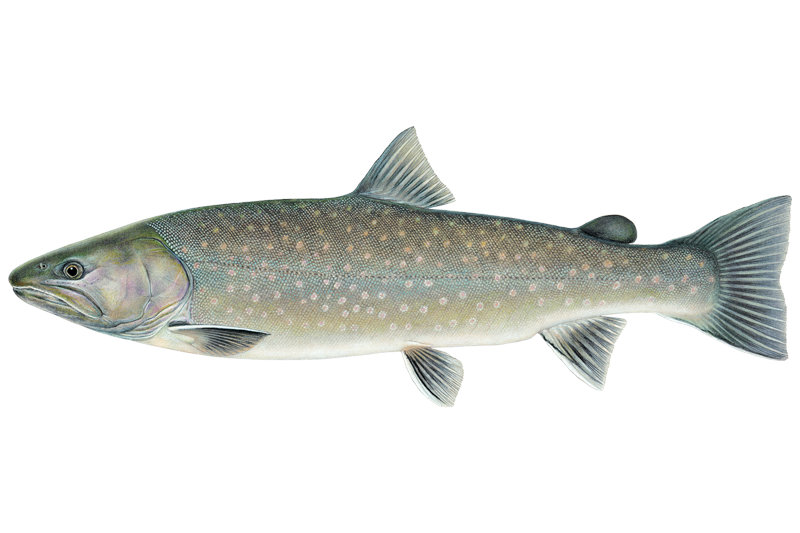
A native char of the cold, clear waters of the Pacific Northwest and northern Rockies, the bull trout is the West's largest stream-resident salmonid and one of its most uncompromising indicators of healthy water.
Federally threatened across the lower 48, it's a catch-and-release-only fish that draws a small, devoted following of streamer anglers willing to chase shadows in the deep, dark corners of mountain rivers.
Scientific Name: Salvelinus confluentus
Also known as Inland Dolly Varden, Bull Char
- A char, not a true trout — light yellow, orange, or salmon-pink round spots over an olive-to-bronze body, with the white-edged fins shared by all chars.
- Separated from brook trout by a clean, unspotted dorsal fin and the absence of worm-track markings; separated from lake trout by a tail that is only shallowly forked.
- Outsized head and mouth give the species its name — the upper jaw extends past the eye, and teeth on the roof of the mouth help it grip large prey.
- Average adults run around 25 inches; migratory lake-run fish exceed 15 pounds where forage allows, and the all-tackle record stands at 32 pounds — a fish that has never been seriously challenged.
What to know
Habitat Distribution
- Native to mountain and coastal drainages of the Pacific Northwest, northern Rockies, and a single isolated drainage in the Great Basin, with fragmented populations divided into six federal recovery units.
- A cold-water specialist in the strictest sense — rarely found where temperatures push past 59-64°F, and tied to drainages fed by snowfields, glaciers, and spring sources.
- Needs what biologists call the 'four Cs': cold, clean, complex, and connected — meaning low-sediment gravel, abundant wood and cut-bank cover, and unbroken corridors between spawning headwaters and adult rearing water.
- Lives in four distinct life-history forms: stream residents, river migrants, lake-run adfluvial fish, and a rare anadromous coastal form that uses Puget Sound nearshore habitat.
Specific Spots
- Deep pools — particularly the slow tail-outs with walking-speed current and overhead cover — where a big char can hold near the bottom and intercept whatever drifts by.
- Convergence water: the seam below an island where two currents fold back together, the slack behind a boulder garden, the shadow under a log jam. Cover plus reduced current equals a bull trout lie.
- In winter, the slowest soft water the river offers, near structure and shade. Energy conservation drives them out of any meaningful current.
- In clear water, look for a long shadow on the streambed or the white flash of a fin edge — they're often visible if you know what you're looking at, and invisible if you don't.
Bull Trout FAQ
Answers from onWater's species guide.
What are the best lures and bait for Bull Trout?
Large minnow-profile plugs and crankbaits, Rapalas, Kwikfish, Flatfish, and old-school trolling plugs in the Lucky Louie style, are the proven producers, and they're what put both the all-tackle world record and the second-place fish in the books. Big spinners, spoons, and jigs round out the kit.
What flies work for Bull Trout?
Streamers are the headline pattern: articulated flies 4-8 inches long, intruder-style ties, and sculpin imitations in white, olive, black, and purple, with cone heads or dumbbell eyes to drop fast.
What do Bull Trout eat?
Adults eat fish, whitefish, sculpin, dace, stickleback, and other trout, which is why large baitfish-profile streamers (sculpin patterns, articulated bugs in white, olive, black, and purple) and minnow plugs like Rapalas and Kwikfish are the core of the toolkit.
Where do Bull Trout live?
Native to mountain and coastal drainages of the Pacific Northwest, northern Rockies, and a single isolated drainage in the Great Basin, with fragmented populations divided into six federal recovery units.
See it in the app
Most maps show you water.
onWater shows you Bull Trout.



- 01 · Species map filter
Map every Bull Trout water
Pick Bull Trout and the map zeroes in on the waters they call home. No more guessing which lake holds them.
- 02 · Waterbody species
Tap any water. See what lives there.
Species, behavior and seasonal patterns for every lake, river and pond, before you leave the driveway.
- 03 · Angler Intelligence
Ask how to catch Bull Trout
Tactics, gear and timing from onWater's AI fishing guide, tuned to the species and the water you're on.
Stop guessing where Bull Trout are.
Open the map, filter by Bull Trout, and head to water that holds them. Download onWater and plan your next trip in minutes.
- Species map filter
- Angler Intelligence
- Fishing journal
Explore other species
Trout, bass, salmon, panfish and everything in between. Each guide unpacks the behavior, seasons, and tactics that put fish in the net.
No species information available.
Smarter Fishing Starts in the App.
onWater Fish gives you everything you need to plan smarter, fish better, and own every trip from first cast to last.