Largemouth Bass
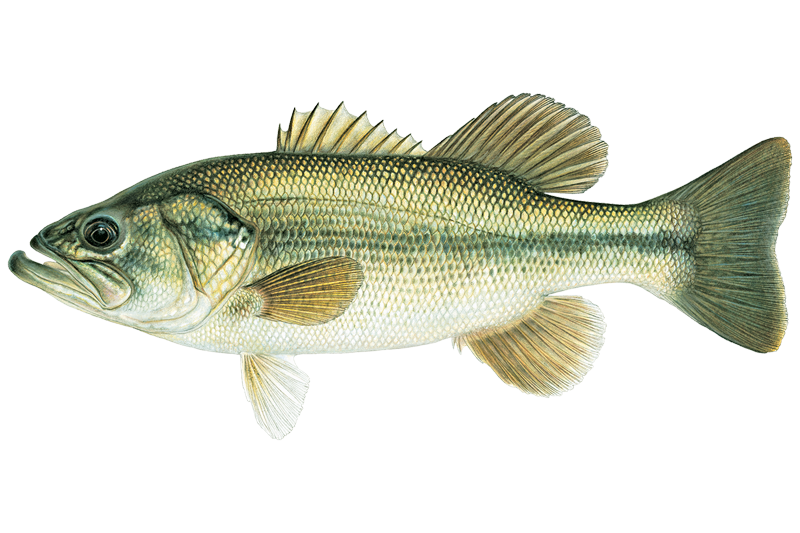
The defining freshwater gamefish of American angling — present in ponds, reservoirs, and rivers across all 48 contiguous states through more than a century of stocking.
Largemouth combine a willingness to eat almost anything moving with explosive, close-quarters strikes that draw more anglers than any other species in the country.
Scientific Name: Micropterus salmoides
Also known as Bigmouth Bass, Bucketmouth, Widemouth Bass, Black Bass, Green Bass, Florida Bass, Florida Largemouth, Green Trout, Bayou Bass, Swamp Bass, Marsh Bass, Oswego Bass
- Olive-green to greenish-gray flanks broken by a bold, jagged dark stripe running gill cover to tail; color shifts brassy in clear water and brownish in tannic water.
- The single most reliable ID mark: the upper jaw extends well past the back edge of the eye in adults. Smallmouth and spotted bass jaws stop at or before the eye.
- Deep notch between the spiny and soft dorsal fins makes the fin look almost split in two; tongue is smooth, with no rough tooth patch (spotted bass has one).
- Most wild fish run 1–3 lbs and around 16 inches. Five pounds is a quality fish across most of the country; double-digit bass are realistic only where Florida-strain genetics dominate, and trophies are almost always females.
What to know
Habitat Distribution
- Native to the Mississippi, Great Lakes, and St. Lawrence drainages plus Atlantic and Gulf coastal rivers, but stocking since the 1890s has put them in every state but Alaska.
- A warm-water generalist — large lakes, reservoirs, slow rivers, oxbows, swamps, ponds, and drainage ditches all hold them. They favor clear-to-moderately turbid water with vegetation.
- Active feeding peaks between 65–80°F and falls off hard below 41°F or above the upper 80s, when low dissolved oxygen in shallow water pushes fish deeper.
- The Florida Bass subspecies is native only to peninsular Florida; its genetics have been stocked into warm-climate reservoirs nationwide to grow bigger fish, and the two strains interbreed wherever they overlap.
Specific Spots
- Edges are everything — the seam where weeds meet open water, where wood meets sand, where a flat breaks into the channel. Bass post up on these transitions to ambush whatever moves through.
- Submerged vegetation, lily pads, laydowns, stumps, riprap, dock pilings, and brush piles all hold fish. Larger bass claim the best ambush spots and defend them.
- Most of the year fish hold in 2–15 feet, but summer heat and winter cold both push them deeper to channel ledges, offshore humps, and submerged timber where baitfish concentrate.
- Spawning beds appear in 2–8 feet in protected coves and back ends of creek arms, almost always tucked against a log, rock, or dock post that breaks wind and wakes.
Largemouth Bass FAQ
Answers from onWater's species guide.
What are the best lures and bait for Largemouth Bass?
Soft plastics are the year-round backbone, Texas-rigged worms, wacky-rigged stick baits (Senko-style), creature baits, drop-shot rigs, craws. Slow, bottom-oriented, and effective on every body of water in the country.
What flies work for Largemouth Bass?
Poppers and foam or cork surface bugs are the quintessential largemouth fly, loud, splashy retrieves around dock shadows, grass edges, and pad lines pull explosive strikes, especially low light. Black, white, chartreuse, and frog patterns cover most situations.
What do Largemouth Bass eat?
Adults are predominantly fish-eaters, bluegill, shad, golden shiners, yellow perch, minnows, even smaller bass, which is why swimbaits, jerkbaits, crankbaits, and large streamers all work. Prey can run up to half the bass's own body length. Crayfish are a major secondary forage, especially in clearer, rockier water.
Where do Largemouth Bass live?
Native to the Mississippi, Great Lakes, and St. Lawrence drainages plus Atlantic and Gulf coastal rivers, but stocking since the 1890s has put them in every state but Alaska. A warm-water generalist, large lakes, reservoirs, slow rivers, oxbows, swamps, ponds, and drainage ditches all hold them.
See it in the app
Most maps show you water.
onWater shows you Largemouth Bass.



- 01 · Species map filter
Map every Largemouth Bass water
Pick Largemouth Bass and the map zeroes in on the waters they call home. No more guessing which lake holds them.
- 02 · Waterbody species
Tap any water. See what lives there.
Species, behavior and seasonal patterns for every lake, river and pond, before you leave the driveway.
- 03 · Angler Intelligence
Ask how to catch Largemouth Bass
Tactics, gear and timing from onWater's AI fishing guide, tuned to the species and the water you're on.
Stop guessing where Largemouth Bass are.
Open the map, filter by Largemouth Bass, and head to water that holds them. Download onWater and plan your next trip in minutes.
- Species map filter
- Angler Intelligence
- Fishing journal
Explore other species
Trout, bass, salmon, panfish and everything in between. Each guide unpacks the behavior, seasons, and tactics that put fish in the net.
No species information available.

Smarter Fishing Starts in the App.
onWater Fish gives you everything you need to plan smarter, fish better, and own every trip from first cast to last.