Flier
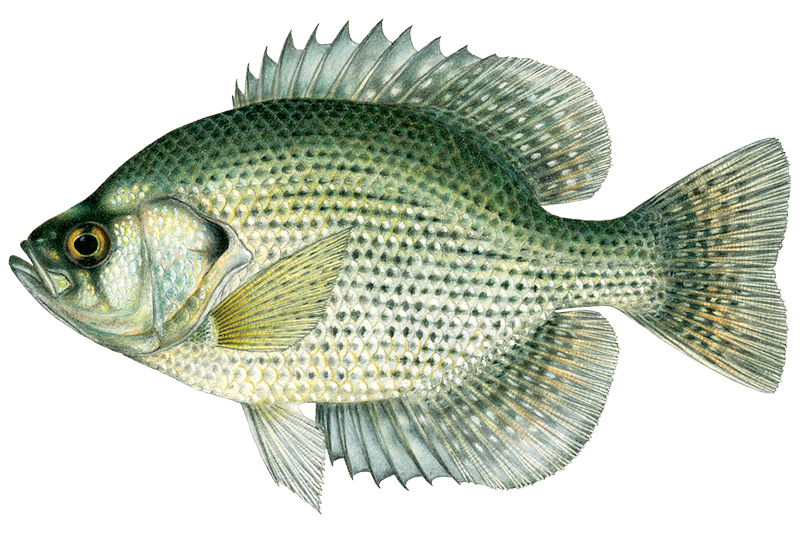
A small, saucer-shaped sunfish of the Southeast's blackwater country — cypress sloughs, swamp ponds, and weed-choked oxbows from the Coastal Plain of the mid-Atlantic down through Florida and west to east Texas.
Often mistaken for a small crappie, the flier is a panfish most anglers catch by accident while bream fishing, but it'll take a fly readily and dive hard for the nearest root tangle.
Scientific Name: Centrarchus macropterus
Also known as Peacock Sunfish, Round Sunfish, Fly Bream, Flier Bream, Crying Bream, Round Bream, Cheeky Bream, Government Fish, Flyers
- Round, slab-sided body with rows of dark brown-to-black spots over an olive-green or brassy background and a pale cream belly; 4–5 short dark vertical bars sometimes show on the upper sides.
- The dead giveaway is a dark teardrop bar running through and below the eye — no other sunfish or crappie carries that mark.
- Anal fin is nearly the same size as the dorsal, giving the symmetrical, wing-like silhouette the species is named for; 7–8 anal spines and 11–13 dorsal spines separate it from true Lepomis sunfish (3 anal spines) and black crappie (7–8 dorsal spines).
- Most adults run about 5 inches and a few ounces; a 7-incher is a trophy and the all-tackle record is just over a pound and a quarter.
What to know
Habitat Distribution
- Native to Coastal Plain waters from the Potomac drainage south through Florida and west to the Trinity River in east Texas, then north up the Mississippi Embayment into the southern reaches of Illinois and Indiana.
- A soft-water, acidic-water specialist — pH 6.5–7.5, warm summer temperatures in the mid-70s to mid-80s, and almost always below the Fall Line where gradients flatten and water stains dark.
- Classic flier water is cypress swamp, blackwater bayou, oxbow lake, slough, and overflow pool — slow or no current, soft mud bottom, and heavy vegetation.
- At the northern edge of the range, populations are uncommon and patchy, often hanging on only in protected bottomland refuges where lowland swamps haven't been drained or ditched.
Specific Spots
- Tucked into dense submerged and emergent vegetation — fliers don't drift over open water; they live inside the salad and bolt back into it the moment something startles them.
- Submerged tree roots, cypress knees, and floating mats are prime — the same tangle a panfisherman would skip past is exactly where a flier is hiding.
- Small open pockets within the weeds, especially over soft mud or sandy patches, where colonial nests are built in shallow water during the spawn.
- Backwaters and pools off the main channel of small rivers and creeks — anywhere current dies and vegetation takes over.
Flier FAQ
Answers from onWater's species guide.
What are the best lures and bait for Flier?
Live bait is the high-percentage play, red worms, nightcrawlers, and crickets fished under a small float over weed pockets match the natural diet directly.
What flies work for Flier?
Small dries and nymphs imitating mayflies, damsels, midges, and water boatmen are the staples, Elk Hair Caddis, parachute mayflies, and beadhead Pheasant Tails or Hare's Ears in size 12–16 cover most insect feeding.
What do Flier eat?
Aquatic insects make up the bulk of the diet, water boatmen, mayfly and damselfly nymphs, midges, along with snails, worms, leeches, and small crustaceans, which is why small nymphs (Pheasant Tail, Hare's Ear, beadhead size 12–16) and live worms or crickets are the most consistent producers.
Where do Flier live?
Native to Coastal Plain waters from the Potomac drainage south through Florida and west to the Trinity River in east Texas, then north up the Mississippi Embayment into the southern reaches of Illinois and Indiana.
See it in the app
Most maps show you water.
onWater shows you Flier.



- 01 · Species map filter
Map every Flier water
Pick Flier and the map zeroes in on the waters they call home. No more guessing which lake holds them.
- 02 · Waterbody species
Tap any water. See what lives there.
Species, behavior and seasonal patterns for every lake, river and pond, before you leave the driveway.
- 03 · Angler Intelligence
Ask how to catch Flier
Tactics, gear and timing from onWater's AI fishing guide, tuned to the species and the water you're on.
Stop guessing where Flier are.
Open the map, filter by Flier, and head to water that holds them. Download onWater and plan your next trip in minutes.
- Species map filter
- Angler Intelligence
- Fishing journal
Explore other species
Trout, bass, salmon, panfish and everything in between. Each guide unpacks the behavior, seasons, and tactics that put fish in the net.
No species information available.
Smarter Fishing Starts in the App.
onWater Fish gives you everything you need to plan smarter, fish better, and own every trip from first cast to last.