Alabama Shad
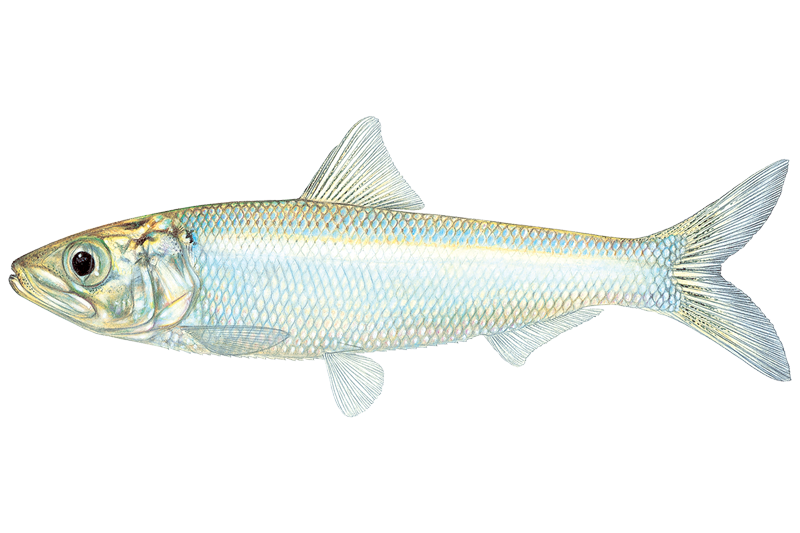
A native Gulf Coast herring with one of the most contracted ranges of any North American sport fish — once running rivers from Iowa to Florida, now barely hanging on in a handful of northern Gulf drainages. Most anglers will never encounter one.
The largest surviving spawning population uses the Apalachicola-Chattahoochee-Flint system, where a brief spring run is the only realistic shot at intercepting one.
Scientific Name: Alosa alabamae
Also known as Gulf Shad, Ohio Shad
- Slender, laterally compressed silver body with a greenish-blue back, clear fins, and a row of hardened scutes forming a keel along the belly midline.
- Upper jaw has a distinct median notch that the lower jaw fits into; lower jaw doesn't project past the snout, and there are no teeth on the jaws.
- Best ID feature is the gill raker count — 42 to 48 on the lower limb of the first arch, far more than skipjack herring (20-24), the only other Gulf shad you'd confuse it with.
- Typically runs 12-18 inches and up to 3 pounds; females grow larger than males and live longer (to about 6 years vs. 4 in males).
What to know
Habitat Distribution
- Native and never introduced; historically ran from the Mississippi and its tributaries (as far as the Monongahela in West Virginia and into Iowa) east to the Suwannee in Florida.
- Modern range is a fraction of that — viable populations persist mainly in northern Gulf rivers from the Mississippi east to the Suwannee, with the ACF basin holding the strongest run.
- Anadromous: adults live in coastal Gulf saltwater and ascend medium-to-large free-flowing rivers in spring to spawn. Dams are the single biggest reason the species disappeared from most of its old range.
- Spawning rivers need moderate current (roughly 0.5-1 m/s), coarse sand or gravel substrate, and clear-to-moderate turbidity — habitat that channel dredging directly degrades.
Specific Spots
- During the spring run, schools concentrate below natural and man-made barriers, where upstream migration stalls and fish stack in moderate-flow lanes.
- Spawning happens over open coarse sand bars and gravel shoals in moderate current — eggs are broadcast into the flow rather than nested.
- Adults school in the open main channel, holding in flow lanes and along river bends rather than relating tightly to bank cover.
- Juveniles use sandbars when small, then shift to open channel and steep banks with woody debris before dropping to the sea in late summer.
Alabama Shad FAQ
Answers from onWater's species guide.
What are the best lures and bait for Alabama Shad?
No species-specific lure tradition exists. Adults aren't feeding, but like other Alosa shad they'll strike out of aggression, small dart jigs (1/16-1/8 oz), shad spoons, and sabiki rigs in chartreuse, pink, or silver are the standard offerings used for co-occurring shad species in Gulf drainages and would apply here...
What do Alabama Shad eat?
At sea, they're presumed to eat what other Alosa shad eat, zooplankton, small crustaceans, and small baitfish in the water column. Marine feeding habits are genuinely poorly studied. Adults shut off the feeding switch on the spawning run and don't eat in fresh water.
Where do Alabama Shad live?
Native and never introduced; historically ran from the Mississippi and its tributaries (as far as the Monongahela in West Virginia and into Iowa) east to the Suwannee in Florida.
See it in the app
Most maps show you water.
onWater shows you Alabama Shad.



- 01 · Species map filter
Map every Alabama Shad water
Pick Alabama Shad and the map zeroes in on the waters they call home. No more guessing which lake holds them.
- 02 · Waterbody species
Tap any water. See what lives there.
Species, behavior and seasonal patterns for every lake, river and pond, before you leave the driveway.
- 03 · Angler Intelligence
Ask how to catch Alabama Shad
Tactics, gear and timing from onWater's AI fishing guide, tuned to the species and the water you're on.
Stop guessing where Alabama Shad are.
Open the map, filter by Alabama Shad, and head to water that holds them. Download onWater and plan your next trip in minutes.
- Species map filter
- Angler Intelligence
- Fishing journal
Explore other species
Trout, bass, salmon, panfish and everything in between. Each guide unpacks the behavior, seasons, and tactics that put fish in the net.
No species information available.
Smarter Fishing Starts in the App.
onWater Fish gives you everything you need to plan smarter, fish better, and own every trip from first cast to last.