Guadalupe Bass
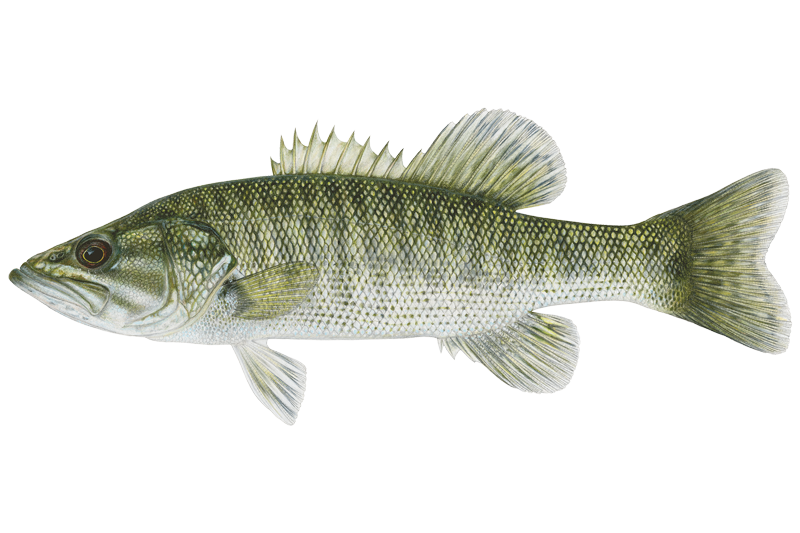
The official state fish of Texas and the only black bass endemic to a single state, the Guadalupe bass is a small, current-loving cousin of the smallmouth that lives nowhere outside the Edwards Plateau region.
Anglers chase it in clear, spring-fed Hill Country rivers — cypress-lined limestone water where an 11-inch fish fights like a trout twice its size.
Scientific Name: Micropterus treculii
Also known as Guad, Texas Brook Trout, Texas Trout, Green Trout, Guadalupe Spotted Bass
- Olive to lime-green body with a row of dark, diamond-shaped blotches along the lateral line and rows of small spots forming irregular stripes on a whitish belly — that belly-stripe pattern is the cleanest separator from spotted bass.
- The jaw stops at or before the back of the eye (unlike largemouth, whose jaw extends past it), and there are no vertical bars like a smallmouth carries.
- Sleek and slender-bodied; river fish run lighter in shade than reservoir fish, and spawning males darken to a deep green-black with sharper lateral contrast.
- Typical fish are 8–13 inches; a 14-incher is a serious trophy and the Texas state record sits at 3.71 lb.
What to know
Habitat Distribution
- A Texas-only species — native to the Brazos, Colorado, Guadalupe, and San Antonio drainages of the Edwards Plateau, with key waters including the San Marcos, Llano, Colorado, and Guadalupe Rivers plus smaller Hill Country creeks.
- A current specialist that thrives in clear, cool, spring-fed flowing water over rock and gravel; persists in reservoirs where rivers impound, but the heart of the range is moving water with limestone bedrock and bald cypress banks.
- Was inadvertently introduced to the headwaters of the Nueces in 1973, but otherwise has the most range-limited distribution of any black bass in the country.
Specific Spots
- Holds in current seams and feeding lanes alongside riffles, using moving water rather than avoiding it the way a largemouth would.
- Smaller fish stack behind riffles picking off drifting nymphs and minnows; bigger fish drop into deeper pools that still carry some current.
- Cypress roots, undercut banks, submerged logs, and large limestone slabs all serve as ambush cover and current breaks.
- During the spawn, males fan gravel nests in shallow water with more flow than largemouth tolerate — and they'll strike anything that crosses the bed.
Guadalupe Bass FAQ
Answers from onWater's species guide.
What are the best lures and bait for Guadalupe Bass?
Think scaled-down bass tackle: 1/8–1/4 oz inline spinners (Rooster Tails are a Hill Country staple), small crankbaits, and compact topwater poppers worked at first light.
What flies work for Guadalupe Bass?
Crawfish patterns are the year-round workhorse, dead-drift or slow-strip them along the bottom near rocks and cypress roots to imitate the species' top crustacean forage.
What do Guadalupe Bass eat?
Mayfly nymphs and other aquatic insects make up an unusually large share of the diet at every life stage, which is why nymphs (Pheasant Tail, Hare's Ear) and small soft plastics consistently outfish bigger profiles in clear water.
Where do Guadalupe Bass live?
A Texas-only species, native to the Brazos, Colorado, Guadalupe, and San Antonio drainages of the Edwards Plateau, with key waters including the San Marcos, Llano, Colorado, and Guadalupe Rivers plus smaller Hill Country creeks.
See it in the app
Most maps show you water.
onWater shows you Guadalupe Bass.



- 01 · Species map filter
Map every Guadalupe Bass water
Pick Guadalupe Bass and the map zeroes in on the waters they call home. No more guessing which lake holds them.
- 02 · Waterbody species
Tap any water. See what lives there.
Species, behavior and seasonal patterns for every lake, river and pond, before you leave the driveway.
- 03 · Angler Intelligence
Ask how to catch Guadalupe Bass
Tactics, gear and timing from onWater's AI fishing guide, tuned to the species and the water you're on.
Stop guessing where Guadalupe Bass are.
Open the map, filter by Guadalupe Bass, and head to water that holds them. Download onWater and plan your next trip in minutes.
- Species map filter
- Angler Intelligence
- Fishing journal
Explore other species
Trout, bass, salmon, panfish and everything in between. Each guide unpacks the behavior, seasons, and tactics that put fish in the net.

Find which waters have the species you want to catch

Redfish
Sciaenops ocellatus

Black Drum
Pogonias cromis

Spotted Seatrout
Cynoscion nebulosus

Weakfish
Cynoscion regalis

White Seabass
Atractoscion nobilis

Atlantic Croaker
Micropogonias undulatus

Spot
Leiostomus xanthurus

Northern Kingfish
Menticirrhus saxatilis

Southern Kingfish
Menticirrhus americanus

California Corbina
Menticirrhus undulatus

Whiting
Menticirrhus littoralis

Snook
Centropomus undecimalis

Tarpon
Megalops atlanticus

Ladyfish
Elops saurus

Bonefish
Albula vulpes

Mangrove Snapper
Lutjanus griseus

Red Snapper
Lutjanus campechanus

Lane Snapper
Lutjanus synagris

Mutton Snapper
Lutjanus analis

Yellowtail Snapper
Ocyurus chrysurus

Cubera Snapper
Lutjanus cyanopterus

Vermilion Snapper
Rhomboplites aurorubens

Gag Grouper
Mycteroperca microlepis

Red Grouper
Epinephelus morio

Black Grouper
Mycteroperca bonaci

Goliath Grouper
Epinephelus itajara

Scamp
Mycteroperca phenax

Snowy Grouper
Hyporthodus niveatus

Black Sea Bass
Centropristis striata

Kelp Bass
Paralabrax clathratus

Barred Sand Bass
Paralabrax nebulifer

Spotted Sand Bass
Paralabrax maculatofasciatus

Bluefish
Pomatomus saltatrix

Crevalle Jack
Caranx hippos

Permit
Trachinotus falcatus

Florida Pompano
Trachinotus carolinus

Greater Amberjack
Seriola dumerili

Almaco Jack
Seriola rivoliana

Yellowtail
Seriola lalandi

Blue Runner
Caranx crysos
Smarter Fishing Starts in the App.
onWater Fish gives you everything you need to plan smarter, fish better, and own every trip from first cast to last.