Grass Carp
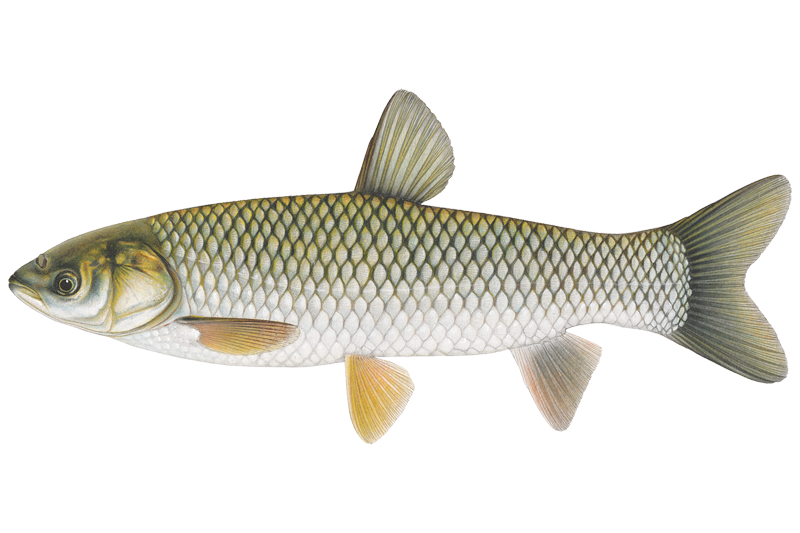
An eastern Asian native introduced to US waters in 1963 for aquatic weed control, the grass carp now turns up in 45 states — sometimes as permit-only triploid stockers in ponds and reservoirs, sometimes as established wild populations in the Mississippi basin and Great Lakes tributaries.
Among carp anglers, they hold near-mythic status: 30- to 50-pound herbivores that cruise shallow flats and demand a presentation closer to permit fishing than anything else in fresh water.
Also known as White Amur, Silver Orfe, Grasser, Grassy
- Long, torpedo-shaped body that's notably more cylindrical than the deeper-bodied common carp, olive to brownish-yellow on the sides with a clean white belly and large, dark-edged scales.
- Terminal mouth with firm, non-fleshy lips and no barbels — an immediate ID separator from common carp, which always shows barbels at the corners of the mouth.
- Short dorsal fin (only 7-10 soft rays) and a wide, flat-topped head with small low-set eyes; nothing about the head looks downward-facing the way silver and bighead carp do.
- Adults commonly run 18-40 lb in US waters, with stocked ponds producing fish over 50 lb; the IGFA all-tackle world record is 87 lb 10 oz, and a 92-pounder was netted by biologists in Louisiana in 2024.
What to know
Habitat Distribution
- Introduced — not native anywhere in North America. Now documented in 45 states, with the densest distribution through the Mississippi River basin and the Southeast, plus permitted triploid stockings in farm ponds and reservoirs almost everywhere else.
- A warm-water generalist that thrives in lakes, ponds, reservoirs, and the slow backwaters and pools of large rivers — anywhere with abundant submerged or emergent vegetation to graze on.
- Physiologically tough: tolerates 0-38°C water, dissolved oxygen down to 0.5 ppm, and salinities up to 10 ppt. Feeding tapers off sharply below about 14°C (57°F), so warm months drive most angling opportunity.
- Wild reproducing populations need long stretches of turbulent river current to keep the pelagic eggs suspended during incubation — which is why established breeding is largely confined to big-river systems like the lower Mississippi, Atchafalaya, and Lake Erie tributaries.
Specific Spots
- Vegetated shoreline margins, weedy flats, and the backs of coves are the classic search water — fish cruise just under the surface grazing on submerged plants and whatever drops onto the water.
- In rivers, look in slow eddies, backwaters, and weedy slack-water margins rather than the main current; even sterile triploids stage below dams and barriers in spring on instinctive spawning runs.
- Cottonwood-lined banks during seed-fluff drop and mulberry trees overhanging the water concentrate surface-feeding fish — they'll sip fluff and fallen berries for hours under calm conditions.
- As surface temperatures climb in mid-summer, fish slide deeper during midday and return to the shallows in the cooler hours of morning and evening.
Grass Carp FAQ
Answers from onWater's species guide.
What are the best lures and bait for Grass Carp?
Whole-kernel corn, canned or fresh, fished on a hair rig, is the most consistently effective bait across the country. Pre-baiting a spot a day or two ahead concentrates fish noticeably, where it's legal; chumming rules vary by state.
What flies work for Grass Carp?
Surface-feeding fish: mulberry patterns, foam beetles, cottonwood-fluff dries, and grass-clipping imitations. Match what's actually on the water, if cottonwood is dropping fluff, fish a fluff fly; if a mulberry tree is over the bank, throw a berry.
What do Grass Carp eat?
Adults are obligate herbivores that eat aquatic plants in staggering volumes, up to 45 kg of vegetation a day. Hydrilla, milfoil, pondweeds, and submerged grasses are the staples, which is why corn, dough baits, and vegetation-imitating flies all work where insect or baitfish patterns won't.
Where do Grass Carp live?
Introduced, not native anywhere in North America. Now documented in 45 states, with the densest distribution through the Mississippi River basin and the Southeast, plus permitted triploid stockings in farm ponds and reservoirs almost everywhere else.
See it in the app
Most maps show you water.
onWater shows you Grass Carp.



- 01 · Species map filter
Map every Grass Carp water
Pick Grass Carp and the map zeroes in on the waters they call home. No more guessing which lake holds them.
- 02 · Waterbody species
Tap any water. See what lives there.
Species, behavior and seasonal patterns for every lake, river and pond, before you leave the driveway.
- 03 · Angler Intelligence
Ask how to catch Grass Carp
Tactics, gear and timing from onWater's AI fishing guide, tuned to the species and the water you're on.
Stop guessing where Grass Carp are.
Open the map, filter by Grass Carp, and head to water that holds them. Download onWater and plan your next trip in minutes.
- Species map filter
- Angler Intelligence
- Fishing journal
Explore other species
Trout, bass, salmon, panfish and everything in between. Each guide unpacks the behavior, seasons, and tactics that put fish in the net.
No species information available.
Smarter Fishing Starts in the App.
onWater Fish gives you everything you need to plan smarter, fish better, and own every trip from first cast to last.