Gila Trout
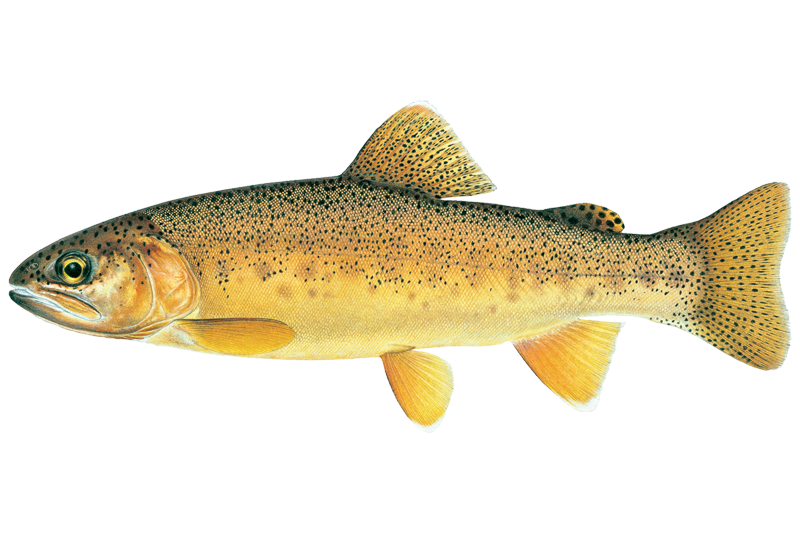
A small native trout of the Southwest, found only in headwater streams of the Gila and San Francisco River drainages in New Mexico and Arizona.
Once reduced to 20 miles of stream and federally listed as endangered, it now occupies roughly two dozen recovery streams and a handful of stocked waters — making it one of the most coveted life-list species in American trout fishing.
Scientific Name: Oncorhynchus gilae
- Golden-yellow to iridescent gold flanks fading to copper on the gill covers, with an olive back and small, profuse dark spots concentrated above the lateral line and onto the head, dorsal, and tail.
- A faint salmon-pink lateral band runs the length of adults and intensifies during spawning — the key feature separating Gila from the closely related Apache Trout, which has no lateral band.
- Dorsal, pelvic, and anal fins carry white to yellowish tips, a yellow cutthroat slash sits under the jaw on most adults, and parr marks often persist into adulthood.
- Wild stream fish typically run 5–9 inches; given decent habitat they reach 12 inches, and trophy-class fish in restored waters can stretch to 17–18 inches.
What to know
Habitat Distribution
- Native exclusively to higher-elevation streams of the Gila and San Francisco drainages, with historical presence in the Verde and Agua Fria. Restoration has rebuilt the species into 21 streams in New Mexico and 4 in Arizona — there are no naturalized populations anywhere else in the country.
- A cold-water specialist of montane conifer forests at 5,400–9,000 ft. Water needs to stay below 77°F, and most occupied streams rarely top 70°F. Strictly freshwater, non-anadromous.
- Perennial flow is non-negotiable. During drought, populations contract into deep pools and groundwater seeps as surface water disappears, which makes them acutely vulnerable to wildfire ash flows and prolonged dry years.
Specific Spots
- Adults hold in pools — particularly the deep ones below cascades and at canyon bends — while juveniles work the riffles. Pools are also drought refuge, so fish concentrate there when flows drop.
- Undercut banks, logjams, and woody debris are prime cover, doubling as ambush lies and shade in narrow canyon water.
- Streamside alder, box elder, and willow shade the water and drop a steady supply of terrestrial insects — fish station themselves where this canopy meets a feeding lane.
- Most fishable water is only 4–8 feet wide and densely brushy, with plunge pools and pocket water where individual fish defend a single feeding station.
Gila Trout FAQ
Answers from onWater's species guide.
What are the best lures and bait for Gila Trout?
Small gold or silver spinners in size 0 or 00, micro jigs in dark earth tones (black, brown) imitating aquatic insects, and 1–2 inch soft plastics in muted colors are the conventional staples. Avoid bright colors, the water is gin-clear and the fish are wary.
What flies work for Gila Trout?
Match-the-hatch dries are the first move: Adams and Elk Hair Caddis in sizes 14–18 cover the mayfly and caddis activity that defines these streams, with midge patterns filling the gaps.
What do Gila Trout eat?
Aquatic insects make up the foundation: midges, caddisflies, mayflies, and beetles. That maps directly to small attractor dries (size 14–18 Adams, Elk Hair Caddis), bead-head nymphs (Pheasant Tail and Hare's Ear imitate mayfly and caddis nymphs), and midge patterns.
Where do Gila Trout live?
Native exclusively to higher-elevation streams of the Gila and San Francisco drainages, with historical presence in the Verde and Agua Fria. Restoration has rebuilt the species into 21 streams in New Mexico and 4 in Arizona, there are no naturalized populations anywhere else in the country.
See it in the app
Most maps show you water.
onWater shows you Gila Trout.



- 01 · Species map filter
Map every Gila Trout water
Pick Gila Trout and the map zeroes in on the waters they call home. No more guessing which lake holds them.
- 02 · Waterbody species
Tap any water. See what lives there.
Species, behavior and seasonal patterns for every lake, river and pond, before you leave the driveway.
- 03 · Angler Intelligence
Ask how to catch Gila Trout
Tactics, gear and timing from onWater's AI fishing guide, tuned to the species and the water you're on.
Stop guessing where Gila Trout are.
Open the map, filter by Gila Trout, and head to water that holds them. Download onWater and plan your next trip in minutes.
- Species map filter
- Angler Intelligence
- Fishing journal
Explore other species
Trout, bass, salmon, panfish and everything in between. Each guide unpacks the behavior, seasons, and tactics that put fish in the net.

Find which waters have the species you want to catch

Redfish
Sciaenops ocellatus

Black Drum
Pogonias cromis

Spotted Seatrout
Cynoscion nebulosus

Weakfish
Cynoscion regalis

White Seabass
Atractoscion nobilis

Atlantic Croaker
Micropogonias undulatus

Spot
Leiostomus xanthurus

Northern Kingfish
Menticirrhus saxatilis

Southern Kingfish
Menticirrhus americanus

California Corbina
Menticirrhus undulatus

Whiting
Menticirrhus littoralis

Snook
Centropomus undecimalis

Tarpon
Megalops atlanticus

Ladyfish
Elops saurus

Bonefish
Albula vulpes

Mangrove Snapper
Lutjanus griseus

Red Snapper
Lutjanus campechanus

Lane Snapper
Lutjanus synagris

Mutton Snapper
Lutjanus analis

Yellowtail Snapper
Ocyurus chrysurus

Cubera Snapper
Lutjanus cyanopterus

Vermilion Snapper
Rhomboplites aurorubens

Gag Grouper
Mycteroperca microlepis

Red Grouper
Epinephelus morio

Black Grouper
Mycteroperca bonaci

Goliath Grouper
Epinephelus itajara

Scamp
Mycteroperca phenax

Snowy Grouper
Hyporthodus niveatus

Black Sea Bass
Centropristis striata

Kelp Bass
Paralabrax clathratus

Barred Sand Bass
Paralabrax nebulifer

Spotted Sand Bass
Paralabrax maculatofasciatus

Bluefish
Pomatomus saltatrix

Crevalle Jack
Caranx hippos

Permit
Trachinotus falcatus

Florida Pompano
Trachinotus carolinus

Greater Amberjack
Seriola dumerili

Almaco Jack
Seriola rivoliana

Yellowtail
Seriola lalandi

Blue Runner
Caranx crysos
Smarter Fishing Starts in the App.
onWater Fish gives you everything you need to plan smarter, fish better, and own every trip from first cast to last.