Skipjack Herring
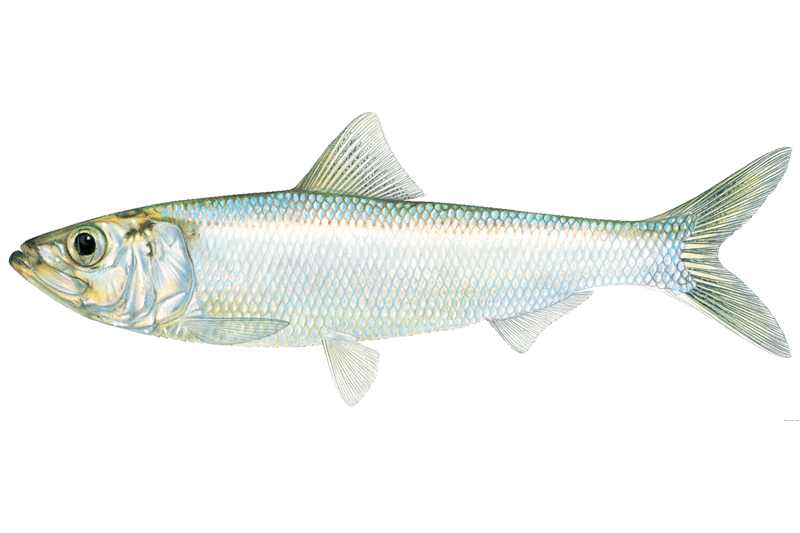
A slender, silver-sided river herring of big-water systems — the Mississippi, Ohio, Tennessee, Cumberland, and Gulf Coast drainages — where it runs in pelagic schools through swift current and crashes shad on the surface.
Tailwater anglers in the mid-South know it as 'Tennessee Tarpon' for its acrobatic leaps on light tackle.
Scientific Name: Alosa chrysochloris
Also known as Skipjack Shad, Blue Herring, Tennessee Tarpon, Golden Shad, McKinley Shad, River Shad, River Herring
- Strongly projecting lower jaw is the giveaway — the bottom jaw juts past the upper, which has a central notch the lower fits into. Teeth on both jaws and on the tongue.
- Deep blue-green back fading abruptly to silver-white sides and belly, often with a blue or iridescent flash. Yellow eyes with a clear adipose eyelid. No dark spot behind the gill cover, which separates it from alewife and blueback herring.
- A continuous keel of saw-toothed belly scutes runs the length of the underside — run a finger forward along the belly and you'll feel them.
- Adults commonly run 12–18 inches and a pound or so; a true big one is 3 to 3.5 lb, with a published max around 20 inches and 3.75 lb.
What to know
Habitat Distribution
- Native to the Mississippi basin from the upper Midwest south to the Gulf, plus Gulf Slope drainages from the Florida Panhandle west to Texas. Strongholds today are the lower Ohio, the mainstem Mississippi below the Ohio confluence, and the Tennessee, Cumberland, and Mobile systems.
- A big-river fish through and through — pelagic, schooling, tied to current. Lives in the open water column of main channels and reservoirs, not on the bottom and not in slack water.
- Wants clear to moderately turbid water for visual feeding and avoids muddy conditions. Comfortable across a wide temperature band but most active around 73–77°F.
- Euryhaline along the Gulf Coast, where some populations slip into brackish estuaries; interior populations complete the whole life cycle in freshwater.
Specific Spots
- Swift tailwaters immediately below dams are the single most reliable place to find them — fish stack in the boil and current seams, especially during spring spawning runs.
- Warm-water discharge outfalls below power plants concentrate schools in cooler months, sometimes holding fish year-round in the Tennessee–Cumberland system.
- Current seams and the edges where fast water meets slower water in main-channel river habitat — that's where they ambush small shad pushed along in the flow.
- When schools are actively feeding, watch the surface: silver fish leaping clear and bait scattering tells you exactly where to cast.
Skipjack Herring FAQ
Answers from onWater's species guide.
What are the best lures and bait for Skipjack Herring?
Small crappie-style jigs from 1/64 to 1/8 oz in white, chartreuse, yellow, or pink are the workhorse, a curly-tail grub or paddle tail on a light jighead, fished fast, will out-produce most everything else.
What flies work for Skipjack Herring?
Chartreuse-and-white Clouser Minnows are the documented go-to, the weighted-eye streamer matches the small shad skipjack are chasing and gets down into the current quickly. White or chartreuse baitfish streamers tied with deer hair or craft fur on size 4–6 hooks cover the same water and same forage.
What do Skipjack Herring eat?
Adults eat small fish, threadfin shad, gizzard shad, and young-of-year herring make up the bulk of it. Match a fly or lure to the size of bait in the system, generally a small shiny baitfish profile two to three inches long.
Where do Skipjack Herring live?
Native to the Mississippi basin from the upper Midwest south to the Gulf, plus Gulf Slope drainages from the Florida Panhandle west to Texas. Strongholds today are the lower Ohio, the mainstem Mississippi below the Ohio confluence, and the Tennessee, Cumberland, and Mobile systems.
See it in the app
Most maps show you water.
onWater shows you Skipjack Herring.



- 01 · Species map filter
Map every Skipjack Herring water
Pick Skipjack Herring and the map zeroes in on the waters they call home. No more guessing which lake holds them.
- 02 · Waterbody species
Tap any water. See what lives there.
Species, behavior and seasonal patterns for every lake, river and pond, before you leave the driveway.
- 03 · Angler Intelligence
Ask how to catch Skipjack Herring
Tactics, gear and timing from onWater's AI fishing guide, tuned to the species and the water you're on.
Stop guessing where Skipjack Herring are.
Open the map, filter by Skipjack Herring, and head to water that holds them. Download onWater and plan your next trip in minutes.
- Species map filter
- Angler Intelligence
- Fishing journal
Explore other species
Trout, bass, salmon, panfish and everything in between. Each guide unpacks the behavior, seasons, and tactics that put fish in the net.
No species information available.

Smarter Fishing Starts in the App.
onWater Fish gives you everything you need to plan smarter, fish better, and own every trip from first cast to last.