Golden Redhorse
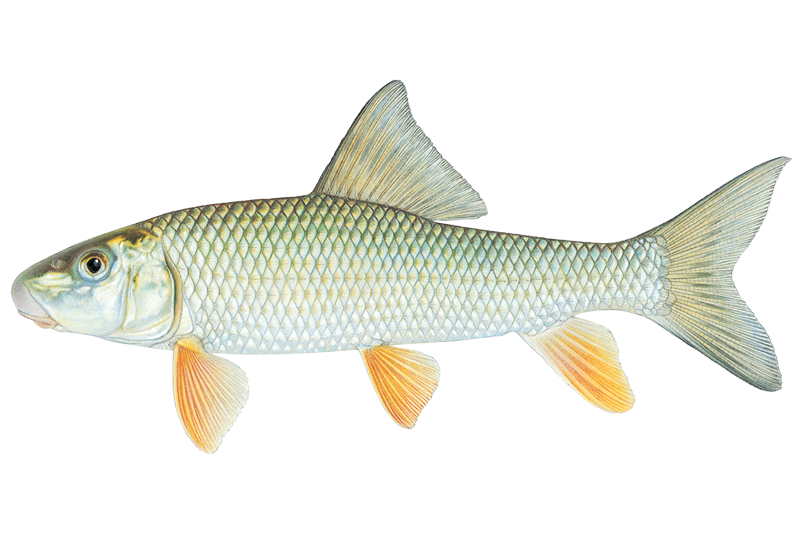
A clean-lined sucker of the eastern half of the country with brassy-gold flanks and orange fins, common in gravel-bottomed creeks and mid-sized rivers from the Great Lakes south through the Mississippi and Ohio basins.
The most widespread of the redhorse clan, and a small but devoted niche of anglers chases them on light tackle and nymph rigs.
Scientific Name: Moxostoma erythrurum
Also known as Golden Sucker, Yellow Sucker
- Light-yellow to brassy-gold back and sides over a white belly, with orange or pinkish fins and a slate-to-pale tail; scales are clean and unspotted at the base, giving the body a metallic look.
- Lower lip is plicate (broken into parallel folds) and forms a V-shaped angle at the rear margin — the cleanest way to separate it from black redhorse and river redhorse in hand.
- Lateral line carries 39–43 scales; dorsal fin has 12–13 rays with a slightly concave outer edge, distinguishing it from silver redhorse, which has a straighter dorsal margin and more rays.
- Typical adults run 12–18 inches and 1–2 pounds; a true trophy stretches to 26 inches and 4–5 pounds, with rare records pushing well beyond.
What to know
Habitat Distribution
- Native across roughly 25 states in the eastern US — Great Lakes basins (minus Superior), the Mississippi, Ohio, and lower Missouri drainages, south to the Mobile Bay system and the Red River, with an isolated relict population in the lower Mississippi country.
- Established as a non-native in the Potomac drainage since at least the 1950s, source unknown.
- A warmwater fish with intermediate pollution tolerance; handles moderate turbidity and intermittent flow better than most redhorse cousins but won't persist in continuously silted, industrially fouled water.
- Most abundant in small to moderate streams of medium gradient with permanent pools and firm rocky riffles; uncommon in heavily turbid big-river systems.
Specific Spots
- Deep permanent pools below well-defined gravel or cobble riffles — fish drop back into the pools to rest and slide up onto the rocky tailouts and runs to feed on dislodged invertebrates.
- Gravel and rubble shoals during the spring spawn, where males set up territories and females stage out of adjacent pools; below low-head dams concentrates migrating fish.
- Sandy and silty pool bottoms with enough current passing through to keep silt from blanketing — these are the daily holding lies between feeding moves onto rock.
- Smaller, well-protected tributaries in spring; juveniles in particular tuck under stones in gravel-bottomed reaches.
Golden Redhorse FAQ
Answers from onWater's species guide.
What are the best lures and bait for Golden Redhorse?
Nightcrawlers and red earthworms drifted along the bottom, almost universal among dedicated redhorse anglers. The presentation that matters is getting the worm to come to rest on clean gravel where the fish can find it.
What flies work for Golden Redhorse?
Weighted nymphs in sizes 10–14 fished dead-drift on the bottom, Pheasant Tails (mayfly nymphs), Hare's Ears (general mayfly/caddis), and beadhead caddis or midge larva patterns all match the documented forage.
What do Golden Redhorse eat?
Larval aquatic insects do most of the feeding, mayfly nymphs, caddis larvae, and midge larvae, along with small mollusks and microcrustaceans, all rooted out of the substrate with a downward-pointing protrusible mouth rather than chased in the drift.
Where do Golden Redhorse live?
Native across roughly 25 states in the eastern US, Great Lakes basins (minus Superior), the Mississippi, Ohio, and lower Missouri drainages, south to the Mobile Bay system and the Red River, with an isolated relict population in the lower Mississippi country.
See it in the app
Most maps show you water.
onWater shows you Golden Redhorse.



- 01 · Species map filter
Map every Golden Redhorse water
Pick Golden Redhorse and the map zeroes in on the waters they call home. No more guessing which lake holds them.
- 02 · Waterbody species
Tap any water. See what lives there.
Species, behavior and seasonal patterns for every lake, river and pond, before you leave the driveway.
- 03 · Angler Intelligence
Ask how to catch Golden Redhorse
Tactics, gear and timing from onWater's AI fishing guide, tuned to the species and the water you're on.
Stop guessing where Golden Redhorse are.
Open the map, filter by Golden Redhorse, and head to water that holds them. Download onWater and plan your next trip in minutes.
- Species map filter
- Angler Intelligence
- Fishing journal
Explore other species
Trout, bass, salmon, panfish and everything in between. Each guide unpacks the behavior, seasons, and tactics that put fish in the net.
No species information available.

Smarter Fishing Starts in the App.
onWater Fish gives you everything you need to plan smarter, fish better, and own every trip from first cast to last.