White Crappie
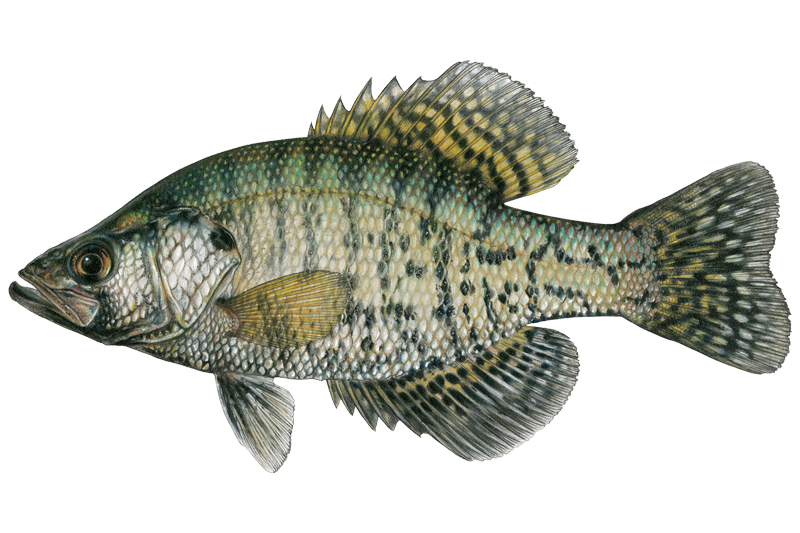
A schooling panfish of warm, often-turbid lakes, reservoirs, and slow river backwaters across the eastern and central US, with stocked populations now scattered well beyond the native Mississippi and Great Lakes basins.
White crappie are the species behind countless brush-pile fishing trips and bucket-of-minnows weekends — find one fish and you've usually found fifty.
Scientific Name: Pomoxis annularis
Also known as Sac-a-lait, White Perch, Papermouth, Silver Perch, Goldring, Calico Bass, Speckled Perch, Strawberry Bass
- Deep, strongly compressed 'pancake' body with iridescent olive-green back fading to silver-white sides marked by 5–10 dark vertical bars — the cleanest visual separator from the randomly-blotched black crappie.
- Counts the dorsal spines: 5 or 6 on a white crappie versus 7 or 8 on a black. The predorsal region is also longer than the dorsal fin base, giving the head a pushed-forward look.
- Oversized protrusible mouth that opens nearly to the diameter of the body, paired with a thin, papery membrane around the jaw — the source of the 'papermouth' nickname and the reason hard hooksets tear out.
- Typical fish run 7–12 inches and a half-pound to a pound; a 'slab' is anything over 10 inches, and a true trophy pushes 2 pounds. The IGFA all-tackle record stands at 5.2 pounds from a Mississippi reservoir in 1957.
What to know
Habitat Distribution
- Native to the Mississippi, Hudson Bay, and southern Great Lakes drainages, plus Gulf Slope rivers from Mobile Bay to south Texas — essentially everything west of the Appalachians and east of the Plains.
- Stocked widely since the 1890s and now established in roughly 34 additional states, including Atlantic Coast reservoirs, scattered Western impoundments, and the Columbia system; California's entire population descends from 16 fish stocked in 1917.
- Tolerates turbid, low-clarity water better than almost any other sunfish-family species and dominates muddy reservoirs and prairie impoundments where black crappie struggle. Optimum temperature is 81–84°F and they're a strict freshwater species.
- In rivers, sticks to slow pools, backwaters, and oxbows over sand or mud; avoids strong current. In reservoirs, almost always lives above the thermocline, typically the upper 15–30 feet.
Specific Spots
- Submerged timber, brush piles, stumps, dock pilings, and laydown logs in 6–12 feet of water hold daytime schools — these are ambush points where the fish suspend mid-column waiting for baitfish to drift past.
- At dawn, dusk, and after dark, schools slide off the cover and into open water or up onto shoreline flats to feed; their oversized eyes are built for low light.
- Summer fish often suspend in open water with no obvious structure — sometimes 10 feet down over 30 feet — and finding them is a sonar-and-trolling exercise rather than a structure-casting one.
- In spring pre-spawn, look in dark-bottomed coves and bays under 8 feet deep with woody cover; spawning colonies form in barely knee-deep water against overhanging brush and banks.
White Crappie FAQ
Answers from onWater's species guide.
What are the best lures and bait for White Crappie?
A live minnow, fathead, rosy red, or small shiner, under a slip float is the most consistently effective presentation across the species's range, in every season. Soft-plastic jigs in the 1/32 to 1/8 oz range cover the artificial side: tubes, curly-tail grubs, paddle-tail swimbaits, and marabou hair jigs.
What flies work for White Crappie?
Small streamers and jig-style flies, Clouser Minnows (which imitate baitfish), sparse Woolly Buggers, and shad-fry patterns in size 6–10, match the adult diet of small fish and are the bread-and-butter subsurface choices.
What do White Crappie eat?
Adult white crappie are mostly fish-eaters, minnows, shad, young sunfish, darters, which is why small soft-plastic jigs (1/16 and 1/32 oz tubes, curly-tails, paddle-tails) and small streamers in the 1–2 inch range are the workhorse artificials. A live minnow under a slip float is the gold standard.
Where do White Crappie live?
Native to the Mississippi, Hudson Bay, and southern Great Lakes drainages, plus Gulf Slope rivers from Mobile Bay to south Texas, essentially everything west of the Appalachians and east of the Plains.
See it in the app
Most maps show you water.
onWater shows you White Crappie.



- 01 · Species map filter
Map every White Crappie water
Pick White Crappie and the map zeroes in on the waters they call home. No more guessing which lake holds them.
- 02 · Waterbody species
Tap any water. See what lives there.
Species, behavior and seasonal patterns for every lake, river and pond, before you leave the driveway.
- 03 · Angler Intelligence
Ask how to catch White Crappie
Tactics, gear and timing from onWater's AI fishing guide, tuned to the species and the water you're on.
Stop guessing where White Crappie are.
Open the map, filter by White Crappie, and head to water that holds them. Download onWater and plan your next trip in minutes.
- Species map filter
- Angler Intelligence
- Fishing journal
Explore other species
Trout, bass, salmon, panfish and everything in between. Each guide unpacks the behavior, seasons, and tactics that put fish in the net.
No species information available.

Smarter Fishing Starts in the App.
onWater Fish gives you everything you need to plan smarter, fish better, and own every trip from first cast to last.