Walleye
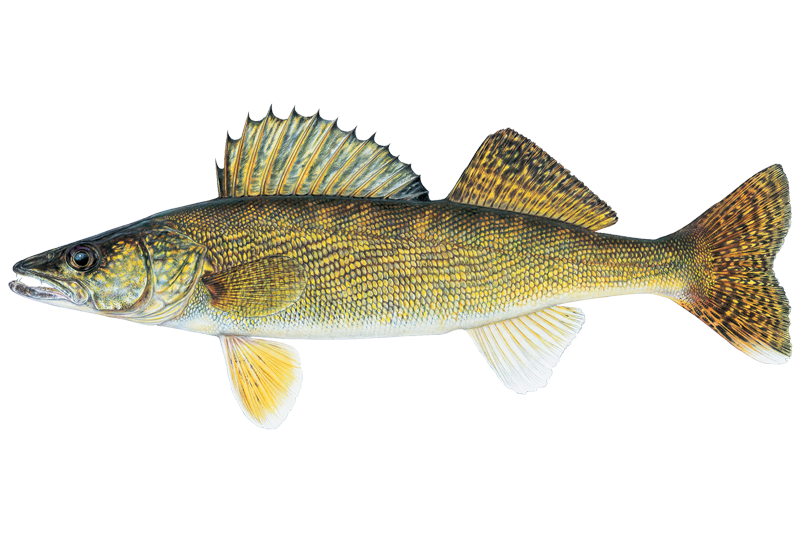
A cool-water predator native to the Great Lakes and Mississippi basin and now stocked across most of the lower 48, walleye are best known for the milky, reflective eyes that let them feed in low light and stained water.
Anglers chase them for their willingness to school up on structure and for fillets that many consider the best eating in fresh water.
Scientific Name: Sander vitreus
Also known as Walleyed pike, yellow pike, yellow pikeperch, yellow pickerel, pickerel, doré, marble eyes
- Olive to gold flanks broken by five darker saddle bars over a white belly, with color intensity shifting based on water clarity.
- Large, glassy, pearlescent eyes — the result of a tapetum lucidum behind the retina that reflects light and gives the species its name.
- Two separate dorsal fins with a dark blotch at the rear base of the spiny dorsal, and a white tip on the lower lobe of the tail — the most reliable mark separating walleye from sauger.
- Typical catch runs 12–20 inches and 1–3 pounds; a fish over 28 inches or 10 pounds is broadly considered a trophy, with the all-tackle record at 25 pounds 4 ounces.
What to know
Habitat Distribution
- Native through the St. Lawrence, Great Lakes, and Mississippi drainages; introduced widely east, west, and south, with self-sustaining populations now in 44 states wherever latitude or elevation provides cool enough water.
- A coolwater generalist that thrives between 55–70°F in rivers, natural lakes, and reservoirs — clear or stained, shallow or deep — but is absent from genuinely warm water.
- Strong preference for stained or wind-rippled water with under two meters of light penetration, where their light-gathering eyes give them an edge over prey species.
Specific Spots
- Gravel and rock — reefs, shoals, humps, riprap, points, and old river channels in reservoirs — especially where a depth change runs nearby. Any break line on hard bottom is worth working.
- Sits along weed edges and timber adjacent to deeper water during the day, drifting up onto sand flats and shoreline shallows at dusk and after dark to hunt.
- Wind-blown shorelines and points — the classic "walleye chop" — pile up baitfish and cut light penetration, and fish will stack up on the windy side of the lake to feed.
- In rivers, holds tight to current breaks: eddies, seams, tailwaters below dams, and rocky pools where bait is funneled within reach without burning energy.
Walleye FAQ
Answers from onWater's species guide.
What are the best lures and bait for Walleye?
Jigs from 1/8 to 3/4 ounce, tipped with a minnow, leech, or 3 to 5-inch soft plastic minnow body, paddle-tail, or grub, are the foundation. Fish them slowly along bottom; the majority of bites come on the fall.
What flies work for Walleye?
Streamers do most of the work: 2 to 4-inch baitfish patterns like Clouser Minnows, Woolhead Sculpins, EP Baitfish, and marabou minnows, all imitating the perch, shad, smelt, and shiners walleye eat. Match the local forage and tie hook-up to limit snags on rocky bottom.
What do Walleye eat?
Adults are heavily fish-eaters, and yellow perch are often the single most important meal where both occur. Shiners, shad, smelt, alewives, and other minnows fill out the menu, match those with 2–5 inch jigs-and-minnows, paddle-tail swimbaits, minnow plugs, and shad-bodied crankbaits.
Where do Walleye live?
Native through the St. Lawrence, Great Lakes, and Mississippi drainages; introduced widely east, west, and south, with self-sustaining populations now in 44 states wherever latitude or elevation provides cool enough water.
See it in the app
Most maps show you water.
onWater shows you Walleye.



- 01 · Species map filter
Map every Walleye water
Pick Walleye and the map zeroes in on the waters they call home. No more guessing which lake holds them.
- 02 · Waterbody species
Tap any water. See what lives there.
Species, behavior and seasonal patterns for every lake, river and pond, before you leave the driveway.
- 03 · Angler Intelligence
Ask how to catch Walleye
Tactics, gear and timing from onWater's AI fishing guide, tuned to the species and the water you're on.
Stop guessing where Walleye are.
Open the map, filter by Walleye, and head to water that holds them. Download onWater and plan your next trip in minutes.
- Species map filter
- Angler Intelligence
- Fishing journal
Explore other species
Trout, bass, salmon, panfish and everything in between. Each guide unpacks the behavior, seasons, and tactics that put fish in the net.

Find which waters have the species you want to catch

Redfish
Sciaenops ocellatus

Black Drum
Pogonias cromis

Spotted Seatrout
Cynoscion nebulosus

Weakfish
Cynoscion regalis

White Seabass
Atractoscion nobilis

Atlantic Croaker
Micropogonias undulatus

Spot
Leiostomus xanthurus

Northern Kingfish
Menticirrhus saxatilis

Southern Kingfish
Menticirrhus americanus

California Corbina
Menticirrhus undulatus

Whiting
Menticirrhus littoralis

Snook
Centropomus undecimalis

Tarpon
Megalops atlanticus

Ladyfish
Elops saurus

Bonefish
Albula vulpes

Mangrove Snapper
Lutjanus griseus

Red Snapper
Lutjanus campechanus

Lane Snapper
Lutjanus synagris

Mutton Snapper
Lutjanus analis

Yellowtail Snapper
Ocyurus chrysurus

Cubera Snapper
Lutjanus cyanopterus

Vermilion Snapper
Rhomboplites aurorubens

Gag Grouper
Mycteroperca microlepis

Red Grouper
Epinephelus morio

Black Grouper
Mycteroperca bonaci

Goliath Grouper
Epinephelus itajara

Scamp
Mycteroperca phenax

Snowy Grouper
Hyporthodus niveatus

Black Sea Bass
Centropristis striata

Kelp Bass
Paralabrax clathratus

Barred Sand Bass
Paralabrax nebulifer

Spotted Sand Bass
Paralabrax maculatofasciatus

Bluefish
Pomatomus saltatrix

Crevalle Jack
Caranx hippos

Permit
Trachinotus falcatus

Florida Pompano
Trachinotus carolinus

Greater Amberjack
Seriola dumerili

Almaco Jack
Seriola rivoliana

Yellowtail
Seriola lalandi

Blue Runner
Caranx crysos
Smarter Fishing Starts in the App.
onWater Fish gives you everything you need to plan smarter, fish better, and own every trip from first cast to last.