River Redhorse
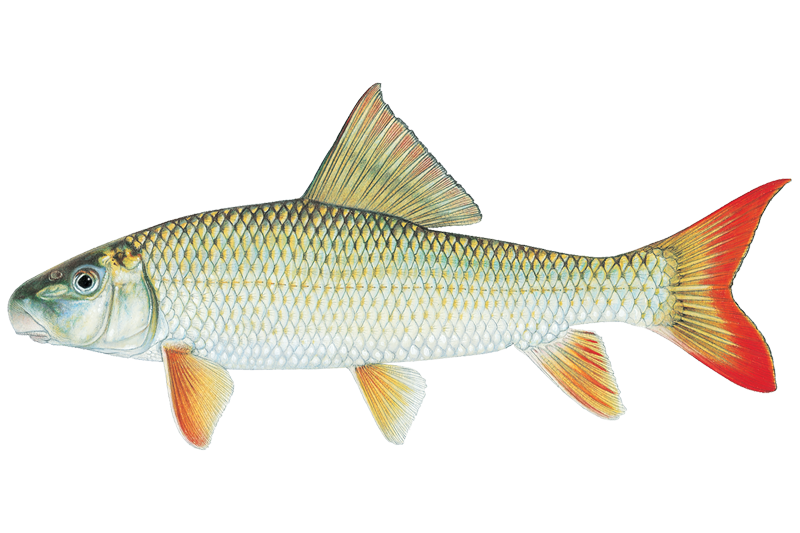
The largest and most heavy-shouldered of the redhorse suckers, a clean-water specialist of medium and large rivers across the central and eastern US.
Anglers seek it out for its dead-weight pull in current, its size — fish over 20 inches are common — and the fact that catching one means you're standing in a genuinely healthy river.
Scientific Name: Moxostoma carinatum
Also known as Big-sawed sucker, river mullet, redfin redhorse, redhorse sucker
- Olive-brown to brassy back with golden-yellow sides and a white belly; each scale carries a dark crescent at its base, giving a faintly speckled look.
- Crimson dorsal and tail fins are the standout field mark on living adults, with orange-red pectorals, pelvics, and anal fin.
- Separates from other redhorse by molar-like pharyngeal teeth built for crushing mussels (other redhorse have comb-like teeth) and 12 scale rows around the caudal peduncle.
- Adults average around 22 inches; trophy fish push 30 inches and 10+ pounds, with the IGFA all-tackle record at 16 lb 7 oz.
What to know
Habitat Distribution
- Native — never stocked — across roughly 24 states in the Mississippi, Ohio, and Tennessee drainages, with Gulf Slope populations from the Pearl River east to the Escambia.
- Lives in clean, unpolluted rivers with moderate to swift current and gravel, cobble, or rock bottoms; so sensitive to siltation and pollution that biologists use it as a bioindicator of river health.
- Cool-to-warm water fish; most active and catchable in the 55–70°F range. Occasionally found in lakes and reservoirs, but the species needs riverine habitat to spawn and persist.
Specific Spots
- Long, deep runs 1–10 feet deep with the swiftest current in the reach — that's where adults spend most of the year working the bottom for mussels and crayfish.
- Beds of native freshwater mussels are a magnet; post-spawn radio-tracking shows fish concentrating in mussel-rich habitat, which makes sense given how they feed.
- From mid-spring through early summer, shift to shallow gravel riffles and the runs immediately below them — males excavate broad nest depressions in the gravel, often within 100 feet of rapids.
- In larger rivers, summer fish may drop into deep slower water 10–40 feet down; some individuals stay near spawning grounds, others travel up to 30 miles downstream.
River Redhorse FAQ
Answers from onWater's species guide.
What are the best lures and bait for River Redhorse?
Nightcrawlers are the top producer range-wide, followed by crayfish tail pieces, fresh mussel or clam flesh, and leeches. Keep hardware minimal, these fish drop bait at the first hint of resistance.
What flies work for River Redhorse?
Size 10–12 weighted nymphs (Pheasant Tails and Hare's Ears imitate the mayfly and caddis larvae these fish eat in many rivers), small beadhead Woolly Buggers, and Clouser Minnows that imitate small baitfish all produce.
What do River Redhorse eat?
Adults are mussel and snail crushers, those molar-like throat teeth are built specifically for it, with crayfish rounding out the bulk of the diet. That's why fresh mussel/clam flesh, crayfish tail chunks, and nightcrawlers consistently outfish anything else.
Where do River Redhorse live?
Native, never stocked, across roughly 24 states in the Mississippi, Ohio, and Tennessee drainages, with Gulf Slope populations from the Pearl River east to the Escambia.
See it in the app
Most maps show you water.
onWater shows you River Redhorse.



- 01 · Species map filter
Map every River Redhorse water
Pick River Redhorse and the map zeroes in on the waters they call home. No more guessing which lake holds them.
- 02 · Waterbody species
Tap any water. See what lives there.
Species, behavior and seasonal patterns for every lake, river and pond, before you leave the driveway.
- 03 · Angler Intelligence
Ask how to catch River Redhorse
Tactics, gear and timing from onWater's AI fishing guide, tuned to the species and the water you're on.
Stop guessing where River Redhorse are.
Open the map, filter by River Redhorse, and head to water that holds them. Download onWater and plan your next trip in minutes.
- Species map filter
- Angler Intelligence
- Fishing journal
Explore other species
Trout, bass, salmon, panfish and everything in between. Each guide unpacks the behavior, seasons, and tactics that put fish in the net.
No species information available.

Smarter Fishing Starts in the App.
onWater Fish gives you everything you need to plan smarter, fish better, and own every trip from first cast to last.