Redeye Bass
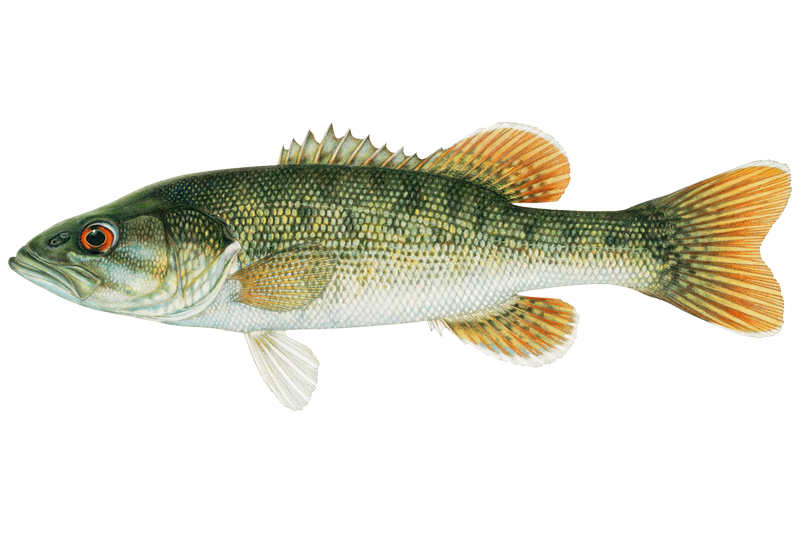
The smallest member of the black bass family, redeye bass are a small-stream specialist of the southern Appalachian and Piedmont uplands.
A wild ten-inch redeye from a clear Coosa tributary is the angling equivalent of a backcountry brook trout — small, beautiful, willing to crush a popper, and tied tightly to cool, rocky, canopied creek water.
Scientific Name: Micropterus coosae
Also known as Coosa Bass, Alabama Brook Trout
- Bronze-olive to mottled brown-green back fading to pale belly, with dark lateral blotches and rows of spots low on the sides; the tail's white (sometimes turquoise or red) margins on both upper and lower edges are the most reliable field mark.
- Bright brick-red iris gives the fish its name, but the more diagnostic eye feature is a silver-white crescent on the back half of the eyeball — eye color alone can mislead since smallmouth and spotted bass also show red.
- Upper jaw stops at the rear edge of the eye rather than running past it, separating redeye from largemouth at a glance. Young fish carry vertical bars and a rusty-red base to the tail.
- Adults usually run 6–12 inches and a pound or less; a true 12-incher from native water is likely past a decade old and a genuine trophy, with the maximum approaching about 5 pounds.
What to know
Habitat Distribution
- Native, in the strict modern sense, only to the Coosa River system of the southern Appalachians and Piedmont. Several recently split sister species occupy nearby drainages and are still often called 'redeye' by anglers.
- Introduced and established in parts of the southern Appalachians outside the Coosa, in foothill tributaries of the Sacramento–San Joaquin system in California, and in scattered Southwest streams.
- An upland stream specialist — clear, cool, rocky creeks and small to medium rivers above the Fall Line, with canopy cover, undercut banks, and ledge or boulder structure. Summer water in the high 70s to low 80s°F is well within tolerance.
- Reservoirs are a poor fit; populations rarely thrive in impoundments and the species essentially never shows up in brackish water.
Specific Spots
- Boulder runs and the calm pockets immediately downstream of them — adults hover on the seam between fast and slow water, using the current as a conveyor belt for drifting bugs.
- Shoreline cover beats midstream: undercut banks, sunken logs, and limestone ledges along tight bends let fish ambush from below and stay close to the surface feeding zone.
- Plunge pools below small waterfalls, rocky shoals, and the slack water behind midstream rocks are classic holding water — moving water is the cue, dead pools are not.
- Juveniles tuck into deeper, shadier pool tails with slower current; bigger fish sit shallower and faster than you'd expect, often in less than two feet of water.
Redeye Bass FAQ
Answers from onWater's species guide.
What are the best lures and bait for Redeye Bass?
Small topwaters carry a lot of the workload, a Heddon Tiny Torpedo, mini popper, or small prop bait pitched into a slack pocket beside fast water often gets eaten the instant it lands. Crayfish imitations are the other reliable producer.
What flies work for Redeye Bass?
Topwater poppers in sizes 6–10 are the signature redeye fly. BoogleBugs and Sam's One Bug are cult favorites; yellow and chartreuse work well early summer, with orange, blue, green, and black taking over later in the season. Terrestrial patterns, foam hoppers, crickets, beetles, match the bulk of the diet directly.
What do Redeye Bass eat?
Terrestrial insects can make up more than half the annual diet, beetles, ants, hoppers, crickets, the occasional moth, which is why a small foam hopper or a popper drifted along a current seam is the single most productive presentation. Crayfish are the meat course.
Where do Redeye Bass live?
Native, in the strict modern sense, only to the Coosa River system of the southern Appalachians and Piedmont. Several recently split sister species occupy nearby drainages and are still often called 'redeye' by anglers.
See it in the app
Most maps show you water.
onWater shows you Redeye Bass.



- 01 · Species map filter
Map every Redeye Bass water
Pick Redeye Bass and the map zeroes in on the waters they call home. No more guessing which lake holds them.
- 02 · Waterbody species
Tap any water. See what lives there.
Species, behavior and seasonal patterns for every lake, river and pond, before you leave the driveway.
- 03 · Angler Intelligence
Ask how to catch Redeye Bass
Tactics, gear and timing from onWater's AI fishing guide, tuned to the species and the water you're on.
Stop guessing where Redeye Bass are.
Open the map, filter by Redeye Bass, and head to water that holds them. Download onWater and plan your next trip in minutes.
- Species map filter
- Angler Intelligence
- Fishing journal
Explore other species
Trout, bass, salmon, panfish and everything in between. Each guide unpacks the behavior, seasons, and tactics that put fish in the net.
No species information available.

Smarter Fishing Starts in the App.
onWater Fish gives you everything you need to plan smarter, fish better, and own every trip from first cast to last.