Rainbow Trout
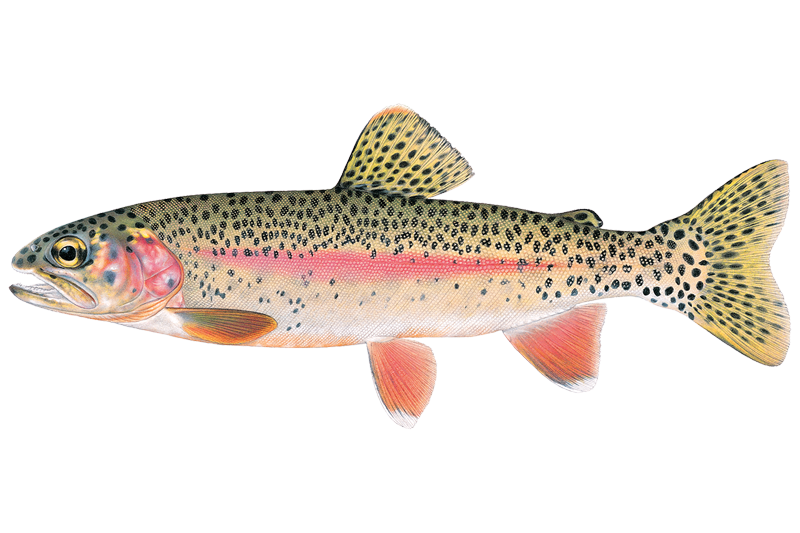
The defining trout of American fly fishing — native to Pacific drainages from Alaska to California, but stocked and self-sustaining in cold water across all 50 states.
Rainbows leap when hooked, key on insect drift in ways that reward observation, and turn up everywhere from suburban put-and-take ponds to remote wilderness tailwaters. The anadromous form is called steelhead.
Scientific Name: Oncorhynchus mykiss
Also known as Steelhead, Steelhead Trout, Redband Trout, Kamloops, Kamloops Trout, Hardhead, Coast Range Trout
- Pink-to-red lateral stripe running gills to tail is the giveaway, brightest on stream residents and breeding males. Back is blue-green to olive, belly silvery white, with black spots scattered across back, dorsal, adipose, and caudal fins.
- Coloration shifts dramatically with habitat: lake fish go silvery and lightly marked, stream fish darken and intensify, and sea-run steelhead come back chrome-bright with the stripe muted or absent.
- Easy to separate from cutthroat (no red slash under the jaw), brown trout (no haloed orange spots), and Atlantic salmon (rainbows have spotted tails and a shorter maxillary).
- Most stream fish run 1–3 lb; trophies start around 5–6 lb in rivers, while lake-run and steelhead forms regularly hit 8–20 lb. The all-tackle record is a 48-pounder from a stocked Saskatchewan reservoir.
What to know
Habitat Distribution
- A cold-water specialist — needs clean, well-oxygenated water in the 55–65°F range to thrive, and starts to suffer above 70°F. Natural reproduction collapses below pH 6.0, which is why so many acidic eastern drainages are stocking-dependent.
- Native to Pacific Coast drainages from the Kuskokwim south to Baja, but introduced and established throughout the Lower 48 — Atlantic, Great Lakes, Mississippi, and Rio Grande basins all hold them.
- Western fisheries are largely wild and tailwater-driven; eastern and Mid-Atlantic fisheries skew put-and-take, with wild reproduction confined to limestone spring creeks and a handful of cold mountain streams.
- The anadromous steelhead form spawns in coastal rivers, smolts through estuaries, and feeds 2–3 years at sea before returning. The interior redband subspecies handles warmer, more alkaline desert streams than coastal rainbows can.
Specific Spots
- In rivers, read the seams: tailouts of pools, the inside line of outside bends, pocket water behind boulders, and the soft cushion under undercut banks. Drift feeders want current delivering food to a low-energy lie.
- Deep pools and shaded plunges hold the bigger fish through summer low-flow and winter cold, particularly where woody debris or root wads add overhead cover.
- On lakes and reservoirs, work weed-bed edges, rock piles, fallen timber, and dam faces; on windy days, fish cruise just under the surface in wind lanes picking off blown insects.
- Spawning fish stack on clean gravel riffles with steady, cool flow — important to recognize so you can give redds a wide berth in spring.
Rainbow Trout FAQ
Answers from onWater's species guide.
What are the best lures and bait for Rainbow Trout?
Inline spinners (Rooster Tail, Panther Martin) and small spoons (Kastmaster, Swedish Pimple in 1/16–1/10 oz) cover most river and lake situations. Small minnow-imitating crankbaits earn their place when fish are chasing baitfish.
What flies work for Rainbow Trout?
Nymphs do most of the work: Pheasant Tail and Hare's Ear imitate mayfly nymphs, the Zebra Midge and Copper John round out subsurface staples, and Prince Nymphs draw strikes when nothing specific is hatching. Fish them under an indicator or Euro-nymph style.
What do Rainbow Trout eat?
Aquatic insects do the heavy lifting in most rivers, mayflies, caddis, and midges in their nymph and emerger stages. That's exactly what Pheasant Tails, Hare's Ears, and Zebra Midges imitate, and why subsurface nymphing accounts for most rainbows caught on fly.
Where do Rainbow Trout live?
A cold-water specialist, needs clean, well-oxygenated water in the 55–65°F range to thrive, and starts to suffer above 70°F. Natural reproduction collapses below pH 6.0, which is why so many acidic eastern drainages are stocking-dependent.
See it in the app
Most maps show you water.
onWater shows you Rainbow Trout.



- 01 · Species map filter
Map every Rainbow Trout water
Pick Rainbow Trout and the map zeroes in on the waters they call home. No more guessing which lake holds them.
- 02 · Waterbody species
Tap any water. See what lives there.
Species, behavior and seasonal patterns for every lake, river and pond, before you leave the driveway.
- 03 · Angler Intelligence
Ask how to catch Rainbow Trout
Tactics, gear and timing from onWater's AI fishing guide, tuned to the species and the water you're on.
Stop guessing where Rainbow Trout are.
Open the map, filter by Rainbow Trout, and head to water that holds them. Download onWater and plan your next trip in minutes.
- Species map filter
- Angler Intelligence
- Fishing journal
Explore other species
Trout, bass, salmon, panfish and everything in between. Each guide unpacks the behavior, seasons, and tactics that put fish in the net.

Find which waters have the species you want to catch

Redfish
Sciaenops ocellatus

Black Drum
Pogonias cromis

Spotted Seatrout
Cynoscion nebulosus

Weakfish
Cynoscion regalis

White Seabass
Atractoscion nobilis

Atlantic Croaker
Micropogonias undulatus

Spot
Leiostomus xanthurus

Northern Kingfish
Menticirrhus saxatilis

Southern Kingfish
Menticirrhus americanus

California Corbina
Menticirrhus undulatus

Whiting
Menticirrhus littoralis

Snook
Centropomus undecimalis

Tarpon
Megalops atlanticus

Ladyfish
Elops saurus

Bonefish
Albula vulpes

Mangrove Snapper
Lutjanus griseus

Red Snapper
Lutjanus campechanus

Lane Snapper
Lutjanus synagris

Mutton Snapper
Lutjanus analis

Yellowtail Snapper
Ocyurus chrysurus

Cubera Snapper
Lutjanus cyanopterus

Vermilion Snapper
Rhomboplites aurorubens

Gag Grouper
Mycteroperca microlepis

Red Grouper
Epinephelus morio

Black Grouper
Mycteroperca bonaci

Goliath Grouper
Epinephelus itajara

Scamp
Mycteroperca phenax

Snowy Grouper
Hyporthodus niveatus

Black Sea Bass
Centropristis striata

Kelp Bass
Paralabrax clathratus

Barred Sand Bass
Paralabrax nebulifer

Spotted Sand Bass
Paralabrax maculatofasciatus

Bluefish
Pomatomus saltatrix

Crevalle Jack
Caranx hippos

Permit
Trachinotus falcatus

Florida Pompano
Trachinotus carolinus

Greater Amberjack
Seriola dumerili

Almaco Jack
Seriola rivoliana

Yellowtail
Seriola lalandi

Blue Runner
Caranx crysos
Smarter Fishing Starts in the App.
onWater Fish gives you everything you need to plan smarter, fish better, and own every trip from first cast to last.