Freshwater Drum
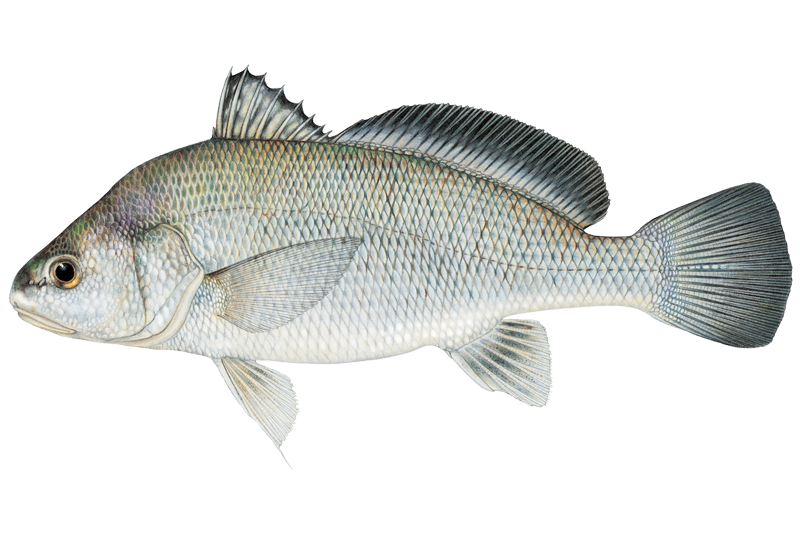
The only North American member of the drum family that lives entirely in freshwater, ranging across the Mississippi drainage, Great Lakes, and most of the central and eastern US. Big rivers, large lakes, and reservoirs are home water.
Often dismissed by walleye and bass anglers, but a 10-pound drum on light tackle pulls as hard as anything in fresh water.
Scientific Name: Aplodinotus grunniens
Also known as Sheepshead, Gaspergou, Gou, Thunder Pumper, Gray Bass, Silver Bass, Lake Drum, Croaker, Grunter, Bubbler, Russell Fish
- Deep, laterally compressed body with a pearl-gray back, silvery sides, and milky belly; turbid-water fish often show more bronze.
- Rounded (not forked) tail that comes to a single point, plus a long two-part dorsal fin — the cleanest separation from carp and buffalo, which have forked tails and a single dorsal.
- Subterminal (downturned) mouth and small barbels signal the bottom-feeding habit; large fish develop a noticeably humped back.
- Average angler fish run 2–10 lb and 12–20 inches, but 20-pounders are realistic in productive water and the all-tackle record stands at 54 lb 8 oz.
What to know
Habitat Distribution
- Native across the Mississippi and Ohio drainages, the Great Lakes (all but Lake Superior, where it arrived in the 1970s), and the Missouri system out into the northern plains.
- Big-water fish — medium to large rivers, large lakes, reservoirs, and oxbows. Avoids high-gradient streams, fast current, and shallow weed flats.
- Tolerates turbid, murky water as well as or better than most co-occurring species, but stresses above 78°F and pulls into deeper, well-oxygenated water during summer heat.
Specific Spots
- Deep pools, slack water along channel edges, and tailwaters below dams hold fish year-round, typically at 20–60 feet hugging bottom.
- Wing dams, current seams, and rocky banks in big rivers concentrate fish where slower water meets harder structure and mussel beds.
- In summer, drum slide shallower onto sand and gravel flats — especially near tributary mouths — where they root for crayfish and mollusks.
- On the Great Lakes, rocky shores, breakwalls, and zebra mussel reefs are reliable, since fish over 25 cm can crush mussels and key on them.
Freshwater Drum FAQ
Answers from onWater's species guide.
What are the best lures and bait for Freshwater Drum?
Nightcrawlers, crayfish tails, shrimp, and cut bait fished on the bottom are the high-percentage starting point. Crayfish in particular account for a lot of the biggest fish.
What flies work for Freshwater Drum?
Woolly Buggers in brown, black, and olive (#2–#6), with a touch of pearl or red flash, dead-drifted or crawled along bottom, they read as crayfish, leech, or general food depending on how you fish them.
What do Freshwater Drum eat?
Crayfish and mollusks (mussels, clams, snails) make up the year-round backbone of the diet, molariform throat plates let drum crush hard shells, which is why crayfish baits and crayfish patterns like a brown Woolly Bugger or weighted crayfish fly are so consistent.
Where do Freshwater Drum live?
Native across the Mississippi and Ohio drainages, the Great Lakes (all but Lake Superior, where it arrived in the 1970s), and the Missouri system out into the northern plains. Big-water fish, medium to large rivers, large lakes, reservoirs, and oxbows.
See it in the app
Most maps show you water.
onWater shows you Freshwater Drum.



- 01 · Species map filter
Map every Freshwater Drum water
Pick Freshwater Drum and the map zeroes in on the waters they call home. No more guessing which lake holds them.
- 02 · Waterbody species
Tap any water. See what lives there.
Species, behavior and seasonal patterns for every lake, river and pond, before you leave the driveway.
- 03 · Angler Intelligence
Ask how to catch Freshwater Drum
Tactics, gear and timing from onWater's AI fishing guide, tuned to the species and the water you're on.
Stop guessing where Freshwater Drum are.
Open the map, filter by Freshwater Drum, and head to water that holds them. Download onWater and plan your next trip in minutes.
- Species map filter
- Angler Intelligence
- Fishing journal
Explore other species
Trout, bass, salmon, panfish and everything in between. Each guide unpacks the behavior, seasons, and tactics that put fish in the net.
No species information available.

Smarter Fishing Starts in the App.
onWater Fish gives you everything you need to plan smarter, fish better, and own every trip from first cast to last.