Grass Pickerel
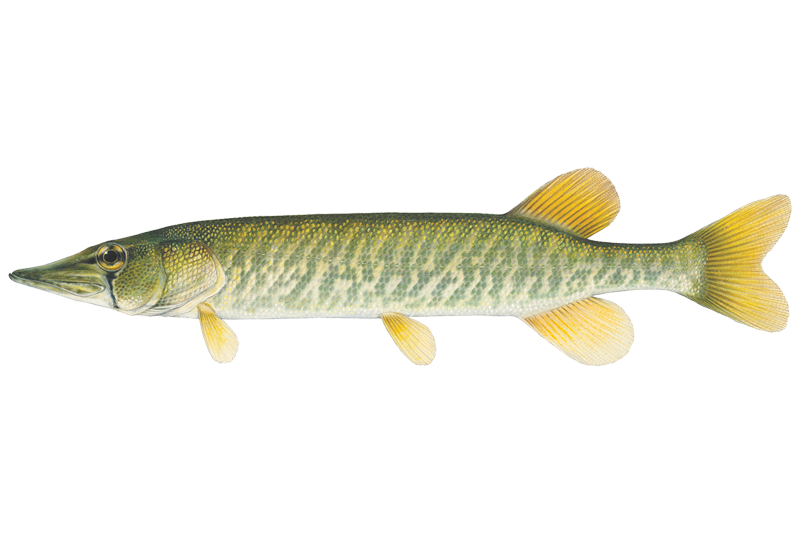
The smallest member of the pike family in North America, grass pickerel rarely top a foot but carry every trait that makes Esox what it is — toothy snout, ambush instincts, and a body built for short bursts through the weeds.
They live in slow, vegetated water across the Great Lakes basin, the Mississippi drainage, and Gulf slope rivers, mostly west of the Appalachians. A scrappy light-tackle target in water most anglers overlook.
Scientific Name: Esox americanus
Also known as American pickerel, banded pickerel, little pickerel, mud pickerel
- Slender, near-cylindrical body with a duck-billed snout, deeply forked tail, and a single dorsal fin set far back directly above the anal fin.
- Olive to yellow-brown back and sides marked with 20+ wavy dark bars; the pale spaces between bars are wider than the bars themselves.
- A dark, near-vertical bar drops down and slightly back from the eye — one of the most reliable field marks separating it from juvenile pike or muskie.
- Typical fish run 10–12 inches and well under a pound; anything pushing 14 inches or 2 pounds is a genuine trophy for the species.
What to know
Habitat Distribution
- Native through the Great Lakes basin and Mississippi drainage south into Gulf slope rivers, ranging west into the Great Plains; replaced on the Atlantic slope by the redfin pickerel subspecies.
- A warmwater fish — comfortable up to about 80°F and remarkably tolerant of low oxygen, which lets it persist in swampy backwaters that crowd out most other predators.
- Dense submerged and emergent vegetation is non-negotiable; if a stretch of water has no weeds or woody cover, grass pickerel won't be there.
- Introduced populations exist in a handful of western states from misidentified pike shipments, but core angling range is the Midwest, Mid-South, and Mississippi Valley.
Specific Spots
- Edges where weed beds meet open water or pool basins — fish sit motionless inside the cover with their heads pointed toward the opening, watching for prey to drift past.
- Stream pools and glides with overhanging branches, in-channel logs, or laydowns; they avoid riffles entirely and won't hold in current.
- Shallow vegetated coves and lily-pad pockets in ponds and lake bays, especially where pondweed or coontail forms a canopy with open lanes underneath.
- Spawning fish push even shallower in late winter, often into flooded grass and skinny shoreline weed flats most anglers walk right past.
Grass Pickerel FAQ
Answers from onWater's species guide.
What are the best lures and bait for Grass Pickerel?
Small jigheads dressed with 2–3 inch paddle tails or curly-tail grubs, worked slowly along weed edges; weedless rigging matters more than color in the salad they live in.
What flies work for Grass Pickerel?
Small minnow streamers in 1–3 inch sizes, Clouser Minnows (which imitate small baitfish with their dumbbell-eye sink-and-dart action) are a reliable choice stripped along weed edges.
What do Grass Pickerel eat?
Adults eat smaller fish, sunfish, minnows, and darters make up most of the diet, which is why small minnow-profile lures and 2–3 inch baitfish-imitating soft plastics are the bread and butter for targeting them.
Where do Grass Pickerel live?
Native through the Great Lakes basin and Mississippi drainage south into Gulf slope rivers, ranging west into the Great Plains; replaced on the Atlantic slope by the redfin pickerel subspecies.
See it in the app
Most maps show you water.
onWater shows you Grass Pickerel.



- 01 · Species map filter
Map every Grass Pickerel water
Pick Grass Pickerel and the map zeroes in on the waters they call home. No more guessing which lake holds them.
- 02 · Waterbody species
Tap any water. See what lives there.
Species, behavior and seasonal patterns for every lake, river and pond, before you leave the driveway.
- 03 · Angler Intelligence
Ask how to catch Grass Pickerel
Tactics, gear and timing from onWater's AI fishing guide, tuned to the species and the water you're on.
Stop guessing where Grass Pickerel are.
Open the map, filter by Grass Pickerel, and head to water that holds them. Download onWater and plan your next trip in minutes.
- Species map filter
- Angler Intelligence
- Fishing journal
Explore other species
Trout, bass, salmon, panfish and everything in between. Each guide unpacks the behavior, seasons, and tactics that put fish in the net.
No species information available.
Smarter Fishing Starts in the App.
onWater Fish gives you everything you need to plan smarter, fish better, and own every trip from first cast to last.