Burbot
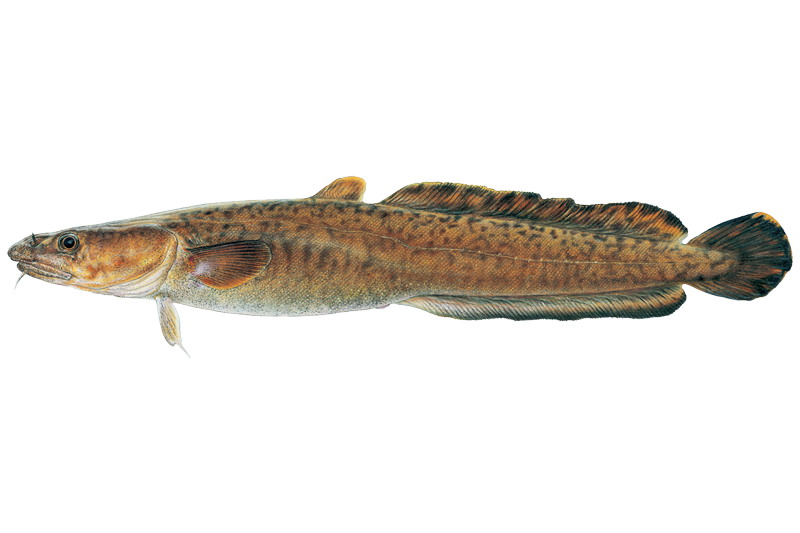
The only freshwater cod in North America, burbot are eel-shaped, whisker-chinned bottom dwellers of cold lakes and rivers across Alaska, the Great Lakes basin, the northern Rockies, and parts of New England.
Most US anglers chase them through the ice in deep winter, when fish leave deep basins to spawn on shallow shoals after dark.
Scientific Name: Lota lota
Also known as Eelpout, Ling, Freshwater Ling, Lawyer, Freshwater Cod, Freshwater Cusk, Loche, Lush, Methy, Kootenai Leopard, Poor Man's Lobster
- Long, serpentine body with mottled brown, olive, and yellow camouflage; tiny embedded scales make the skin look smooth and slimy. Far-northern fish can run nearly solid dark brown.
- One fleshy chin barbel — the dead-giveaway ID feature — plus smaller barbel-like tubes off each nostril. Wide mouth packed with small inward-slanting teeth.
- Two dorsal fins (a short front one, a very long rear one) that mirror an equally long anal fin, both running back to a paddle-shaped tail. Pelvic fins sit forward in the throat, ahead of the pectorals.
- Typical adults run around 16 inches and a couple of pounds; fish in the 5-15 lb range are good ones, and the IGFA all-tackle record stands at 25 lb 2 oz from Saskatchewan.
What to know
Habitat Distribution
- Native across Alaska, the Great Lakes basin, the upper Mississippi and Missouri drainages, New England, and the northern Rockies, reaching their southwestern native limit in Wyoming's Wind River drainage.
- A cold-water specialist — they prefer water at or below 54°F and hold below the thermocline once surface temps climb past 70°F. Optimal water is right around 39°F.
- Demersal at almost any depth, from a few feet under the ice to over 700 feet in Lake Superior. They tolerate mud, sand, gravel, cobble, and boulder bottoms, and adults will dig burrows in clay or soft substrate for daytime cover.
- Stocked or otherwise established outside their native range in parts of the Northeast and Midwest; non-native populations in the upper Colorado River drainage are managed as invasive.
Specific Spots
- Rocky reefs, boulder fields, and cobble bottoms hold crayfish, sculpin, and young whitefish year-round, which is why burbot patrol them. The transition from rock to softer bottom in 20-35 ft is especially reliable.
- Deep basins and 40-80+ ft holes serve as daytime refuges; in rivers, fish bury into pools 40 ft and deeper between feeding windows.
- Sandy or gravel shoals adjacent to deep water — sometimes in as little as 8-10 ft — concentrate spawning fish under the ice. Small flats and rocky points rising out of a basin are the spots to drill over.
- Mud flats that drop into deep basins act as nighttime hunting lanes, and in rivers the inside of gravel bars on bends and the mouths of clear tributaries entering bigger main stems are prime.
Burbot FAQ
Answers from onWater's species guide.
What are the best lures and bait for Burbot?
Heavy glow jigs and jigging spoons in the 3/4-1.5 oz range are the workhorse, phosphorescent paint is essentially mandatory for drawing fish in dark, deep water, and you recharge the glow every 10-15 minutes with a headlamp. Pound the bottom: lift 12-18 inches, drop hard, pause 3-5 seconds.
What do Burbot eat?
Juveniles eat aquatic insects and invertebrates, but by age five or six burbot turn nearly full piscivore, whitefish, cisco, sculpin, perch, smelt, shiners, suckers, gobies, and other burbot. That's why a glow jig or spoon tipped with cut cisco, smelt, sucker, or whitefish is the standard ice-fishing presentation.
Where do Burbot live?
Native across Alaska, the Great Lakes basin, the upper Mississippi and Missouri drainages, New England, and the northern Rockies, reaching their southwestern native limit in Wyoming's Wind River drainage.
See it in the app
Most maps show you water.
onWater shows you Burbot.



- 01 · Species map filter
Map every Burbot water
Pick Burbot and the map zeroes in on the waters they call home. No more guessing which lake holds them.
- 02 · Waterbody species
Tap any water. See what lives there.
Species, behavior and seasonal patterns for every lake, river and pond, before you leave the driveway.
- 03 · Angler Intelligence
Ask how to catch Burbot
Tactics, gear and timing from onWater's AI fishing guide, tuned to the species and the water you're on.
Stop guessing where Burbot are.
Open the map, filter by Burbot, and head to water that holds them. Download onWater and plan your next trip in minutes.
- Species map filter
- Angler Intelligence
- Fishing journal
Explore other species
Trout, bass, salmon, panfish and everything in between. Each guide unpacks the behavior, seasons, and tactics that put fish in the net.
No species information available.

Smarter Fishing Starts in the App.
onWater Fish gives you everything you need to plan smarter, fish better, and own every trip from first cast to last.