Yellow Bullhead
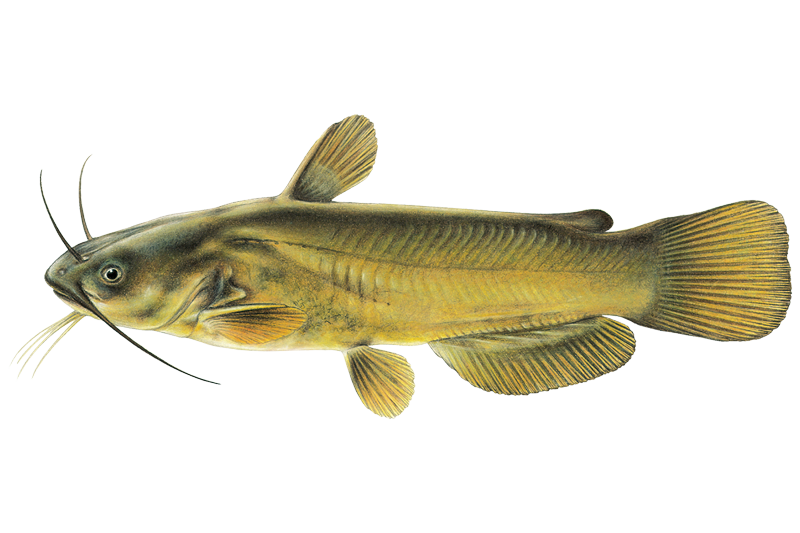
The bullhead with the white whiskers — yellows live in warm, slow water across most of the eastern and central US, native through the Atlantic and Gulf slopes, Great Lakes, and Mississippi drainages, with introduced populations scattered through the West.
They handle silt, low oxygen, and pollution that drives most other gamefish out, which is why they show up in waters nothing else can hold.
Scientific Name: Ameiurus natalis
Also known as Polliwog, Chucklehead Cat, Butter Cat, Yellow Cat, White-Whiskered Bullhead, Horned Pout, Creek Cat
- White or pale yellow chin barbels are the giveaway — black and brown bullheads have dark, pigmented chin whiskers (Florida fish can run dusky brown).
- Yellow-olive to slate back fading to a yellow-white belly, more uniform in color than the mottled brown bullhead, with a rounded — not forked — tail.
- Long, nearly straight anal fin with 24–27 rays, more than any other bullhead; pectoral spines carry 5–8 saw-like serrations and the skin is scaleless.
- A 6 lb 6 oz IGFA all-tackle record makes this the smallest of the three common bullheads at peak size; expect most fish in hand at 6–14 inches and well under 2 lb.
What to know
Habitat Distribution
- Native across Atlantic and Gulf slope drainages, the St. Lawrence–Great Lakes basin, and the Mississippi watershed; introduced and established in scattered western and New England waters.
- Of the three common bullheads, yellows lean toward the cleaner, more vegetated water — they'll tolerate degraded conditions but pick the better neighborhood when given a choice.
- Pools, backwaters, oxbows, ponds, and the sluggish reaches of creeks and rivers; tolerates light brackish water up to about 5 PSU but is essentially a freshwater fish.
Specific Spots
- Soft-bottomed pools and backwaters with current barely moving — muck, silt, sand, or clay where a worm can sit and put off scent without getting washed downstream.
- Cover edges around stumps, sunken logs, submerged tree roots, and rock piles with weeds growing up alongside; these double as nest sites and daytime hides.
- Weedy lake coves and pond shallows, particularly near any inflowing water that warms earliest in spring and concentrates pre-spawn fish willing to feed in daylight.
- After dark, fish slide shallow to forage along bottom — bank-fishing the first 6 feet of water from a beach, dock, or bridge often beats any boat presentation.
Yellow Bullhead FAQ
Answers from onWater's species guide.
What are the best lures and bait for Yellow Bullhead?
Worms first, nightcrawlers and garden worms account for the majority of trophy bullheads, and a gob fished on bottom is hard to beat anywhere in the species' range.
What do Yellow Bullhead eat?
Worms, aquatic insect larvae, crayfish, snails, small minnows, and a meaningful share of plant matter, yellows eat more vegetation than black or brown bullheads, plus dead organic material picked up off the bottom.
Where do Yellow Bullhead live?
Native across Atlantic and Gulf slope drainages, the St. Lawrence–Great Lakes basin, and the Mississippi watershed; introduced and established in scattered western and New England waters.
See it in the app
Most maps show you water.
onWater shows you Yellow Bullhead.



- 01 · Species map filter
Map every Yellow Bullhead water
Pick Yellow Bullhead and the map zeroes in on the waters they call home. No more guessing which lake holds them.
- 02 · Waterbody species
Tap any water. See what lives there.
Species, behavior and seasonal patterns for every lake, river and pond, before you leave the driveway.
- 03 · Angler Intelligence
Ask how to catch Yellow Bullhead
Tactics, gear and timing from onWater's AI fishing guide, tuned to the species and the water you're on.
Stop guessing where Yellow Bullhead are.
Open the map, filter by Yellow Bullhead, and head to water that holds them. Download onWater and plan your next trip in minutes.
- Species map filter
- Angler Intelligence
- Fishing journal
Explore other species
Trout, bass, salmon, panfish and everything in between. Each guide unpacks the behavior, seasons, and tactics that put fish in the net.
No species information available.
Smarter Fishing Starts in the App.
onWater Fish gives you everything you need to plan smarter, fish better, and own every trip from first cast to last.