Yellow Bass
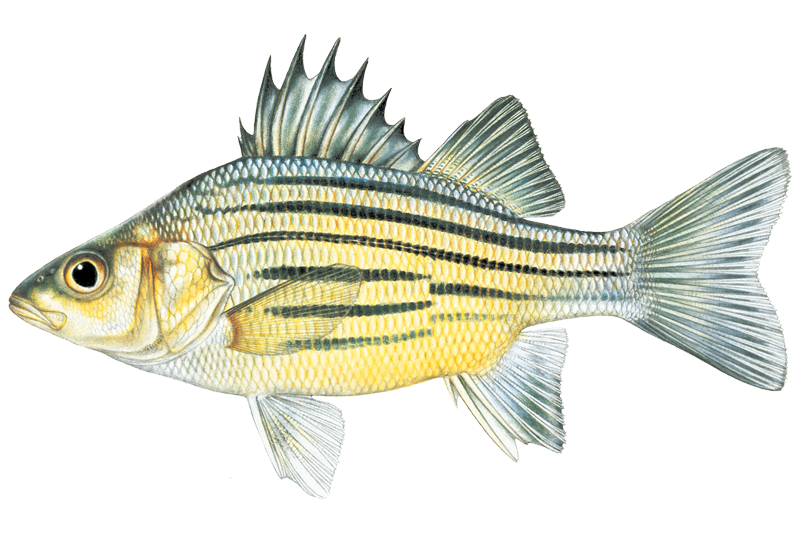
The smallest member of the temperate bass family, yellow bass run the Mississippi River corridor and Gulf Slope drainages and have been stocked into a handful of lakes well outside that native range.
They school heavily, eat well, and reward anglers who find a pile of them rather than chase a single big fish — an honest 12-incher is a good one.
Scientific Name: Morone mississippiensis
Also known as Brassy Bass, Gold Bass, Barfish, Streakers, Streaks, Yellow Jacks
- Brassy yellow to silvery-yellow sides over a dark olive back, with a belly that often takes on the distinct yellow cast that gives the species its name.
- Five to seven dark lateral stripes — and the key field mark: the two lowest stripes are broken and offset just behind the midpoint, separating yellow bass from white bass and young striped bass, both of which carry unbroken stripes.
- No tooth patch on the tongue (striped bass has one), 9–10 anal soft rays vs. 11–13 in white bass, and second and third anal spines roughly equal in length.
- Average wild fish run 9–12 inches and 8–12 ounces; a one-pound fish is a real one, and the IGFA all-tackle world record stands at 4 lb 5 oz.
What to know
Habitat Distribution
- Native through the Mississippi River and Lake Michigan basins from the Upper Midwest down to the Gulf, plus Gulf Slope drainages from the Mobile Bay system west to the Galveston Bay drainage.
- Stocking has pushed the species well outside that core, with established non-native populations as far west as Arizona and into glacial lakes well north of the historic range — sometimes managed as a sportfish, sometimes as a nuisance.
- A warm-water fish that does best between roughly 65–80°F, in clear to moderately turbid water; heavy turbidity or pollution knocks back both feeding and reproduction.
- Big rivers, oxbows, lakes, and reservoirs are the typical settings; at the southern edge of the range, fish sometimes drop into brackish estuaries.
Specific Spots
- Quiet pools, backwaters, and the slack water behind bridge pilings, brush, and channel-edge rock — yellow bass want some current break with structure nearby.
- Schools push baitfish to the surface at dawn and dusk in summer; visible blitzes on flat water are the giveaway, much like white bass behavior.
- Once the surface bite shuts off, fish drop onto drop-offs and creek-channel edges where vertical jigging gets you back into them.
- In winter on reservoirs, warm-water discharges from power plants concentrate fish — predictable thermal refuge that holds schools through the cold months.
Yellow Bass FAQ
Answers from onWater's species guide.
What are the best lures and bait for Yellow Bass?
Small spoons, inline spinners, and live minnows are the bread and butter, sized to imitate the shad and silversides yellow bass are pushing to the surface.
What do Yellow Bass eat?
Small fish like shad and silversides drive the adult diet, which is why small spoons, inline spinners, and small soft-plastic swimbaits on light jigheads cover most situations, match the size of the bait being herded to the surface.
Where do Yellow Bass live?
Native through the Mississippi River and Lake Michigan basins from the Upper Midwest down to the Gulf, plus Gulf Slope drainages from the Mobile Bay system west to the Galveston Bay drainage.
See it in the app
Most maps show you water.
onWater shows you Yellow Bass.



- 01 · Species map filter
Map every Yellow Bass water
Pick Yellow Bass and the map zeroes in on the waters they call home. No more guessing which lake holds them.
- 02 · Waterbody species
Tap any water. See what lives there.
Species, behavior and seasonal patterns for every lake, river and pond, before you leave the driveway.
- 03 · Angler Intelligence
Ask how to catch Yellow Bass
Tactics, gear and timing from onWater's AI fishing guide, tuned to the species and the water you're on.
Stop guessing where Yellow Bass are.
Open the map, filter by Yellow Bass, and head to water that holds them. Download onWater and plan your next trip in minutes.
- Species map filter
- Angler Intelligence
- Fishing journal
Explore other species
Trout, bass, salmon, panfish and everything in between. Each guide unpacks the behavior, seasons, and tactics that put fish in the net.
No species information available.

Smarter Fishing Starts in the App.
onWater Fish gives you everything you need to plan smarter, fish better, and own every trip from first cast to last.