Rock Bass
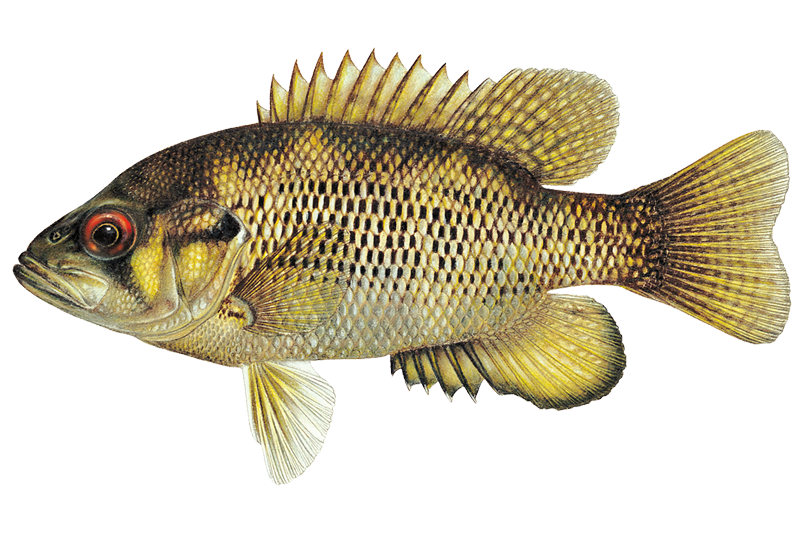
A thick-bodied panfish of clear rocky waters across the eastern half of the country, native from the Great Lakes and St. Lawrence south through the Mississippi drainage and Atlantic slope, and introduced well beyond.
The bright red-orange iris and rows of dark scale spots make it unmistakable in hand, and its willingness to bite makes it a favorite when smallmouth go quiet.
Scientific Name: Ambloplites rupestris
Also known as Goggle-eye, Redeye, Northern Rock Bass, Black Perch, Rock Perch
- Bright red to orange-red iris is the giveaway field mark — vivid in fresh fish and the source of the 'goggle-eye' nickname.
- Six anal fin spines (occasionally 5-7) cleanly separate rock bass from warmouth and green sunfish, which carry only three.
- Olive to golden-brown back fading to a silvery belly, with rows of dark, roughly square spots running horizontally along the flanks and a bluish-black smudge at the tip of the gill plate.
- Average fish run 6-10 inches and under a pound; lake fish push past a pound and the all-tackle record sits at 3 lb even.
What to know
Habitat Distribution
- Native across the St. Lawrence and Great Lakes, the upper and middle Mississippi basin, and Atlantic slope drainages from the Northeast down through the southern Appalachians.
- Stocked widely since the late 1800s — now established in 23+ states outside its native range, including parts of the Mountain West and the Pacific Northwest's Chehalis drainage.
- A clear-water specialist tied to clean rock, rubble, and gravel substrates; intolerant of silt, low oxygen, and acidic water, which keeps it out of muddy lowland rivers.
- Tolerates 50-84°F and lives shallow to about 70 feet, but most fish are caught well within 20 feet of the surface around hard-bottom shorelines.
Specific Spots
- In rivers, sits in deep pools, eddies tight to the bank, and the slack pockets behind boulders and ledges — often hovering inches off the shoreline in shaded water.
- Logs, deadfalls, and submerged stumps in pool tailouts hold concentrations; rock bass linger around tree roots and submerged vegetation rather than roaming.
- On lakes, work rocky points, rubble coves, riprap, and reefs — anywhere hard bottom meets a little cover. Docks, including occupied ones, are surprisingly reliable.
- Find them stacked alongside smallmouth and other sunfish on the same structure; rock bass are not shy about boat traffic or wading anglers.
Rock Bass FAQ
Answers from onWater's species guide.
What are the best lures and bait for Rock Bass?
Small soft plastics on light jigheads, in-line spinners, Beetlespins, small spinnerbaits, and small crankbaits all work, keep the retrieve slow and bump bottom near cover.
What flies work for Rock Bass?
Crayfish patterns in brown, olive, and rust match the primary forage, crawl them along bottom around rock and wood for the most consistent eats. Woolly Buggers in olive, brown, and black (sizes 6-10) imitate leeches, hellgrammites, and general baitfish, and they're the single most useful fly to carry for this species.
What do Rock Bass eat?
Crayfish are the staple across the range, which is why crayfish-colored jigs, tubes, soft plastics, and crayfish flies in browns and olives consistently produce.
Where do Rock Bass live?
Native across the St. Lawrence and Great Lakes, the upper and middle Mississippi basin, and Atlantic slope drainages from the Northeast down through the southern Appalachians.
See it in the app
Most maps show you water.
onWater shows you Rock Bass.



- 01 · Species map filter
Map every Rock Bass water
Pick Rock Bass and the map zeroes in on the waters they call home. No more guessing which lake holds them.
- 02 · Waterbody species
Tap any water. See what lives there.
Species, behavior and seasonal patterns for every lake, river and pond, before you leave the driveway.
- 03 · Angler Intelligence
Ask how to catch Rock Bass
Tactics, gear and timing from onWater's AI fishing guide, tuned to the species and the water you're on.
Stop guessing where Rock Bass are.
Open the map, filter by Rock Bass, and head to water that holds them. Download onWater and plan your next trip in minutes.
- Species map filter
- Angler Intelligence
- Fishing journal
Explore other species
Trout, bass, salmon, panfish and everything in between. Each guide unpacks the behavior, seasons, and tactics that put fish in the net.
No species information available.
Smarter Fishing Starts in the App.
onWater Fish gives you everything you need to plan smarter, fish better, and own every trip from first cast to last.