Longnose Gar
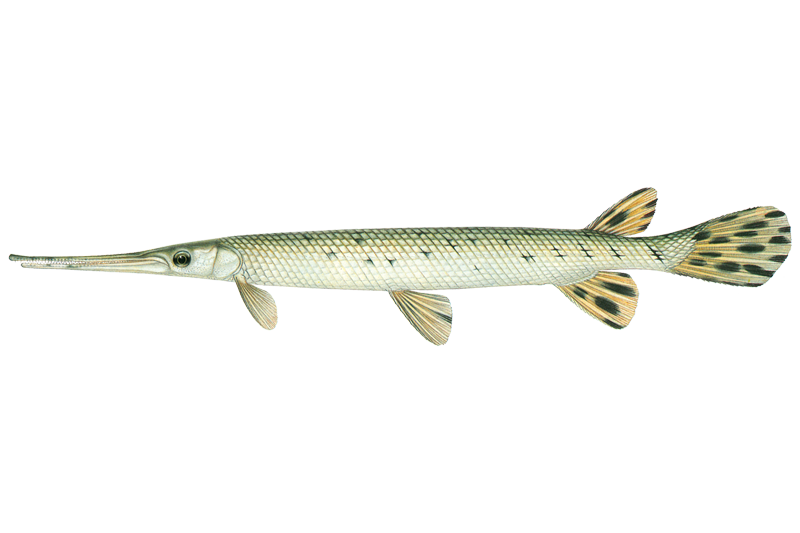
A living relic with a snout like a pair of needle-nose pliers, the longnose gar ranges across most of the eastern half of the country — from the Atlantic slope and Great Lakes through the Mississippi basin and down into Gulf Coast estuaries.
Anglers target them for the sight-fishing experience: spotting a long, dark fish hanging just under the surface and watching it rocket sideways at a fly or rope lure.
Scientific Name: Lepisosteus osseus
Also known as Longnose Garpike, Billy Gar, Billfish, Needlenose, Scissorbill, Bonypike, Pin Nose Gar
- The defining feature is the snout — at least 10 times longer than wide, lined with a single row of villiform teeth. No other gar has a beak this slender.
- Torpedo-shaped body wrapped in hard, diamond-shaped ganoid scales (prehistoric armor that requires tin snips to cut through).
- Olive-brown to green on top, pale below, with dark oval spots scattered across the body and fins but never on the head. Color runs deeper green in clear water, drabber in stained water.
- Typical adults run 28–48 inches; trophies push 5 feet, with the rod-and-reel record at 43 pounds and the bowfishing record at 56 pounds.
What to know
Habitat Distribution
- Native across eastern North America — the Atlantic slope south of the Delaware, every Great Lake except Superior, the entire Mississippi basin, and Gulf drainages west to the Rio Grande. The most widespread of the gars.
- Sluggish stretches of larger rivers, oxbows, reservoirs, swamps, and coastal bayous are home water; tolerates current better than other gars but still gravitates to slower edges.
- One of the few freshwater fish that pushes into truly brackish water — salinities up to 31 ppt are tolerable, which is why coastal estuaries hold them.
- Air-breathing through a vascularized swim bladder lets gar survive in warm, oxygen-starved water that would kill most gamefish — expect them in places bass and pike can't live.
Specific Spots
- Shallow, weedy backwater bays under six feet deep, with a mix of pads, emergent grass, and downed wood — prime warm-month holding water where gar lie just under the surface.
- Edges of woody debris, stone outcrops, and vegetation lines where ambushing baitfish is easiest. Gar position to lateral-strike, so they want cover at one shoulder.
- Surface itself counts as a spot — gar roll and gulp air in open water on warm afternoons, giving away their location to a sight-fisher.
- Along the Gulf Coast, watch tidal timing: fish push toward higher-salinity bayou mouths in the afternoon to feed on menhaden, then drift back upstream by morning.
Longnose Gar FAQ
Answers from onWater's species guide.
What are the best lures and bait for Longnose Gar?
Rope lures, frayed nylon cord, paracord, or pantyhose, with or without bait, are the single most reliable gar method. Teeth tangle in the fibers, eliminating the hookset problem entirely. Almost anyone serious about gar fishes a rope.
What flies work for Longnose Gar?
The hookless nylon rope fly, six to nine inches of unbraided dock line, frayed at the end, is the standard pattern. Fibers tangle in the teeth and the fish essentially hooks itself by chewing. Cotton rope works as well.
What do Longnose Gar eat?
Adults eat fish, up to 98% of the diet, with the menu shifting by region: shiners, gizzard shad, bullheads, bluegills, silversides, menhaden in brackish water. A 4–6 inch baitfish profile is the right starting point for any imitation. Strikes are sideways, not head-on.
Where do Longnose Gar live?
Native across eastern North America, the Atlantic slope south of the Delaware, every Great Lake except Superior, the entire Mississippi basin, and Gulf drainages west to the Rio Grande. The most widespread of the gars.
See it in the app
Most maps show you water.
onWater shows you Longnose Gar.



- 01 · Species map filter
Map every Longnose Gar water
Pick Longnose Gar and the map zeroes in on the waters they call home. No more guessing which lake holds them.
- 02 · Waterbody species
Tap any water. See what lives there.
Species, behavior and seasonal patterns for every lake, river and pond, before you leave the driveway.
- 03 · Angler Intelligence
Ask how to catch Longnose Gar
Tactics, gear and timing from onWater's AI fishing guide, tuned to the species and the water you're on.
Stop guessing where Longnose Gar are.
Open the map, filter by Longnose Gar, and head to water that holds them. Download onWater and plan your next trip in minutes.
- Species map filter
- Angler Intelligence
- Fishing journal
Explore other species
Trout, bass, salmon, panfish and everything in between. Each guide unpacks the behavior, seasons, and tactics that put fish in the net.
No species information available.

Smarter Fishing Starts in the App.
onWater Fish gives you everything you need to plan smarter, fish better, and own every trip from first cast to last.