Black Buffalo
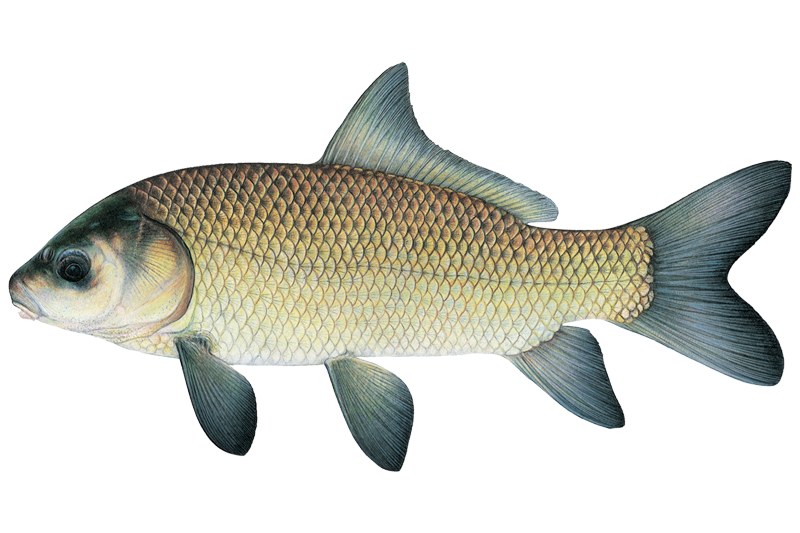
The least-encountered of North America's three buffalo species, black buffalo park in deep, fast slots of big rivers where most anglers aren't fishing.
They reach 30-plus pounds across the Mississippi, Missouri, and Ohio basins and Gulf Slope drainages, and recent otolith work has aged individuals past 100 years — among the longest-lived freshwater fish on the continent.
Scientific Name: Ictiobus niger
Also known as Current Buffalo, Blue Buffalo, Buffalofish
- Slate-to-bronze back with a greenish overcast and a dark gunmetal-blue wash on the sides — lacking the brassy luster of bigmouth buffalo.
- Small, nearly horizontal mouth set well below the eye, with thick grooved lips — the cleanest separator from bigmouth buffalo, which has a large terminal mouth at eye level.
- Body is rounder and thicker than smallmouth buffalo but not as deep, with a sickle-shaped dorsal fin carrying 27–31 rays.
- Typical fish run 20–30 inches and 10–30 pounds; the IGFA all-tackle record is 63 lb 6 oz from the Mississippi River, and Iowa fish have exceeded 80 pounds.
What to know
Habitat Distribution
- Native across the Mississippi River basin from the upper Midwest south to Louisiana, plus Gulf Slope drainages including the Sabine, Brazos, and Rio Grande, with native populations also in southern Lake Michigan and Lake Erie.
- Of the three US buffalo species, this one leans hardest into current — most often found in medium-to-large rivers and rare in true impoundments, though some reservoirs hold them.
- Below dams on big rivers tends to be denser water than the impoundments above, and the species has declined sharply on channelized stretches like much of the Missouri River.
- An introduced Arizona population in Apache Lake, founded around 1918, persists with most fish estimated at over 80 years old — essentially an old-growth relic with no meaningful natural recruitment.
Specific Spots
- Deep runs and pools with steady current over sand, gravel, or rock — the species feeds nose-down on the bottom and wants flow moving food past it.
- Tailwaters and gravel runs below dams concentrate fish, and schooling buffalo in these zones will occasionally chase silver spoons with the rest of the dam-water mob.
- In spring, flooded flats, vegetated backwaters, and inundated floodplain ground draw spawning aggregations — sometimes hundreds of adults — for several days at a stretch.
- In southern oxbows and cypress sloughs, fish slip into floodplain margins during spring high water, then drop back to the main river when levels fall.
Black Buffalo FAQ
Answers from onWater's species guide.
What are the best lures and bait for Black Buffalo?
Grain and dough baits do the heavy lifting: kernel corn, doughballs built around range cubes, cottonseed meal, oatmeal, garlic and molasses, plus boilies and even canned spinach. Corn is the universal hookbait across the range.
What do Black Buffalo eat?
A bottom-grubbing benthic feeder built around a small ventral mouth, primary forage where studied is the introduced Asiatic clam, supplemented by native mollusks, insect larvae (stonefly nymphs in some rivers), crustaceans, algae, and zooplankton.
Where do Black Buffalo live?
Native across the Mississippi River basin from the upper Midwest south to Louisiana, plus Gulf Slope drainages including the Sabine, Brazos, and Rio Grande, with native populations also in southern Lake Michigan and Lake Erie.
See it in the app
Most maps show you water.
onWater shows you Black Buffalo.



- 01 · Species map filter
Map every Black Buffalo water
Pick Black Buffalo and the map zeroes in on the waters they call home. No more guessing which lake holds them.
- 02 · Waterbody species
Tap any water. See what lives there.
Species, behavior and seasonal patterns for every lake, river and pond, before you leave the driveway.
- 03 · Angler Intelligence
Ask how to catch Black Buffalo
Tactics, gear and timing from onWater's AI fishing guide, tuned to the species and the water you're on.
Stop guessing where Black Buffalo are.
Open the map, filter by Black Buffalo, and head to water that holds them. Download onWater and plan your next trip in minutes.
- Species map filter
- Angler Intelligence
- Fishing journal
Explore other species
Trout, bass, salmon, panfish and everything in between. Each guide unpacks the behavior, seasons, and tactics that put fish in the net.
No species information available.
Smarter Fishing Starts in the App.
onWater Fish gives you everything you need to plan smarter, fish better, and own every trip from first cast to last.