Apache Trout
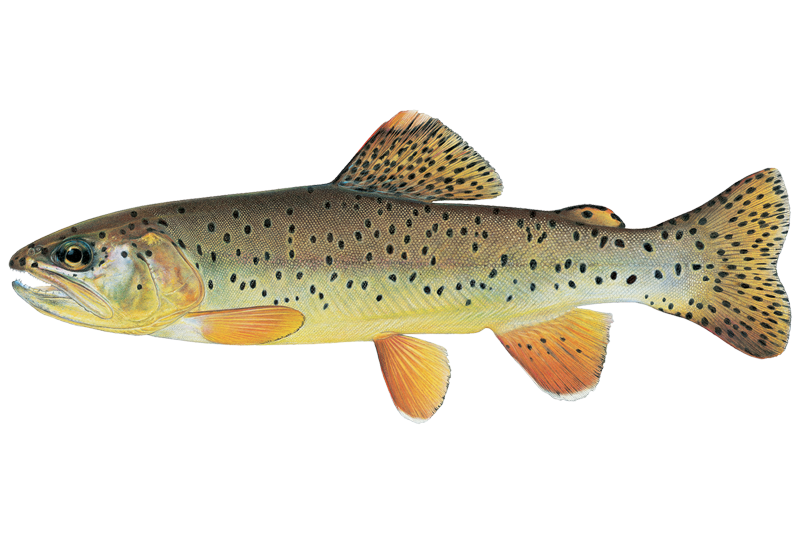
A yellow-gold native trout endemic to the headwater streams of Arizona's White Mountains, Apache Trout exist nowhere else on earth in their pure form.
Decades of cooperative recovery work led to their 2024 federal delisting — the first sport fish ever recovered off the Threatened and Endangered list. For anglers willing to hike, they're a rare chance to hold a true native of a single mountain range.
Scientific Name: Oncorhynchus apache
Also known as Arizona Trout, Yellow Belly
- Yellow to golden body with dark olive head and back, evenly spaced medium-sized dark spots that often extend onto the dorsal and tail fins, and a yellow or orange cutthroat slash under the lower jaw.
- Distinctive 'eye mask' — two small black pigment spots on either side of the pupil that look like a horizontal stripe through each eye. Often faded or absent in hatchery fish.
- Parr marks along the side are absent or very faint at all life stages, which sets juveniles apart from young rainbows or cutthroat. Has the largest dorsal fin of any western trout.
- Wild stream fish typically run 5–9 inches; a 12-incher is a real trophy. Stocked lake fish push 8–15 inches and can reach 5 pounds in fertile waters.
What to know
Habitat Distribution
- The only native range is a handful of headwater streams in the White Mountains of east-central Arizona, above roughly 5,900 feet, draining into the upper White, Black, and Little Colorado rivers. Pure populations exist nowhere else naturally.
- A cold-water specialist tied to clean, shaded mountain creeks under 77°F, with optimal use in waters that stay between roughly 50–72°F through the warm months. Sediment-free gravel substrate is essential for spawning.
- Most pure-strain fish live on the Fort Apache Indian Reservation and the Apache-Sitgreaves National Forest, often above natural waterfall barriers. Conservation introductions exist on the Kaibab Plateau and in the Pinaleños, and hatchery fish are stocked into a few White Mountain lakes.
Specific Spots
- Adults hold in pools and slow eddies behind woody debris, undercut banks, and overhead cover — their gold coloration makes them visible in open water, and they rely on broken structure to avoid being picked off.
- The most productive water tends to be pools roughly knee-deep with slow current, gravel bottom, and shaded canopy above. Fish stack at the downstream tail-outs of pools where drift collects.
- Smaller fish stay tucked along soft margins and shallow stream edges, while larger fish work the deeper heads and tails of pools where current delivers food.
- On stocked lakes, fish cruise weed edges, inlet mouths, and drop-offs, taking food throughout the water column rather than holding to a feeding lane.
Apache Trout FAQ
Answers from onWater's species guide.
What are the best lures and bait for Apache Trout?
Small inline spinners are the workhorse, Panther Martins, Rooster Tails, and Super Dupers in 1/16 to 1/8 oz, fished upstream and twitched back through pool tails and seams.
What flies work for Apache Trout?
Dries: Adams, Parachute Adams, Royal Wulff, and Royal Coachman in sizes 14–18 cover most mayfly and caddis activity. Match small midges and gnats with similarly sized patterns when you see fish sipping flat water.
What do Apache Trout eat?
Stream fish eat almost entirely aquatic insects, mayflies, caddisflies, and midges, picked off the drift. That's the bread and butter of the fly box: Pheasant Tails and Hare's Ears (mayfly nymphs), small caddis pupae, and Adams or Parachute Adams dries when bugs are on the water.
Where do Apache Trout live?
The only native range is a handful of headwater streams in the White Mountains of east-central Arizona, above roughly 5,900 feet, draining into the upper White, Black, and Little Colorado rivers. Pure populations exist nowhere else naturally.
See it in the app
Most maps show you water.
onWater shows you Apache Trout.



- 01 · Species map filter
Map every Apache Trout water
Pick Apache Trout and the map zeroes in on the waters they call home. No more guessing which lake holds them.
- 02 · Waterbody species
Tap any water. See what lives there.
Species, behavior and seasonal patterns for every lake, river and pond, before you leave the driveway.
- 03 · Angler Intelligence
Ask how to catch Apache Trout
Tactics, gear and timing from onWater's AI fishing guide, tuned to the species and the water you're on.
Stop guessing where Apache Trout are.
Open the map, filter by Apache Trout, and head to water that holds them. Download onWater and plan your next trip in minutes.
- Species map filter
- Angler Intelligence
- Fishing journal
Explore other species
Trout, bass, salmon, panfish and everything in between. Each guide unpacks the behavior, seasons, and tactics that put fish in the net.
No species information available.

Smarter Fishing Starts in the App.
onWater Fish gives you everything you need to plan smarter, fish better, and own every trip from first cast to last.