Rio Grande Cichlid
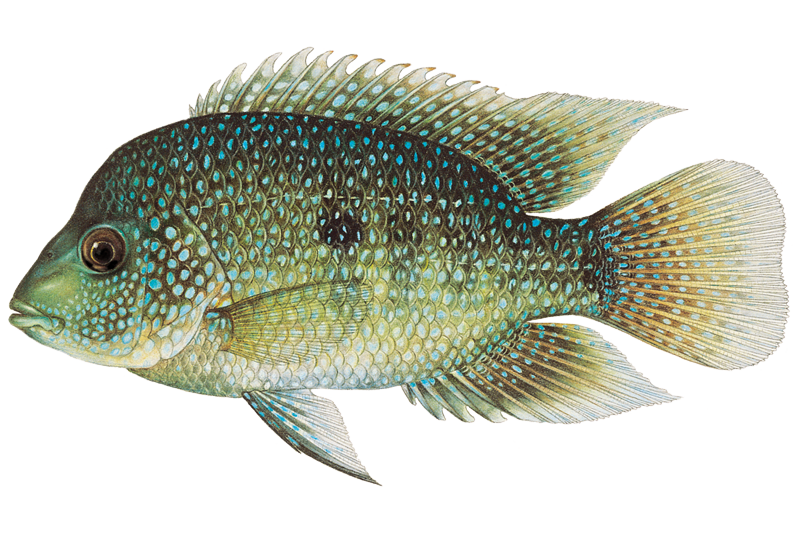
The only cichlid native to the United States, with a small native range in the lower Rio Grande and Nueces drainages and an expanded introduced range across central Texas spring rivers, the Louisiana coastal plain, and parts of central Florida.
Anglers prize them on ultralight and small fly tackle for their size-defying fight and turquoise-speckled looks.
Scientific Name: Herichthys cyanoguttatus
Also known as Texas Cichlid, Rio Grande Perch, Mojarra de Norte, Texas Bluespots
- Olive body dusted with cream and turquoise spots over 4-6 dark vertical bars; the first bar is usually the most prominent and the speckling is the giveaway.
- Mature males carry a pronounced nuchal hump on the forehead, and breeding adults turn ghost-white on the front half of the body and inky black on the rear.
- Long, tapered dorsal and anal fins with 5-7 anal spines — separates them cleanly from sunfish and bass, which have only 3 anal spines and a continuous lateral line.
- Most fish run under 10 inches; anything over a pound is a trophy, and the IGFA all-tackle record stands at 2.02 lbs from Lake Dunlap, Texas.
What to know
Habitat Distribution
- Native only to the lower Rio Grande and Nueces drainages of South Texas and northeastern Mexico — the only US-native cichlid.
- Introduced and well established across central Texas spring-fed rivers (Guadalupe, San Marcos, Comal, Colorado, San Antonio drainages) east into the Houston coastal plain, the New Orleans area and Lake Pontchartrain drainage in Louisiana, and artificial canals in central peninsular Florida.
- A warm-water specialist that can't survive water below about 49°F; thrives where spring flow keeps temperatures in the 68-91°F range year-round.
- Tolerates brackish water to roughly 5-8 ppt, which is how it spreads through coastal estuaries in Louisiana.
Specific Spots
- Hugs the bottom along limestone ledges, rock piles, and submerged timber in slow side channels and quiet pools — benthopelagic by habit.
- Gentle riffles and runs with mixed rock, sand, and clay substrate hold both juveniles and adults; adults push into deeper water as they grow.
- In spring, pairs guard nests on cleaned rock in less than a foot of water and will hammer anything that drifts close — visible nests are sight-fishing gold.
- In urban canals and Louisiana bayous, look along grass mats, lily-pad edges, and seawalls — the same cover that holds bream.
Rio Grande Cichlid FAQ
Answers from onWater's species guide.
What are the best lures and bait for Rio Grande Cichlid?
Live bait wins: earthworms, red worms, and crickets fished under a cork or on a small split-shot rig account for the majority of cichlids caught, including the standing world record.
What flies work for Rio Grande Cichlid?
Small weighted crayfish patterns (Mini-Craw and similar in size 10) crawled along the bottom near rock and timber are the workhorse fly, crayfish are core forage, and bottom presentation matches how cichlids actually feed.
What do Rio Grande Cichlid eat?
Omnivores that mostly grub the bottom, small fish, aquatic insect larvae, crustaceans (especially small crayfish), and the eggs of other fish. Small weighted crayfish patterns, beadhead nymphs, and worms or crickets under a cork all play directly to that bottom-feeding habit.
Where do Rio Grande Cichlid live?
Native only to the lower Rio Grande and Nueces drainages of South Texas and northeastern Mexico, the only US-native cichlid. Introduced and well established across central Texas spring-fed rivers (Guadalupe, San Marcos, Comal, Colorado, San Antonio drainages) east into the Houston coastal plain, the New Orleans area...
See it in the app
Most maps show you water.
onWater shows you Rio Grande Cichlid.



- 01 · Species map filter
Map every Rio Grande Cichlid water
Pick Rio Grande Cichlid and the map zeroes in on the waters they call home. No more guessing which lake holds them.
- 02 · Waterbody species
Tap any water. See what lives there.
Species, behavior and seasonal patterns for every lake, river and pond, before you leave the driveway.
- 03 · Angler Intelligence
Ask how to catch Rio Grande Cichlid
Tactics, gear and timing from onWater's AI fishing guide, tuned to the species and the water you're on.
Stop guessing where Rio Grande Cichlid are.
Open the map, filter by Rio Grande Cichlid, and head to water that holds them. Download onWater and plan your next trip in minutes.
- Species map filter
- Angler Intelligence
- Fishing journal
Explore other species
Trout, bass, salmon, panfish and everything in between. Each guide unpacks the behavior, seasons, and tactics that put fish in the net.
No species information available.

Smarter Fishing Starts in the App.
onWater Fish gives you everything you need to plan smarter, fish better, and own every trip from first cast to last.