Golden Trout
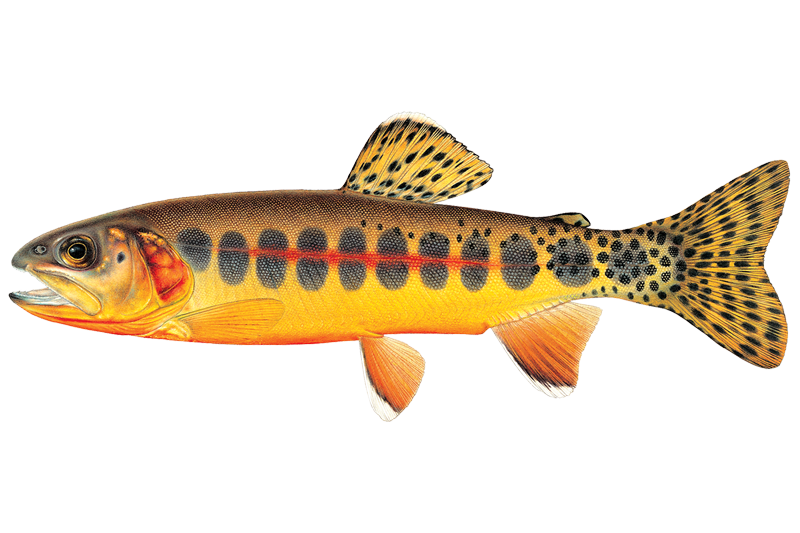
A high-elevation native of California's southern Sierra Nevada now scattered across alpine lakes and creeks throughout the western US, the golden trout is the fish you hike for.
Crimson-banded, gold-flanked, and rarely larger than ten inches in its native streams, it's prized less for size than for the country it lives in — granite cirques and meadow streams above 10,000 feet.
Scientific Name: Oncorhynchus aguabonita
Also known as California Golden Trout, Volcano Creek Golden Trout, South Fork Kern Golden Trout
- Brilliant golden-yellow flanks and belly under an olive back, with a vivid red-orange stripe running from gill plate to tail and intensifying on spawning males.
- Roughly ten dark oval parr marks remain along the lateral line into adulthood — the giveaway that separates a true golden from a hatchery palomino rainbow.
- Dorsal, anal, and lateral fins carry distinctive white leading edges; pectoral, pelvic, and anal fins show orange with a black band and pale tips.
- Stream fish average 6–12 inches with growth around an inch a year; lake-dwelling transplants reach 18–20 inches, and the world record from a Wyoming lake stands at 28 inches and 11 pounds 4 ounces.
What to know
Habitat Distribution
- Native only to Golden Trout Creek and the upper South Fork Kern River in California's southern Sierra Nevada — a tiny endemic range now reduced to less than 4% of its original stream miles.
- Stocked into high-elevation lakes and creeks across the Mountain West, with established populations in Wyoming's Wind Rivers, Montana's Beartooths, and select drainages in Utah, Washington, Idaho, and Colorado.
- A cold, thin-air specialist — most fishable water sits above 7,500 feet and often 10,000–12,000 feet, in clear, oxygen-rich, nutrient-poor systems where weed growth is minimal.
- Native streams are small, meandering meadow channels with cobble-and-gravel bottoms; introduced range skews toward granite cirque lakes that don't shed snow until well after the Fourth of July.
Specific Spots
- In streams, pools and undercut banks hold disproportionate numbers of fish — riffles get used least. Sedge mats, willow roots, and boulder pockets serve as cover and ambush stations.
- Site fidelity is extreme: a fish often spends weeks within a 50-meter section of stream, so a good pool worked carefully is worth more than a mile of water covered fast.
- On alpine lakes, walk the shoreline and watch for cruisers near inlets and outlets, where current funnels drifting insects and crustaceans into predictable lanes.
- Shallow shelves with active insect emergence are the prime feeding zones — fish patrol them in loose circuits rather than holding station.
Golden Trout FAQ
Answers from onWater's species guide.
What are the best lures and bait for Golden Trout?
Small gold or silver spinners (1/16 oz Mepps Aglia, Panther Martin) are the most consistent producer, especially cast and retrieved along lake shorelines or swung through stream pools.
What flies work for Golden Trout?
Dries are the prestige game: Elk Hair Caddis, Parachute Adams, Royal Wulff, and small attractors in 14–18 cover most surface activity. Foam ants and beetles are deadly through summer terrestrial season.
What do Golden Trout eat?
Stream fish are drift feeders working a steady mix of midges, caddis, mayflies, and stoneflies in both nymph and adult stages, Pheasant Tails, Hare's Ears, and Elk Hair Caddis cover the staples.
Where do Golden Trout live?
Native only to Golden Trout Creek and the upper South Fork Kern River in California's southern Sierra Nevada, a tiny endemic range now reduced to less than 4% of its original stream miles.
See it in the app
Most maps show you water.
onWater shows you Golden Trout.



- 01 · Species map filter
Map every Golden Trout water
Pick Golden Trout and the map zeroes in on the waters they call home. No more guessing which lake holds them.
- 02 · Waterbody species
Tap any water. See what lives there.
Species, behavior and seasonal patterns for every lake, river and pond, before you leave the driveway.
- 03 · Angler Intelligence
Ask how to catch Golden Trout
Tactics, gear and timing from onWater's AI fishing guide, tuned to the species and the water you're on.
Stop guessing where Golden Trout are.
Open the map, filter by Golden Trout, and head to water that holds them. Download onWater and plan your next trip in minutes.
- Species map filter
- Angler Intelligence
- Fishing journal
Explore other species
Trout, bass, salmon, panfish and everything in between. Each guide unpacks the behavior, seasons, and tactics that put fish in the net.
No species information available.
Smarter Fishing Starts in the App.
onWater Fish gives you everything you need to plan smarter, fish better, and own every trip from first cast to last.