Chum Salmon
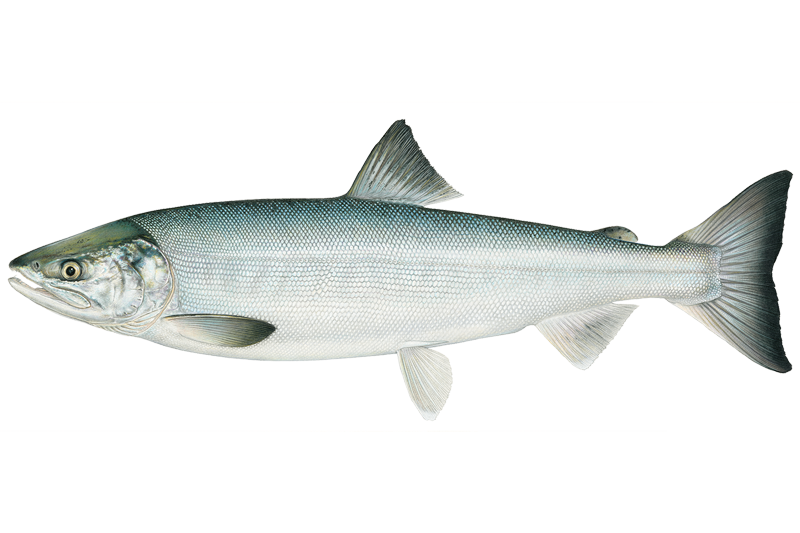
The most widely distributed Pacific salmon, chum return to rivers from Arctic Alaska down through the Pacific Northwest, often spawning closer to saltwater than any other salmon.
Second only to Chinook in size, fresh-run chum are thick, deep-bodied fish with a reputation among guides for breaking more rods than any other Pacific salmon — power that has finally earned them respect on the fly.
Scientific Name: Oncorhynchus keta
Also known as Dog Salmon, Keta Salmon, Calico Salmon, Silverbrite Salmon
- Ocean-phase fish are silvery blue-green with a deep, football-shaped body and almost no spotting — the white tip on the lower anal fin is the telltale field mark.
- In the river, both sexes develop bold red-and-black tiger stripes along the flanks, a pattern unique among Pacific salmon and the source of the 'calico salmon' name.
- Spawning males grow a hooked kype with prominent canine-like teeth — the 'dog teeth' that gave the species its other common name.
- Typical adults run 6–15 lb at around 24 inches; fish into the 20s are common and the IGFA record stands at 35 lb from British Columbia.
What to know
Habitat Distribution
- Native US range covers the Pacific coast from Arctic Alaska south to the Umpqua River in Oregon, with historical records as far south as the Sacramento. No species of Pacific salmon ranges more broadly.
- Anadromous — adults spend most of their lives in the cold North Pacific and Bering Sea (preferred ocean temperatures around 1–8°C) and only return to fresh water to spawn and die.
- Spawning habitat is unusually flexible: spring-fed side channels, large turbid mainstems, small headwater creeks, and even brackish intertidal reaches below the high-tide line all hold spawning chum.
- Alaska is the species' US stronghold; lower-48 populations are smaller and patchier, with the Hood Canal summer run and Lower Columbia stocks federally listed as Threatened.
Specific Spots
- Tidewater and the first few miles of river are prime — fish stage along the edges of sandbars and tidal flats before pushing upstream, and chrome-bright fish here fight hardest and eat most aggressively.
- Adult chum hold and travel in slow-to-moderate current deeper than four feet, so seams along gravel bars and the soft inside edges of runs are higher-percentage water than fast riffles.
- Tail-outs of deep pools and shallow gravel in lower-gradient reaches produce both staging and spawning fish — chum spawn closer to saltwater than coho in most systems they share.
- Look for visible pods. Chum push upriver in groups of dozens or more, and a single staging pod along a current break is usually worth working multiple flies and angles through.
Chum Salmon FAQ
Answers from onWater's species guide.
What are the best lures and bait for Chum Salmon?
Plugs are the boat-fishing standard: Kwikfish K13–K15 and Maglip 3.5–4.0, often wrapped with a sardine or herring fillet for scent, fished on a slow back-troll or anchor.
What flies work for Chum Salmon?
Chartreuse is the dominant color, followed by pink, cerise, hot pink, and purple/black as backups when fish go cold. Egg-sucking leeches and bunny leeches are the foundation patterns; sparser low-water flies for clear coastal creeks, bulkier weighted flies for big or stained water.
What do Chum Salmon eat?
At sea, chum eat a broader prey range than other Pacific salmon, euphausiids, amphipods, gastropods, and squid through summer, shifting to forage fish like myctophids in fall. They make daily vertical migrations through the thermocline to feed. Once in fresh water, adult chum stop feeding entirely.
Where do Chum Salmon live?
Native US range covers the Pacific coast from Arctic Alaska south to the Umpqua River in Oregon, with historical records as far south as the Sacramento. No species of Pacific salmon ranges more broadly.
See it in the app
Most maps show you water.
onWater shows you Chum Salmon.



- 01 · Species map filter
Map every Chum Salmon water
Pick Chum Salmon and the map zeroes in on the waters they call home. No more guessing which lake holds them.
- 02 · Waterbody species
Tap any water. See what lives there.
Species, behavior and seasonal patterns for every lake, river and pond, before you leave the driveway.
- 03 · Angler Intelligence
Ask how to catch Chum Salmon
Tactics, gear and timing from onWater's AI fishing guide, tuned to the species and the water you're on.
Stop guessing where Chum Salmon are.
Open the map, filter by Chum Salmon, and head to water that holds them. Download onWater and plan your next trip in minutes.
- Species map filter
- Angler Intelligence
- Fishing journal
Explore other species
Trout, bass, salmon, panfish and everything in between. Each guide unpacks the behavior, seasons, and tactics that put fish in the net.
No species information available.

Smarter Fishing Starts in the App.
onWater Fish gives you everything you need to plan smarter, fish better, and own every trip from first cast to last.