Shadow Bass
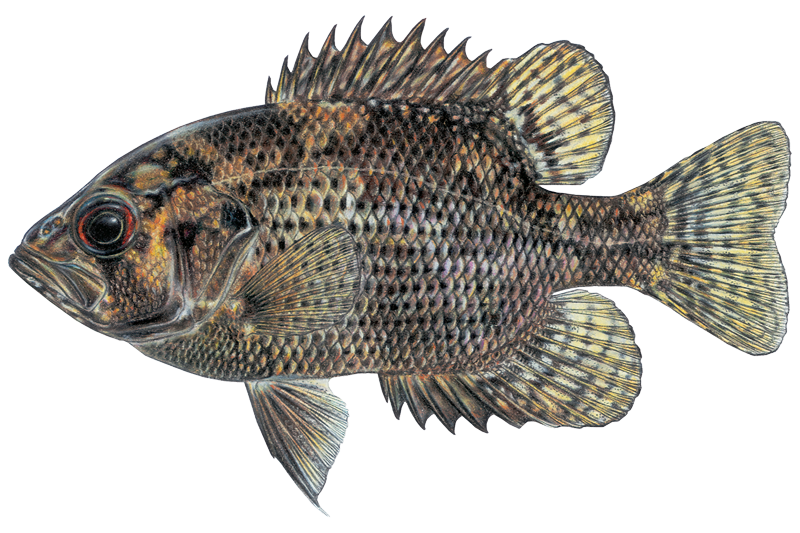
A small, native sunfish of Southeastern and Gulf-slope streams, the shadow bass is a brushy-pool specialist that punches well above its weight on light tackle.
Anglers from Alabama through Georgia and across the Ozarks have chased them as 'goggle-eye' for generations, almost always in moving water — they're rarely found in reservoirs.
Scientific Name: Ambloplites ariommus
Also known as Goggle-Eye, Red-Eye
- Olive to light brown body with 2–4 dark vertical bands and blotches along the flanks; fins are clear to pale yellow with black and gray mottling.
- Reddish-orange iris around a deep blue pupil — the trait that earned them the goggle-eye and red-eye nicknames — with a dark band running from below the eye onto the gill cover.
- Easiest separator from the similar rock bass: shadow bass have triangular spots on the scales (rock bass spots are rectangular), and they often carry a seventh anal fin spine.
- Adults typically run 6–8 inches; a 12-incher is exceptional, and the IGFA record sits at 1 lb 13 oz from the Spring River in Arkansas.
What to know
Habitat Distribution
- Native to Gulf-slope drainages from the Apalachicola system west to the lower Mississippi basin, plus Tennessee River tributaries and the Blackwater and Chattahoochee systems on the Florida–Georgia line.
- Small to medium streams and rivers are the home water — slow to moderate current, gravel, sand, or mud bottoms as long as they stay silt-free. Reservoirs almost never hold them in numbers.
- Both members of the genus react badly to siltation and degraded water; populations vanish from streams with chronic low summer flow or poor water quality.
- Some Ozark populations long called 'goggle-eye' may actually be rock bass or hybrids — taxonomy in that region is genuinely murky.
Specific Spots
- Brushy and vegetated stream pools are the core habitat — woody debris, blowdowns, and undercut banks are where adults spend most of their lives.
- Adults are solitary and territorial, often welded to a single piece of cover; if you catch one off a logjam, the next cast in the same water rarely produces a second.
- Juveniles under a couple inches stack in aquatic vegetation along pool margins, while big adults sit deeper in the pool against the heaviest structure.
- After heavy rain raises a stream, fish slide out onto sand and gravel flats they normally ignore, hunting forage knocked loose by the current.
Shadow Bass FAQ
Answers from onWater's species guide.
What are the best lures and bait for Shadow Bass?
Small inline spinners and spinnerbaits in 1/8 to 1/4 oz, Beetle Spins, Rooster Tails, are the long-running classics, fished slow and close to cover. Small soft-plastic grubs, tiny flukes on light-wire hooks, and crayfish-style hard baits like the Rebel Crawfish round out the lure box.
What flies work for Shadow Bass?
Crayfish patterns, Clouser Crayfish, Near-Nuff Crayfish, Crazi Craw, fished slow and tight to gravel, rubble, and woody cover are the most reliable producers, since they match the dominant adult forage.
What do Shadow Bass eat?
Crayfish are the centerpiece of the adult diet, which is why crayfish-imitating lures and flies, Rebel Crawfish, Clouser Crayfish, Near-Nuff Crayfish, produce so consistently when worked slow along the bottom. Big nymphs make up much of the rest: dragonfly, stonefly, and mayfly nymphs, plus hellgrammites.
Where do Shadow Bass live?
Native to Gulf-slope drainages from the Apalachicola system west to the lower Mississippi basin, plus Tennessee River tributaries and the Blackwater and Chattahoochee systems on the Florida–Georgia line.
See it in the app
Most maps show you water.
onWater shows you Shadow Bass.



- 01 · Species map filter
Map every Shadow Bass water
Pick Shadow Bass and the map zeroes in on the waters they call home. No more guessing which lake holds them.
- 02 · Waterbody species
Tap any water. See what lives there.
Species, behavior and seasonal patterns for every lake, river and pond, before you leave the driveway.
- 03 · Angler Intelligence
Ask how to catch Shadow Bass
Tactics, gear and timing from onWater's AI fishing guide, tuned to the species and the water you're on.
Stop guessing where Shadow Bass are.
Open the map, filter by Shadow Bass, and head to water that holds them. Download onWater and plan your next trip in minutes.
- Species map filter
- Angler Intelligence
- Fishing journal
Explore other species
Trout, bass, salmon, panfish and everything in between. Each guide unpacks the behavior, seasons, and tactics that put fish in the net.
No species information available.

Smarter Fishing Starts in the App.
onWater Fish gives you everything you need to plan smarter, fish better, and own every trip from first cast to last.