Brook Trout
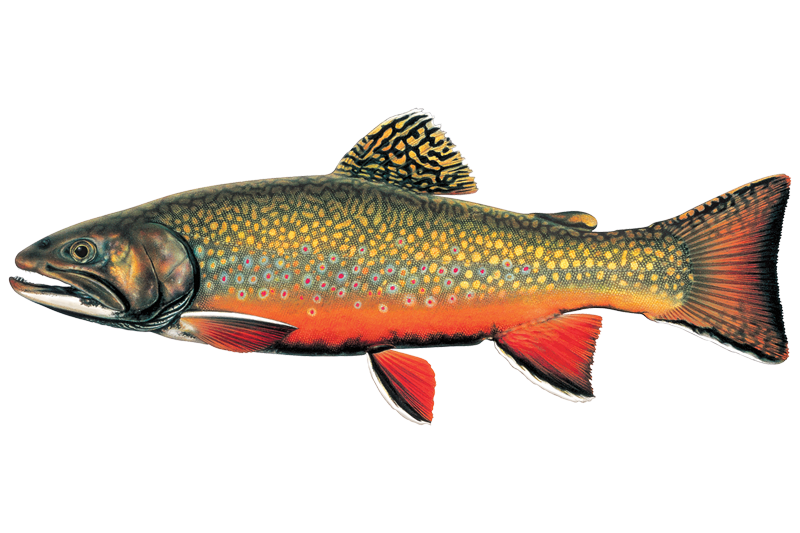
The only trout native to most of the eastern US, brook trout are technically chars — and the fish that built American sport fishing in the 19th century.
They're a cold-water specialist of clear headwater streams, beaver ponds, and alpine lakes, now established far west of their native range through stocking. A wild brookie in fall colors is among the most striking fish swimming in North America.
Scientific Name: Salvelinus fontinalis
Also known as Speckled Trout, Specks, Squaretail, Brookie, Salter, Coaster, Brook Char
- Marbled, worm-like vermiculation in lighter shades across the dark olive-to-brown back and dorsal fin — the single most diagnostic field mark separating them from any other trout or char.
- Red spots ringed with blue halos along the flanks, plus scattered yellow spots; spawning males develop flame-orange bellies bordered by a black stripe.
- Lower fins (pelvic, anal, pectoral) carry a hard white leading edge backed by a black stripe, then orange — a giveaway even at a glance.
- Stream fish typically run 6–12 inches; productive lakes and ponds produce 15–20 inch fish in the 2–5 lb class, and a 3-pounder is a trophy almost anywhere.
What to know
Habitat Distribution
- A cold-water specialist that needs sustained 55–65°F temperatures and high dissolved oxygen; experiences serious mortality as water approaches the upper 70s.
- Native across the eastern US — Great Lakes east to the Atlantic, south down the Appalachians into northern Georgia. The only trout native east of the Rockies.
- Stocked widely starting around 1850 and now established across much of the Mountain West, where they often dominate high alpine lakes and small headwater streams.
- Within their native range, extirpated from roughly 90% of historical waters by damming, deforestation, siltation, and competition from introduced brown and rainbow trout — making strong wild populations a real indicator of watershed health.
Specific Spots
- In streams, fish need three things in close proximity: a deeper pool to rest in, a feeding station near a riffle or current seam, and overhead escape cover — undercut banks, root wads, woody debris, ledge rock.
- Holding lies are usually out of the main current at velocities around half a foot per second — eddies, pool tailouts, the soft water behind boulders.
- Where browns or rainbows share the water, brookies retreat to the upstream end of the system: small tributaries and headwaters where they're the only salmonid.
- In summer, cold tributary mouths and groundwater seeps become magnets — fish stack on these thermal refuges when the main flow climbs past 68°F.
Brook Trout FAQ
Answers from onWater's species guide.
What are the best lures and bait for Brook Trout?
Inline spinners in 1/16–1/8 oz, Mepps Aglia, Panther Martin, Blue Fox Vibrax, Rooster Tail, are the most versatile presentation across streams and lakes. Gold blades for most conditions, silver in bright clear water, copper on overcast days.
What flies work for Brook Trout?
Attractor dries, Royal Wulff, Stimulator, Elk Hair Caddis (caddis imitation), Parachute Adams (a generic mayfly), foam hoppers, are the starting point on mountain streams. Brookies will rise to a bold attractor even with nothing hatching.
What do Brook Trout eat?
Aquatic insects drive most of the daily diet, mayflies, caddis, stoneflies, and midges, which is exactly what Hare's Ear and Pheasant Tail nymphs imitate subsurface, and what Elk Hair Caddis and Parachute Adams imitate on top.
Where do Brook Trout live?
A cold-water specialist that needs sustained 55–65°F temperatures and high dissolved oxygen; experiences serious mortality as water approaches the upper 70s. Native across the eastern US, Great Lakes east to the Atlantic, south down the Appalachians into northern Georgia. The only trout native east of the Rockies.
See it in the app
Most maps show you water.
onWater shows you Brook Trout.



- 01 · Species map filter
Map every Brook Trout water
Pick Brook Trout and the map zeroes in on the waters they call home. No more guessing which lake holds them.
- 02 · Waterbody species
Tap any water. See what lives there.
Species, behavior and seasonal patterns for every lake, river and pond, before you leave the driveway.
- 03 · Angler Intelligence
Ask how to catch Brook Trout
Tactics, gear and timing from onWater's AI fishing guide, tuned to the species and the water you're on.
Stop guessing where Brook Trout are.
Open the map, filter by Brook Trout, and head to water that holds them. Download onWater and plan your next trip in minutes.
- Species map filter
- Angler Intelligence
- Fishing journal
Explore other species
Trout, bass, salmon, panfish and everything in between. Each guide unpacks the behavior, seasons, and tactics that put fish in the net.
No species information available.
Smarter Fishing Starts in the App.
onWater Fish gives you everything you need to plan smarter, fish better, and own every trip from first cast to last.