Alabama Bass
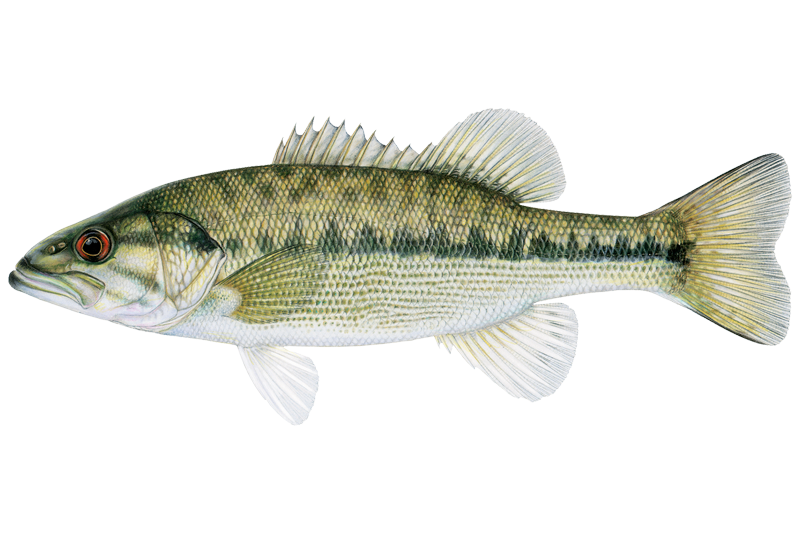
A native of the Mobile Bay drainage that's quietly become one of the more consequential black bass in the country — both a legitimate gamefish in its home rivers and a problem child everywhere it's been moved.
Heavier and longer-lived than the true Spotted Bass it was split from in 2008, it favors rocky, current-swept water across the Southeast and a handful of introduced western reservoirs.
Scientific Name: Micropterus henshalli
Also known as Alabama Spotted Bass, Coosa Spotted Bass
- Greenish-bronze back fading to a pale belly, with dark vertical bars along the sides that often look broken or smudged and frequently fade out on bigger adults.
- The clincher for separating it from a true Spotted Bass: lateral line scales count 71 or more (usually 68-84), the head is narrower, and the tongue tooth patch is smaller.
- Mouth reaches to roughly the back edge of the eye — bigger than a Spotted Bass's, smaller than a Largemouth's — and the dorsal fin is only shallowly notched, not nearly cut in two.
- Common adults run 12-16 inches; fish over 20 inches show up regularly in good water, and the IGFA all-tackle record sits around 10.27 lb out of California.
What to know
Habitat Distribution
- Native only to the Mobile Bay basin — the Alabama, Tallapoosa, Coosa, Cahaba, Black Warrior, and Tombigbee drainages across a small slice of the Deep South.
- Now established well outside that home range through bait-bucket transfers and unauthorized stockings, including reservoirs across the broader Southeast, the Mid-Atlantic, Texas, and the Sacramento-San Joaquin system in California.
- A clear-water, hard-bottom fish: most abundant in deeper pools, river channels, and impoundments with rocky or gravel substrate, and noticeably scarce in turbid mud-bottomed water or brackish reaches.
- Comfort zone runs roughly 65-80°F, and the species does well in both flowing rivers and reservoirs — the habitat flexibility is a big reason it spreads so aggressively.
Specific Spots
- Boulder fields, ledges, and rocky drop-offs hold fish year-round — they orient to hard structure the way smallmouth do, not to wood and grass like largemouth.
- Tailwaters below dams and current seams in river pools are prime; fish stack on the soft side of the seam where crayfish tumble through.
- In reservoirs they pull offshore to deep ledges and humps during the day and slide shallow at night — a daily migration largemouth in the same lake don't make.
- When sharing nearshore water with largemouth at night, they sit deeper on the same break, so probing the outer edge of a likely bank often picks them off.
Alabama Bass FAQ
Answers from onWater's species guide.
What are the best lures and bait for Alabama Bass?
Jigs are the year-round default, football jigs for offshore rock, swim jigs along banks, finesse jigs for pressured fish, with crawfish colors leading the spring and fall bite. Crankbaits cover water effectively: deep-divers in shad or craw patterns for offshore ledges, squarebills banged off shallow rock.
What flies work for Alabama Bass?
Crayfish patterns, Clouser Crayfish, EP Crayfish, and similar weighted ties, fished on the bottom with short, deliberate strips around boulders and ledges. These imitate the species' top forage and play to its rocky-structure habit.
What do Alabama Bass eat?
Crayfish are the centerpiece given the rocky habitat, especially through fall and the pre-spawn, a brown or red football jig, craw-pattern crankbait, or tube on a Texas rig is essentially a crayfish in lure form.
Where do Alabama Bass live?
Native only to the Mobile Bay basin, the Alabama, Tallapoosa, Coosa, Cahaba, Black Warrior, and Tombigbee drainages across a small slice of the Deep South.
See it in the app
Most maps show you water.
onWater shows you Alabama Bass.



- 01 · Species map filter
Map every Alabama Bass water
Pick Alabama Bass and the map zeroes in on the waters they call home. No more guessing which lake holds them.
- 02 · Waterbody species
Tap any water. See what lives there.
Species, behavior and seasonal patterns for every lake, river and pond, before you leave the driveway.
- 03 · Angler Intelligence
Ask how to catch Alabama Bass
Tactics, gear and timing from onWater's AI fishing guide, tuned to the species and the water you're on.
Stop guessing where Alabama Bass are.
Open the map, filter by Alabama Bass, and head to water that holds them. Download onWater and plan your next trip in minutes.
- Species map filter
- Angler Intelligence
- Fishing journal
Explore other species
Trout, bass, salmon, panfish and everything in between. Each guide unpacks the behavior, seasons, and tactics that put fish in the net.
No species information available.

Smarter Fishing Starts in the App.
onWater Fish gives you everything you need to plan smarter, fish better, and own every trip from first cast to last.