Rainbow Trout
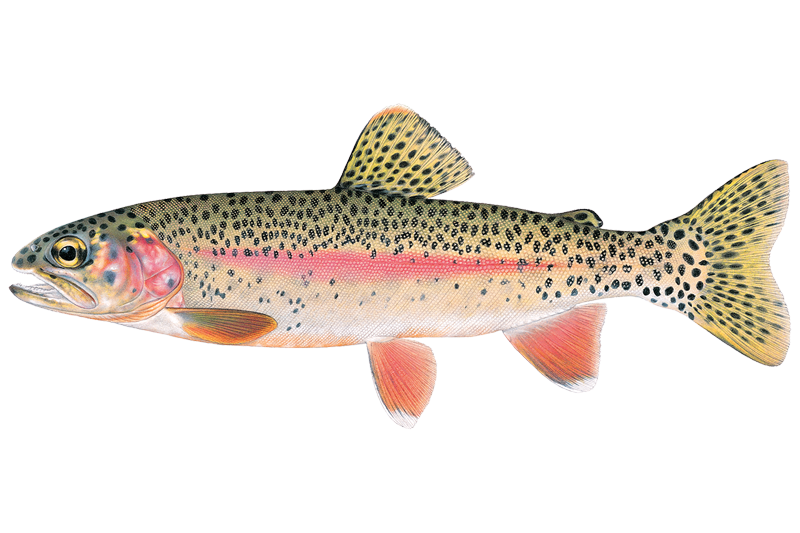
Rainbow trout are the backbone of North Island trout fishing and a major draw across the South Island's alpine lakes.
Introduced from North American stock as early as 1883, they've established self-sustaining wild populations that now define New Zealand's freshwater fishery.
The Lake Taupo system alone — fed by the Tongariro and its sister tributaries — produces fish that rival anything in their native range, with 3–6 lb fish common and genuine double-digit rainbows caught every season.
Scientific Name: Oncorhynchus mykiss
Also known as Rainbow, bow, Taupo rainbow
- Silver-bodied with a dark olive-green back; a pink-to-red lateral band runs from the gill plate toward the tail, intensifying during spawning.
- Dark spots scattered across the back, sides, and — critically — the tail fin; those tail spots separate rainbows from brown trout and Atlantic salmon at a glance.
- Lake fish are often uniformly bright silver with faint spotting; river fish show stronger olive tones and a bolder pink stripe.
- Typical weight 1–2 kg in most rivers; fish in the Taupo system and South Island alpine lakes regularly reach 5 kg, with occasional fish exceeding 7 kg.
What to know
Habitat Distribution
- Introduced — not native to New Zealand; original ova came from Sonoma Creek, California, with first releases in the 1880s.
- Strongest populations in the central North Island: Lake Taupo and its spawning tributaries (Tongariro, Tauranga-Taupo, Waitahanui) form the heart of the fishery.
- South Island populations concentrate in the lakes along the eastern flanks of the Southern Alps and in the clear, braided rivers that drain the range.
- Found in cold, well-oxygenated rivers, streams, and lakes; lake-dwelling fish use rivers and streams for spawning runs.
Key Locations
- Lake Taupo and the Tongariro River (North Island) — the Taupo system is the centre of New Zealand rainbow fishing, with large lake-run fish moving into the Tongariro and other tributaries to spawn.
- Tūrangi (North Island) — the town sits at the Tongariro's mouth and serves as the base for most Taupo tributary fishing; the river's named pools hold fish through the winter run.
- Central Plateau rivers, North Island — the Waitahanui, Tauranga-Taupo, and Hinemaiaia all carry Taupo rainbows and receive less pressure than the Tongariro.
- South Island alpine lakes and their feeder streams — lakes along the eastern flanks of the Southern Alps support healthy rainbow populations; the clear, braided rivers draining the range offer classic sight-fishing.
Specific Spots
- Behind and alongside large boulders in fast runs — fish hold in the reduced current and dart out to intercept food drifting past.
- The tail of a pool where current accelerates over a gravel lip; rainbows stack here to feed on nymphs tumbling through the transition zone.
- Deep, glassy pools in clear rivers — in New Zealand's transparent water, fish are often visible holding mid-column; approach from downstream and stay low.
- Lake tributaries during spawning runs — fish congregate at river mouths and move progressively upstream; the Tongariro's pools (Judges, Major Jones, the Stump) are classic holding water.
Rainbow Trout FAQ
Answers from onWater's species guide.
What are the best lures and bait for Rainbow Trout?
Small spinners (Mepps-style) and spoons in silver or gold work well in rivers, covering water quickly when fish aren't visible. For Taupo lake fishing, harling with small minnow-profile lures or trolling smelt-imitating soft-baits near river mouths at dawn accounts for many of the region's larger fish.
What flies work for Rainbow Trout?
Nymphs are the workhorse: Pheasant Tail (imitates mayfly nymphs), Hare's Ear (mayfly and caddis), and Copper John are all proven. New Zealand guides often fish heavy two-nymph rigs, a weighted point fly with a smaller dropper, dead-drifted through pools and runs.
When is the best time to fish for Rainbow Trout?
Winter and spring (June–October), peak season on the Taupo tributaries as lake-run rainbows move into the Tongariro and other rivers to spawn; the Tongariro fishes through the coldest months.
How do you catch Rainbow Trout?
On the North Island, most anglers fish the Taupo tributaries with nymph rigs dead-drifted through named pools, either wading or working the banks.
What do Rainbow Trout eat?
Aquatic insects, mayfly nymphs, caddis larvae, and midges, make up the bulk of the diet in rivers. A Pheasant Tail or Hare's Ear nymph dead-drifted (carried naturally by the current with no added action) through a run covers the mayfly and caddis bases for beginners.
See it in the app
Most maps show you water.
onWater shows you Rainbow Trout.



- 01 · Species map filter
Map every Rainbow Trout water
Pick Rainbow Trout and the map zeroes in on the waters they call home. No more guessing which lake holds them.
- 02 · Waterbody species
Tap any water. See what lives there.
Species, behavior and seasonal patterns for every lake, river and pond, before you leave the driveway.
- 03 · Angler Intelligence
Ask how to catch Rainbow Trout
Tactics, gear and timing from onWater's AI fishing guide, tuned to the species and the water you're on.
Stop guessing where Rainbow Trout are.
Open the map, filter by Rainbow Trout, and head to water that holds them. Download onWater and plan your next trip in minutes.
- Species map filter
- Angler Intelligence
- Fishing journal
Explore other species
Trout, bass, salmon, panfish and everything in between. Each guide unpacks the behavior, seasons, and tactics that put fish in the net.
No species information available.
Smarter Fishing Starts in the App.
onWater Fish gives you everything you need to plan smarter, fish better, and own every trip from first cast to last.