Chinook Salmon
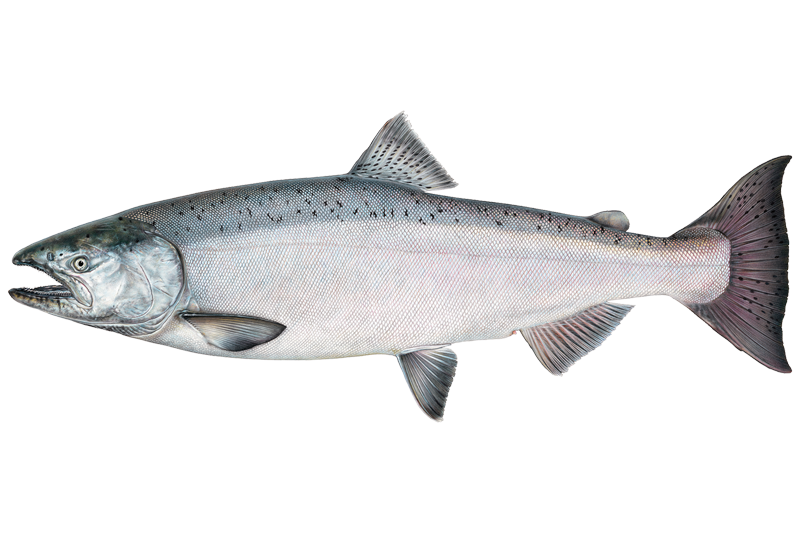
Chinook salmon — called quinnat or king salmon by most Kiwi anglers — were introduced from California's McCloud River in 1901 and established self-sustaining runs in South Island rivers by 1905.
Sea-run fish migrate up east coast South Island rivers between December and April, drawing lines of anglers to river mouths. Landlocked populations also exist in Canterbury and Otago lakes and canals.
Scientific Name: Oncorhynchus tshawytscha
Also known as Quinnat salmon, King salmon
- Black gums and black mouth lining — the clearest field mark separating Chinook from other salmonids in New Zealand waters.
- Silver-sided with small black spots on the back, dorsal fin, and both lobes of the tail; body deepens and darkens to bronze-red as spawning approaches.
- New Zealand's largest salmonid: sea-run fish commonly reach 10–15 kg, with some fish historically exceeding 13 kg (30 lb).
What to know
Habitat Distribution
- Introduced — not native to New Zealand. Eggs arrived from the Sacramento River system in California; self-sustaining runs established by the early 1900s.
- Sea-run fish are found predominantly in east coast South Island rivers, from the Nelson/Marlborough region south through Canterbury and Otago to Southland.
- Landlocked populations live in South Island lakes and hydro canals, including Lake Coleridge and the Mackenzie Basin canal system.
- Juveniles use cold, fast-flowing snow-fed rivers; adults feed and grow at sea before returning to freshwater to spawn in autumn.
Key Locations
- Waimakariri River (Canterbury) — one of the most fished sea-run salmon rivers on the South Island, with a well-known run and easy access from Christchurch.
- Rakaia River (Canterbury) — a major salmon river with a long history of strong runs; the lower river and mouth are heavily fished during the migration.
- Rangitata River (Canterbury) — another key North Canterbury sea-run river where a sea-run salmon licence is required.
- Mackenzie Basin hydro canals and Lake Coleridge — landlocked salmon fisheries that fish differently from river runs; no sea-run licence required.
- Clutha River (Otago) and Paringa River (West Coast) — sea-run fish present but outside the North Canterbury/Central South Island licence zone.
Specific Spots
- River mouths and tidal reaches draw the most fish — and the most anglers — as fresh-run salmon stage before pushing upstream; fish caught here are in the best condition.
- Deep pools and current seams below rapids give migrating fish a resting point; work the slower water on the downstream edge of fast runs.
- Gravel runs and riffles in the mid-river are spawning habitat in autumn — fish are present but deteriorating in condition the further upstream they travel.
- In lakes and canals, fish cruise drop-offs and channel edges rather than holding in current; trolling along depth changes covers the most water.
Chinook Salmon FAQ
Answers from onWater's species guide.
What are the best lures and bait for Chinook Salmon?
Large spinners (Toby-style and similar blade lures) in silver, gold, or bright colours are the go-to for sea-run fish at river mouths and in the lower river, the flash and vibration trigger a reaction strike from non-feeding fish.
What flies work for Chinook Salmon?
Large, bright streamers, Woolly Buggers and Bunny Leeches in orange, pink, red, or chartreuse, are the core fly for sea-run fish; the colour and movement provoke a strike from fish that aren't feeding.
When is the best time to fish for Chinook Salmon?
December–April: the main sea-run migration window, when fish enter South Island east coast rivers from the ocean; the freshest, strongest fish arrive earliest in the season. Autumn (March–May): spawning occurs in river gravel; fish are present but in declining condition the further upstream and later in the season.
How do you catch Chinook Salmon?
Most anglers fish the lower river and river mouth during the December–April migration window, casting spinners or swinging flies across current into holding pools. Bank fishing with spinning gear is the most common approach; fly anglers use Spey or single-handed rods to swing bright streamers through the same water.
What do Chinook Salmon eat?
Sea-run fish stop feeding once they enter freshwater on their spawning migration, flies and lures work by triggering an aggressive territorial or instinctive strike response, not hunger. Bright attractor patterns and large spinners are standard for this reason.
See it in the app
Most maps show you water.
onWater shows you Chinook Salmon.



- 01 · Species map filter
Map every Chinook Salmon water
Pick Chinook Salmon and the map zeroes in on the waters they call home. No more guessing which lake holds them.
- 02 · Waterbody species
Tap any water. See what lives there.
Species, behavior and seasonal patterns for every lake, river and pond, before you leave the driveway.
- 03 · Angler Intelligence
Ask how to catch Chinook Salmon
Tactics, gear and timing from onWater's AI fishing guide, tuned to the species and the water you're on.
Stop guessing where Chinook Salmon are.
Open the map, filter by Chinook Salmon, and head to water that holds them. Download onWater and plan your next trip in minutes.
- Species map filter
- Angler Intelligence
- Fishing journal
Explore other species
Trout, bass, salmon, panfish and everything in between. Each guide unpacks the behavior, seasons, and tactics that put fish in the net.
No species information available.

Smarter Fishing Starts in the App.
onWater Fish gives you everything you need to plan smarter, fish better, and own every trip from first cast to last.