Brown Trout
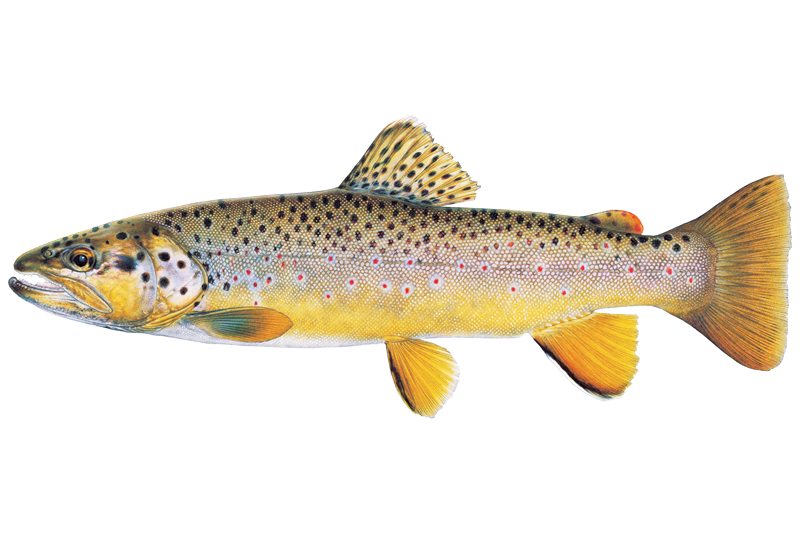
Brown trout are the backbone of New Zealand's freshwater fishery. Introduced from British stock via Tasmania in the late 1860s, they've colonised rivers, lakes, and streams across both islands.
The South Island — particularly the Nelson/Murchison area and the Southern Alps drainages — draws anglers from around the world for sight-fishing to large, wild fish in gin-clear water.
South Island browns average 4–5 pounds, with double-digit fish a real possibility.
Scientific Name: Salmo trutta
Also known as Brownie, Kōaro (sometimes confused locally), sea-run brown
- Brown to yellow-brown body with black spots on the upper flanks surrounded by pale halos, and red spots lower down — particularly vivid on river fish.
- Tail is largely unspotted, which is the quickest way to tell a brown from a rainbow trout in hand.
- Sea-run and lake fish are much more silvery overall; river fish are darker and more richly coloured.
- South Island river fish commonly run 4–5 lbs; fish over 10 lbs are caught and are the benchmark for a serious trip.
What to know
Habitat Distribution
- Introduced — not native to New Zealand — but now the most widespread introduced fish in the country, present in waters across both the North and South Islands.
- The South Island is the heartland: cool, clear freestone rivers draining the Southern Alps, plus large lakes like Te Anau, hold the densest populations of large fish.
- The Nelson/Murchison area — including the Owen, Motueka (the 'Mot'), and surrounding rivers — is regarded as one of the finest brown trout fisheries anywhere.
- Some fish are sea-run, moving between rivers and coastal waters; tagged fish have been tracked moving significant distances along the coast between river systems.
Key Locations
- Motueka River (the 'Mot'), Nelson/Tasman — classic South Island sight-fishing water; sparse fish population but large, wild browns.
- Murchison/Nelson Lakes area — within an hour of dozens of quality brown trout rivers and streams; widely regarded as the heart of the South Island fishery.
- Lake Te Anau and its tributaries, Fiordland — holds both large lake fish and sea-run browns; also one of the few places Atlantic salmon share the water with browns.
- Tongariro River, North Island — a major fishery drawing fish from Lake Taupo; known for large browns as well as rainbow trout.
Specific Spots
- In clear South Island rivers, fish hold in the tail of pools and along current seams where drifting food is funnelled — sight-fishing from high banks or boulders is how guides locate them.
- Large boulders and undercut banks provide shade and break the current; browns sit just off the edge where they can intercept food without fighting the full flow.
- Glassy pool heads and slow flats are prime feeding lies, especially during a hatch — fish become visible as they rise or tip up to take nymphs near the surface.
- Lake fish concentrate near inlet streams and drop-offs, particularly when rivers warm in summer and fish seek cooler, oxygenated water.
Brown Trout FAQ
Answers from onWater's species guide.
What are the best lures and bait for Brown Trout?
Small spinners (Mepps-style) and spoons work well in rivers, cast upstream and retrieved through likely lies, the flash and vibration draw strikes from fish that won't move far for a fly.
What flies work for Brown Trout?
Nymphs are the workhorse: Pheasant Tail (mayfly nymph imitation) and Hare's Ear (general nymph/emerger) fished under an indicator or as a tight-line rig account for the majority of fish.
When is the best time to fish for Brown Trout?
The general trout season runs October through April across most regions, covering the New Zealand spring, summer, and early autumn. Summer (December–February) brings low, clear water on South Island rivers, prime sight-fishing conditions, but fish are at their most alert.
How do you catch Brown Trout?
Sight-fishing is the defining approach on South Island rivers, anglers wade or walk the bank slowly, spotting individual fish before presenting a fly. Guides routinely climb banks or boulders to locate fish from above.
What do Brown Trout eat?
Aquatic insects, mayfly nymphs, caddis larvae, and stoneflies, make up the bulk of the diet in South Island rivers. Because hatches in New Zealand are less dramatic than in North America, fish feed more steadily across a range of food rather than keying hard on a single bug, which makes them willing to eat...
See it in the app
Most maps show you water.
onWater shows you Brown Trout.



- 01 · Species map filter
Map every Brown Trout water
Pick Brown Trout and the map zeroes in on the waters they call home. No more guessing which lake holds them.
- 02 · Waterbody species
Tap any water. See what lives there.
Species, behavior and seasonal patterns for every lake, river and pond, before you leave the driveway.
- 03 · Angler Intelligence
Ask how to catch Brown Trout
Tactics, gear and timing from onWater's AI fishing guide, tuned to the species and the water you're on.
Stop guessing where Brown Trout are.
Open the map, filter by Brown Trout, and head to water that holds them. Download onWater and plan your next trip in minutes.
- Species map filter
- Angler Intelligence
- Fishing journal
Explore other species
Trout, bass, salmon, panfish and everything in between. Each guide unpacks the behavior, seasons, and tactics that put fish in the net.
No species information available.
Smarter Fishing Starts in the App.
onWater Fish gives you everything you need to plan smarter, fish better, and own every trip from first cast to last.