Brook Trout
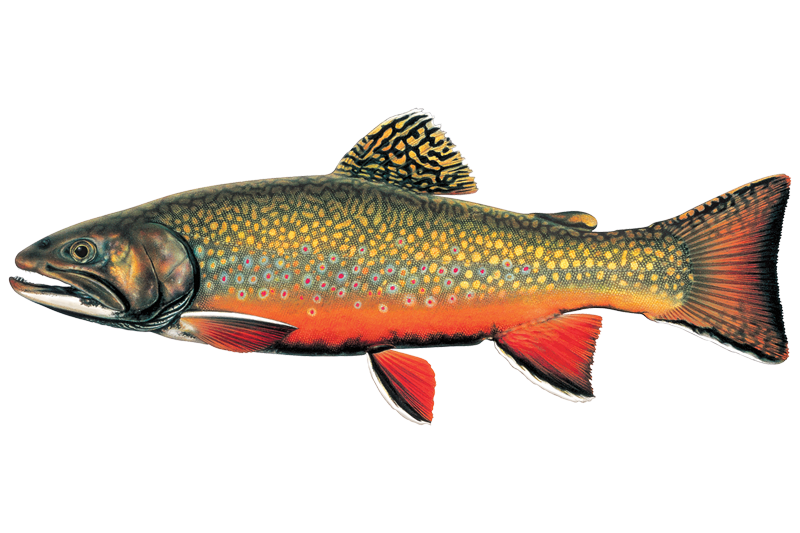
Brook trout — or brook char, as Fish & Game and NIWA prefer — were introduced to New Zealand in the late 1870s and never quite took hold the way brown and rainbow trout did.
Stream populations are mostly small and stunted, squeezed into tiny headwater tributaries where they can't compete with other salmonids.
The real fishing is in a handful of South Island lakes, where char grow to worthwhile size and attract anglers who want something different.
Scientific Name: Salvelinus fontinalis
Also known as Brook char, brookie, eastern brook trout
- Dark olive back with distinctive worm-like marbling (vermiculations); sides carry gold spots and vivid red spots ringed with pale blue halos — unmistakable in hand.
- Leading edges of pelvic, pectoral and anal fins show a crisp white stripe followed by a black stripe — the clearest single ID feature separating them from brown or rainbow trout.
- Very large mouth extending well behind the rear edge of the eye, noticeably bigger relative to head size than on a brown trout of the same length.
- Lake fish in productive South Island waters can reach around 2 kg; stream fish are typically much smaller and often stunted.
What to know
Habitat Distribution
- Introduced — native to eastern North America, first released in New Zealand in the late 1870s or early 1880s.
- South Island populations are the most established; fish have been released across virtually all major east-coast catchments and several lake systems.
- North Island populations are now limited to just three or four rivers in the Central North Island.
- River fish are confined to very small headwater tributaries where they don't have to share water with brown or rainbow trout; lake populations are larger and more fishable.
Key Locations
- Lake Emily, Ashburton River catchment (Canterbury, South Island) — the most cited productive lake fishery, with fish reaching around 2 kg.
- Small headwater tributaries across the east coast of the South Island — widespread but fish are typically small and stunted.
- Central North Island — a handful of rivers still hold brook char, though populations are limited.
Specific Spots
- In lakes, focus on shallower margins and inlet streams — brook char use these areas to feed and stage, especially in cooler months.
- In streams, look for any pool or undercut bank in the smallest tributaries; these fish hold tight to cover because the water is narrow and they have nowhere else to go.
- Brook char avoid water where brown or rainbow trout are present in numbers — if you're finding them, you're usually in the upper reaches above natural barriers like waterfalls.
Brook Trout FAQ
Answers from onWater's species guide.
What are the best lures and bait for Brook Trout?
Small spinners and spoons in the 2–5 g range work well, particularly those with red or orange elements, consistent with the noted attraction to red colouration. Small soft-plastic grubs or worm imitations on a light jig head cover stream and lake-margin fishing where casting room is tight.
What flies work for Brook Trout?
Small nymphs, Pheasant Tail (imitates mayfly nymphs) and Hare's Ear (imitates a range of aquatic invertebrates) in sizes 14–18, are reliable year-round in both streams and lakes.
When is the best time to fish for Brook Trout?
Summer (December–February), lake fish are active and accessible along margins; stream fish can be found in small tributaries throughout the season. Autumn (March–May), fish move toward spawning areas as water cools; this can concentrate fish and improve fishing near inlet streams and gravel runs.
How do you catch Brook Trout?
Most deliberate brook char fishing in New Zealand targets lake populations, particularly Lake Emily, where fish grow large enough to be worthwhile. Shore-based fly fishing or light spinning along lake margins and near inlet streams is the typical approach.
What do Brook Trout eat?
Invertebrates make up the bulk of the diet, aquatic insects including mayfly nymphs, caddis larvae, and small stoneflies. A Pheasant Tail (imitates mayfly nymphs) or a small Hare's Ear (imitates a range of nymphs) covers most situations.
See it in the app
Most maps show you water.
onWater shows you Brook Trout.



- 01 · Species map filter
Map every Brook Trout water
Pick Brook Trout and the map zeroes in on the waters they call home. No more guessing which lake holds them.
- 02 · Waterbody species
Tap any water. See what lives there.
Species, behavior and seasonal patterns for every lake, river and pond, before you leave the driveway.
- 03 · Angler Intelligence
Ask how to catch Brook Trout
Tactics, gear and timing from onWater's AI fishing guide, tuned to the species and the water you're on.
Stop guessing where Brook Trout are.
Open the map, filter by Brook Trout, and head to water that holds them. Download onWater and plan your next trip in minutes.
- Species map filter
- Angler Intelligence
- Fishing journal
Explore other species
Trout, bass, salmon, panfish and everything in between. Each guide unpacks the behavior, seasons, and tactics that put fish in the net.
No species information available.

Smarter Fishing Starts in the App.
onWater Fish gives you everything you need to plan smarter, fish better, and own every trip from first cast to last.