Rainbow Trout
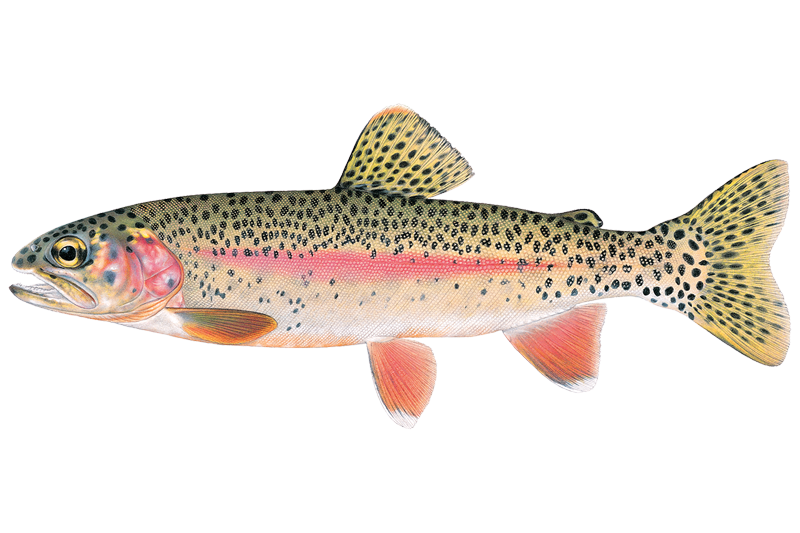
Rainbow trout are not native to the Netherlands — they're a North American species stocked into commercial put-and-take ponds and a handful of larger lakes.
Dutch waters are generally too warm and lack the clean gravel beds the fish need to reproduce, so nearly every rainbow caught here came from a stocking truck.
That makes this a managed fishery, but a genuinely popular one, drawing beginners and fly anglers alike.
Scientific Name: Oncorhynchus mykiss
Also known as Regenboogforel
- Torpedo-shaped body with an olive-green to blue-grey back, silvery-white belly, and the distinctive broad pink-purple stripe running the length of the flank.
- Small black spots scattered across the back, sides, and tail fin; a small adipose fin behind the dorsal fin marks it as a salmonid — same family as salmon and brown trout.
- In Dutch put-and-take waters, most fish run 30–50 cm; stocked specimens can push past 60 cm.
What to know
Habitat Distribution
- Not native to the Netherlands — introduced from western North America and maintained entirely through stocking; wild reproduction is extremely rare in Dutch conditions.
- Found almost exclusively in commercial trout ponds and put-and-take fisheries spread across the country, from Lelystad to Zwolle.
- A small number of larger lakes also hold stocked rainbows — Oostvoornse Meer near Rotterdam is the best-known open-water example, along with Geestmerambacht and Lauwersmeer.
- Dutch waters are generally too warm and lack suitable spawning gravel, so self-sustaining populations do not establish.
Key Locations
- Oostvoornse Meer (near Rotterdam) — one of the few open lakes in the Netherlands with stocked rainbows; fly fishing with a sinking line is recommended here.
- Geestmerambacht — a recreational lake complex in Noord-Holland known for stocked trout alongside other species.
- Lauwersmeer — a large lake in the north where trout have been stocked among brackish-influenced waters.
- Toms Creek Lelystad and Toms Creek Zwolle — dedicated commercial fishing parks with multiple trout ponds, tackle shops, and on-site facilities including a fish smokehouse.
Specific Spots
- In put-and-take ponds, freshly stocked fish often hold near the surface or mid-water in open areas — work the whole water column until you find where they're sitting that day.
- During warm weather, rainbows drop to the deepest, coolest part of the pond; a sinking line or weighted rig gets your presentation down to them.
- In open lakes like Oostvoornse Meer, fish along drop-offs and depth transitions where cooler water collects — trout follow the thermocline rather than holding tight to structure.
- Early morning and evening, fish move shallower to feed; midday in summer, go deeper or switch to slower, bottom-oriented presentations.
Rainbow Trout FAQ
Answers from onWater's species guide.
What are the best lures and bait for Rainbow Trout?
Small spinners (size 0–2) and trout spoons are consistently effective, especially on freshly stocked fish that are still actively hunting, gold and silver finishes cover most conditions.
What flies work for Rainbow Trout?
Dry flies during spring and autumn hatches: an Elk Hair Caddis imitates adult caddisflies riding the surface, and a Parachute Adams covers general mayfly activity, fish them dead-drift (letting the fly float naturally with the current or surface drift, without drag).
When is the best time to fish for Rainbow Trout?
Spring (March–May), water temperatures drop into the ideal range and insect hatches begin; one of the most productive periods, especially for fly fishing with dry flies and nymphs.
How do you catch Rainbow Trout?
The vast majority of Dutch rainbow trout fishing happens in commercial put-and-take ponds, fished from the bank. Fly fishing and light spinning are both well-suited to these waters; the Bombarda (a weighted casting float that lets you present a fly or light lure at distance without a fly rod) is also widely used.
What do Rainbow Trout eat?
Rainbows feed on aquatic insects (mayflies, caddisflies, midges), small crustaceans, and small fish, in put-and-take ponds they also respond readily to scent-based baits like Powerbait, which mimics the pellet feed they were raised on.
See it in the app
Most maps show you water.
onWater shows you Rainbow Trout.



- 01 · Species map filter
Map every Rainbow Trout water
Pick Rainbow Trout and the map zeroes in on the waters they call home. No more guessing which lake holds them.
- 02 · Waterbody species
Tap any water. See what lives there.
Species, behavior and seasonal patterns for every lake, river and pond, before you leave the driveway.
- 03 · Angler Intelligence
Ask how to catch Rainbow Trout
Tactics, gear and timing from onWater's AI fishing guide, tuned to the species and the water you're on.
Stop guessing where Rainbow Trout are.
Open the map, filter by Rainbow Trout, and head to water that holds them. Download onWater and plan your next trip in minutes.
- Species map filter
- Angler Intelligence
- Fishing journal
Explore other species
Trout, bass, salmon, panfish and everything in between. Each guide unpacks the behavior, seasons, and tactics that put fish in the net.
No species information available.
Smarter Fishing Starts in the App.
onWater Fish gives you everything you need to plan smarter, fish better, and own every trip from first cast to last.