Pumpkinseed
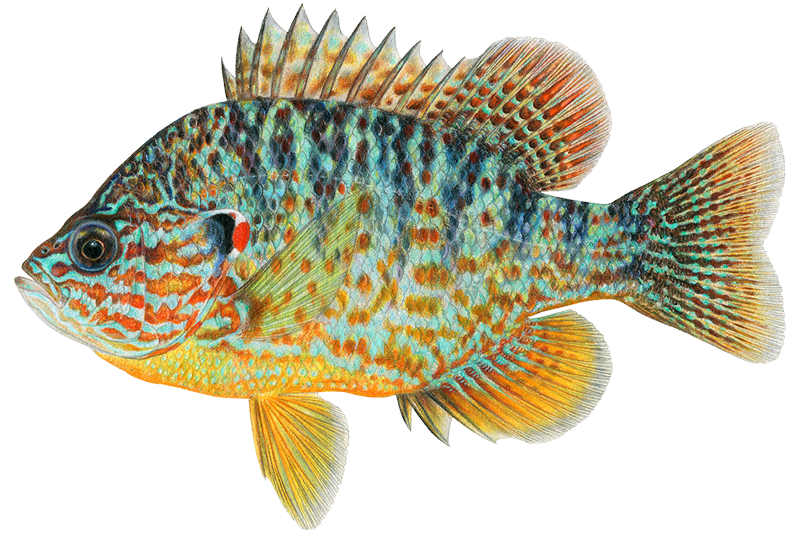
The pumpkinseed arrived in the Netherlands in 1902 as an aquarium and garden pond fish and has since spread across much of the country.
It's now one of the most widespread non-native freshwater fish here — small, brilliantly colored, and willing to bite almost anything small you put in front of it. For beginners and kids especially, it punches well above its weight as a target species.
Scientific Name: Lepomis gibbosus
Also known as Zonnebaars, pond perch, common sunfish
- Deep, disc-shaped body, strongly flattened side-to-side — looks almost circular in profile, which makes it unmistakable in hand.
- Olive-green back with blue and orange spots; flanks show vivid turquoise and orange horizontal stripes unlike any native Dutch species.
- The key ID mark: a black 'ear spot' on the rear edge of the gill cover, ringed in bright red or orange — looks like a false eye.
- Most fish run 8–15 cm; anything over 20 cm is a genuine specimen. Rarely exceeds 30 cm anywhere in its range.
What to know
Habitat Distribution
- Introduced — not native to the Netherlands or Europe. First brought over in 1902 as an ornamental fish; now established widely across the country.
- Especially abundant in moorland pools, fishing ponds, and urban park waters — anywhere shallow, warm, and weedy.
- Thrives in still or very slow-moving water with dense aquatic vegetation; rarely found in fast-flowing rivers or deep, cold lakes.
- Isolated ponds near human habitation and infrastructure tend to have the highest densities, reflecting ongoing accidental or deliberate releases.
Key Locations
- Moorland pools (vennen) across the Veluwe and Brabant heathlands — isolated, warm, and weedy, these are classic pumpkinseed habitat.
- Urban park ponds and city canals throughout the Randstad — fish are abundant here and easily accessible from the bank.
- Fishing ponds (visvijvers) managed by local angling associations across the country; pumpkinseeds are present in a large proportion of these waters.
Specific Spots
- Shallow margins with submerged or emergent vegetation — pumpkinseeds hold tight to weed edges where they can ambush invertebrates and shelter from larger fish.
- Nest depressions on sandy or gravelly shallows during warm months; males stay close to the nest and will strike at anything that comes near.
- Overhanging bankside cover — undercut banks, lily pad edges, and fallen branches concentrate fish, especially in the heat of the day.
- Warm, sun-exposed bays and corners of ponds warm up fastest and draw fish earlier in the season than open water.
Pumpkinseed FAQ
Answers from onWater's species guide.
What are the best lures and bait for Pumpkinseed?
Small pieces of earthworm or maggots under a light float, the single most consistent bait across all Dutch waters and the easiest starting point for beginners.
What flies work for Pumpkinseed?
Small nymphs in sizes 14–18, a Pheasant Tail (imitates a mayfly nymph) or Hare's Ear (imitates a range of aquatic invertebrates) fished just below the surface film works well when fish are visible but not rising.
When is the best time to fish for Pumpkinseed?
Spring (April–May): fish become active as water warms; pre-spawn fish feed heavily and are easy to locate in the shallows. Summer (June–August): peak season, fish are in full spawning and post-spawn mode, males are territorial, and surface feeding is common on warm evenings.
How do you catch Pumpkinseed?
Most Dutch anglers fish for pumpkinseeds from the bank with a light float rod, working close to weed edges and lily pads in shallow water. Ultralight spinning with micro-lures along margins is also popular, and fly fishing with small nymphs or dries is a growing approach for anglers looking to add variety.
What do Pumpkinseed eat?
Primarily insect larvae, small crustaceans, and worms, a small piece of earthworm or a maggot on a size 14–16 hook under a light float is the most reliable approach for beginners.
See it in the app
Most maps show you water.
onWater shows you Pumpkinseed.



- 01 · Species map filter
Map every Pumpkinseed water
Pick Pumpkinseed and the map zeroes in on the waters they call home. No more guessing which lake holds them.
- 02 · Waterbody species
Tap any water. See what lives there.
Species, behavior and seasonal patterns for every lake, river and pond, before you leave the driveway.
- 03 · Angler Intelligence
Ask how to catch Pumpkinseed
Tactics, gear and timing from onWater's AI fishing guide, tuned to the species and the water you're on.
Stop guessing where Pumpkinseed are.
Open the map, filter by Pumpkinseed, and head to water that holds them. Download onWater and plan your next trip in minutes.
- Species map filter
- Angler Intelligence
- Fishing journal
Explore other species
Trout, bass, salmon, panfish and everything in between. Each guide unpacks the behavior, seasons, and tactics that put fish in the net.
No species information available.

Smarter Fishing Starts in the App.
onWater Fish gives you everything you need to plan smarter, fish better, and own every trip from first cast to last.