Burbot
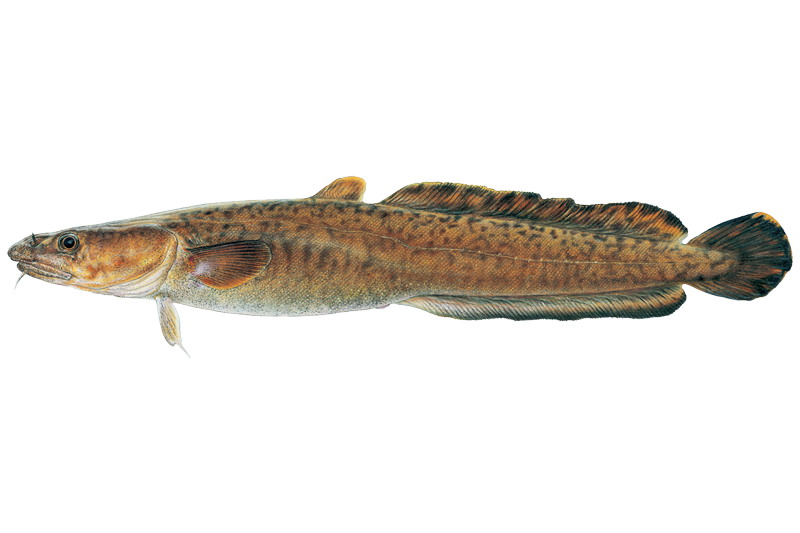
Burbot is a native Dutch species that has nearly vanished from the Netherlands over the past century. Drainage works, river channelization, and agricultural runoff gutted most populations by the mid-1900s.
Today, only two areas still hold spawning fish, and one — the IJssel-Vechtdelta — has shown a genuine recovery, driven largely by restocking efforts in the German reaches of the Vechte. Catching one here is a rare event, not a casual afternoon's fishing.
Scientific Name: Lota lota
Also known as Kwabaal, eelpout, freshwater cod, lawyer fish
- Elongated, almost eel-like body with mottled brown, olive, or grey-yellow patterning — no two fish look quite the same.
- Single soft barbel on the chin, long continuous dorsal and anal fins running to a rounded tail — unmistakable once you've seen one.
- Appears scaleless but carries tiny, nearly invisible scales embedded in thick, slippery skin.
- Dutch fish typically run 30–60 cm; larger specimens approaching 80 cm have been recorded historically in the major river systems.
What to know
Habitat Distribution
- Native to the Netherlands; once widespread across the major lowland river systems but now reduced to relict populations in two areas.
- The IJssel-Vechtdelta — where the Vechte and IJssel converge — holds the only confirmed recovering population, bolstered by upstream German stockings since 2001.
- Favors cold, well-oxygenated rivers, floodplain lakes, and connected backwaters; historically present in the Rhine and Meuse systems.
- Needs clean gravel or sandy substrate for winter spawning; heavily degraded, silted channels are largely unsuitable.
Key Locations
- IJssel-Vechtdelta — the confluence area of the Vechte and IJssel holds the only confirmed recovering spawning population in the country.
- River Vechte — restocking in the German reaches since 2001 has driven the downstream recovery seen in the Dutch delta section.
Specific Spots
- Deep holes and channel edges in the Vechte and IJssel confluence lakes — burbot hold in the coldest, deepest water during daylight hours.
- Rocky or hard-bottom drop-offs where current slows; these concentrate the small fish and invertebrates burbot hunt at night.
- Undercut banks and submerged woody debris in connected floodplain lakes provide daytime cover before nocturnal feeding runs.
Burbot FAQ
Answers from onWater's species guide.
What are the best lures and bait for Burbot?
Cut or whole deadbait, roach, perch, or any available small fish, is the most reliable option; fresh bait outperforms frozen where possible. Large lobworms or bunches of smaller worms work well, especially when fish are actively moving during the pre-spawn period.
When is the best time to fish for Burbot?
Late autumn through early spring is when burbot are most active in Dutch waters, coinciding with falling water temperatures. The pre-spawn period in mid-winter, typically January and February, sees the heaviest feeding activity.
How do you catch Burbot?
Given the species' protected status in the Netherlands, deliberate targeting is not appropriate. Burbot are occasionally taken as bycatch by anglers ledgering for other species at night in the IJssel-Vechtdelta; any such fish should be unhooked carefully and released.
What do Burbot eat?
Feeds mainly on smaller fish, perch, roach, gudgeon, as well as crayfish and large invertebrates; bottom-fished whole or cut deadbait on or near the riverbed is the most direct imitation of this forage.
Where do Burbot live?
Native to the Netherlands; once widespread across the major lowland river systems but now reduced to relict populations in two areas. The IJssel-Vechtdelta, where the Vechte and IJssel converge, holds the only confirmed recovering population, bolstered by upstream German stockings since 2001.
See it in the app
Most maps show you water.
onWater shows you Burbot.



- 01 · Species map filter
Map every Burbot water
Pick Burbot and the map zeroes in on the waters they call home. No more guessing which lake holds them.
- 02 · Waterbody species
Tap any water. See what lives there.
Species, behavior and seasonal patterns for every lake, river and pond, before you leave the driveway.
- 03 · Angler Intelligence
Ask how to catch Burbot
Tactics, gear and timing from onWater's AI fishing guide, tuned to the species and the water you're on.
Stop guessing where Burbot are.
Open the map, filter by Burbot, and head to water that holds them. Download onWater and plan your next trip in minutes.
- Species map filter
- Angler Intelligence
- Fishing journal
Explore other species
Trout, bass, salmon, panfish and everything in between. Each guide unpacks the behavior, seasons, and tactics that put fish in the net.
No species information available.

Smarter Fishing Starts in the App.
onWater Fish gives you everything you need to plan smarter, fish better, and own every trip from first cast to last.