Brown Bullhead
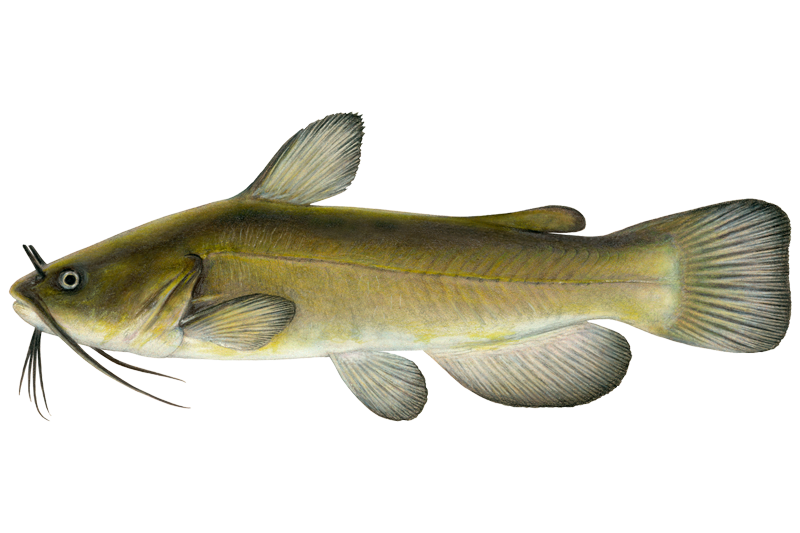
The brown bullhead — known in Dutch as bruine Amerikaanse dwergmeerval — arrived in the Netherlands in the late 19th century as an introduction from North America and has since spread through much of the country's lowland water network.
It's a small, hardy catfish that fills a niche in slow, weedy, often murky waters where other species struggle. Dutch anglers fish it mainly at night from the bank, and it's a reliable target for anyone who enjoys simple, relaxed bottom fishing.
Scientific Name: Ameiurus nebulosus
Also known as bruine Amerikaanse dwergmeerval, poisson chat, dwergmeerval
- Olive-brown to dark brown body with darker mottling or blotching; yellowish-white belly — the mottled pattern distinguishes it from the more uniformly coloured black bullhead.
- Four pairs of dark, whisker-like barbels around the mouth; dark chin barbels are a key ID feature separating it from yellow bullhead, which has pale or white chin barbels.
- Sharp, stout spines on the leading edge of the dorsal and pectoral fins — handle with care; rear edge of pectoral spine carries 5–8 saw-like teeth.
- Typically 8–12 inches (20–30 cm) in Dutch waters; the species can reach 50 cm but fish over 30 cm are uncommon here.
What to know
Habitat Distribution
- Introduced from North America — not native to the Netherlands; established across much of the country's lowland freshwater network since the late 1800s.
- Favours slow-moving or still water: ditches, polders, oxbow lakes, shallow ponds, and the quieter backwaters of larger rivers.
- Tolerates warm, low-oxygen, turbid water that would stress most other species — a direct result of the flat, nutrient-rich Dutch landscape.
- Found throughout the western and central Netherlands in the dense network of polder ditches and urban waterways, as well as in larger lakes and river floodplains.
Key Locations
- Polder ditches and channels throughout the provinces of Zuid-Holland, Noord-Holland, and Utrecht — the dense, slow-water network here is ideal habitat.
- Oxbow lakes and floodplain waters along the Rijn and Maas river systems, where warm, silty backwaters hold good numbers.
- Urban park ponds and city canals across the Netherlands — bullheads colonise almost any connected still or slow water and are commonly caught in Amsterdam, Rotterdam, and Utrecht waterways.
Specific Spots
- Soft, muddy bottom in 1–3 metres of water — this is where the fish roots for food; clean gravel or sand holds far fewer bullheads.
- Dense submerged or emergent vegetation: reed beds, water lilies, and weed mats provide cover and concentrate invertebrates the fish feed on.
- Undercut banks, submerged timber, and hollow snags — bullheads nest and rest in dark, sheltered cavities, so any hard structure in otherwise featureless water is worth targeting.
- Drainage ditches and polder channels at night, especially where two channels meet — current breaks and corners concentrate scent and food.
Brown Bullhead FAQ
Answers from onWater's species guide.
What are the best lures and bait for Brown Bullhead?
Worms, red worms, dendrobaenas, or nightcrawlers, are the most reliable bait; a bunch of worms on the hook produces a strong scent trail that draws fish from a distance in murky water.
When is the best time to fish for Brown Bullhead?
Spring (April–May): fish become active as water warms; pre-spawn fish feed well and this is one of the better daytime windows. Summer (June–August): peak season, especially night sessions; warm water keeps fish active and feeding through the night.
How do you catch Brown Bullhead?
Most Dutch anglers fish for bullheads from the bank at night, using a simple ledger rig with worm or liver bait cast to soft-bottomed margins near reeds or structure. Daytime sessions in shaded, weedy spots can produce fish, but after-dark fishing is consistently more productive.
What do Brown Bullhead eat?
Bottom-dwelling invertebrates, worms, insect larvae, molluscs, and crustaceans, make up the bulk of the diet; this is why a simple worm or bunch of red worms on a size 6–8 hook fished on the bottom is the go-to presentation.
Where do Brown Bullhead live?
Introduced from North America, not native to the Netherlands; established across much of the country's lowland freshwater network since the late 1800s. Favours slow-moving or still water: ditches, polders, oxbow lakes, shallow ponds, and the quieter backwaters of larger rivers.
See it in the app
Most maps show you water.
onWater shows you Brown Bullhead.



- 01 · Species map filter
Map every Brown Bullhead water
Pick Brown Bullhead and the map zeroes in on the waters they call home. No more guessing which lake holds them.
- 02 · Waterbody species
Tap any water. See what lives there.
Species, behavior and seasonal patterns for every lake, river and pond, before you leave the driveway.
- 03 · Angler Intelligence
Ask how to catch Brown Bullhead
Tactics, gear and timing from onWater's AI fishing guide, tuned to the species and the water you're on.
Stop guessing where Brown Bullhead are.
Open the map, filter by Brown Bullhead, and head to water that holds them. Download onWater and plan your next trip in minutes.
- Species map filter
- Angler Intelligence
- Fishing journal
Explore other species
Trout, bass, salmon, panfish and everything in between. Each guide unpacks the behavior, seasons, and tactics that put fish in the net.
No species information available.
Smarter Fishing Starts in the App.
onWater Fish gives you everything you need to plan smarter, fish better, and own every trip from first cast to last.