Rainbow Trout
Rainbow trout are not native to Ireland — they were first stocked here in 1899 and have never established self-sustaining wild populations.
Today they exist almost entirely in put-and-take fisheries: small managed lakes and spring-fed reservoirs stocked regularly from fish farms.
That makes them Ireland's most accessible game fish, with venues spread across every province and no need to chase a hatch or read a wild river.
Scientific Name: Oncorhynchus mykiss
Also known as Rainbow, Rainbows
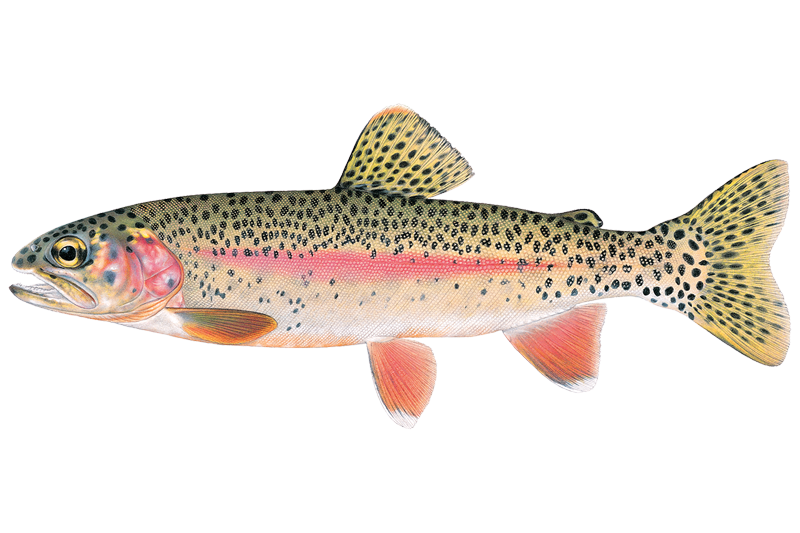
- A broad flush of rosy pink or magenta runs along the lateral line from gill plate to tail — the clearest difference from a brown trout at a glance.
- Tail heavily spotted with small black dots, distinguishing it from the lightly spotted or plain tail of a brown trout.
- Back and flanks olive-green to steel-blue, covered in fine black spots that extend onto the dorsal fin.
- Typical stocked fish in Irish put-and-take waters run 1–4 lb; triploid (sterile) fish stocked at some venues can reach double figures over several seasons.
What to know
Habitat Distribution
- Introduced, not native — no self-sustaining wild populations exist in Ireland despite occasional recorded spawning events.
- Found almost exclusively in managed put-and-take stillwaters: spring-fed lakes, reservoirs, and purpose-built fishery ponds spread across Wicklow, Waterford, Westmeath, Cavan, Laois, Clare, Kildare, Kilkenny, Kerry and beyond.
- More tolerant of warmer water than brown trout, which is why they thrive in the shallower, nutrient-rich lakes that brown trout would struggle in during summer.
- A small number of larger loughs — including some Midland lakes — hold stocked rainbows alongside wild browns, where holdover fish can grow quickly on rich invertebrate food.
Key Locations
- Annamoe Trout Fishery, Co. Wicklow — a well-regarded spring-fed lake in the Wicklow Mountains, short drive from Dublin.
- Carrigavantry Reservoir and Knockaderry Reservoir, Co. Waterford — managed fly-fishing venues in the southeast.
- Derrymore Springs, Co. Westmeath — spring-fed fishery in the Midlands known for clear water and active fish.
- Laois Angling Centre, Co. Laois — a central Ireland venue catering to both fly and lure anglers.
- Corkagh Park Fishery, Co. Dublin — one of the most accessible rainbow trout venues for anglers based in the capital.
Specific Spots
- In spring-fed fisheries, look for the inlet channels and oxygenated shallows — stocked fish gravitate toward moving, well-oxygenated water.
- Weed edges and drop-offs hold fish that have settled after stocking; they use the cover the same way a wild trout would use a undercut bank.
- On windier days, fish the downwind shore of any stillwater — wind lanes concentrate hatching insects and drifting food, pulling trout to the surface.
- In warmer months, deeper water near dam walls or spring upwellings gives fish a thermal refuge; a slow retrieve through these zones often outfishes the shallows.
Rainbow Trout FAQ
Answers from onWater's species guide.
What are the best lures and bait for Rainbow Trout?
Small spinners (Mepps-style, sizes 1–2) and spoons in silver or gold are reliable across Irish put-and-take venues, the flash and vibration draws fish that are holding near structure or in open water.
What flies work for Rainbow Trout?
Buzzers (chironomid midge pupae imitations tied on size 10–14 hooks in black, red, or olive) are the single most consistent pattern on Irish stillwaters, fish them static or on a very slow figure-of-eight retrieve just under the surface.
When is the best time to fish for Rainbow Trout?
Many Irish put-and-take rainbow fisheries are open year-round, unlike wild brown trout rivers which have closed seasons. Spring (March–May) and autumn (September–November) offer the most consistent fishing as water temperatures sit in the ideal range and fish are actively feeding near the surface.
How do you catch Rainbow Trout?
Almost all rainbow trout fishing in Ireland takes place on managed stillwaters, either from the bank or a small boat. Fly fishing with buzzers or small lures on a floating or intermediate line is the dominant method, though spinning with small spinners and soft plastics is common at venues that permit it.
What do Rainbow Trout eat?
Invertebrates are the backbone of the diet, aquatic nymphs, buzzer (chironomid midge) larvae and pupae, and hatching sedge (caddis). On Irish stillwaters, buzzers fished on a slow retrieve or static under an indicator account for a huge proportion of fish taken.
See it in the app
Most maps show you water.
onWater shows you Rainbow Trout.



- 01 · Species map filter
Map every Rainbow Trout water
Pick Rainbow Trout and the map zeroes in on the waters they call home. No more guessing which lake holds them.
- 02 · Waterbody species
Tap any water. See what lives there.
Species, behavior and seasonal patterns for every lake, river and pond, before you leave the driveway.
- 03 · Angler Intelligence
Ask how to catch Rainbow Trout
Tactics, gear and timing from onWater's AI fishing guide, tuned to the species and the water you're on.
Stop guessing where Rainbow Trout are.
Open the map, filter by Rainbow Trout, and head to water that holds them. Download onWater and plan your next trip in minutes.
- Species map filter
- Angler Intelligence
- Fishing journal
Explore other species
Trout, bass, salmon, panfish and everything in between. Each guide unpacks the behavior, seasons, and tactics that put fish in the net.
No species information available.

Smarter Fishing Starts in the App.
onWater Fish gives you everything you need to plan smarter, fish better, and own every trip from first cast to last.