Northern Pike
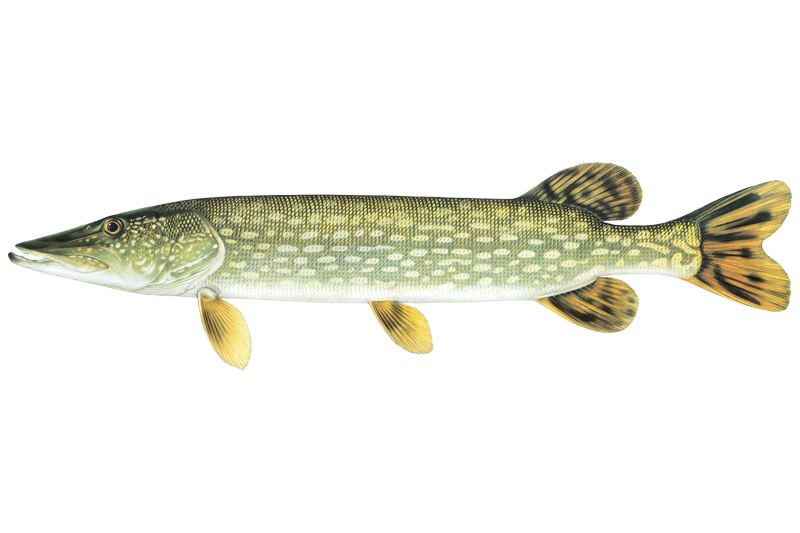
Pike are Ireland's largest freshwater predator and one of the country's most widely targeted species.
Found in loughs, rivers, and canals from Connacht to Ulster, they grow fast on Ireland's rich forage base — fish over 20 lbs are common, and waters like Lough Derg have produced fish pushing 40 lbs.
Whether you're casting lures from a boat or fishing deadbaits from the bank, Irish pike fishing is accessible, productive, and runs virtually year-round.
Scientific Name: Esox lucius
Also known as Pike, Jack
- Long, torpedo-shaped body covered in green-and-gold mottled camouflage — unmistakable among Irish freshwater fish.
- Huge, flat, duck-billed head with a wide gape and rows of sharp, backward-pointing teeth; handle carefully and use long-nose pliers.
- Dorsal and anal fins set far back near the tail, giving the fish explosive short-burst speed from a standstill.
- Common Irish fish run 5–15 lbs; 20 lb+ fish are realistic targets on the better loughs, with 40 lb specimens recorded.
What to know
Habitat Distribution
- Present throughout Ireland — native or very long-established — in thousands of loughs, several thousand kilometres of rivers, and the canal network.
- Genetic evidence points to two distinct populations: one that colonised naturally after the last ice age, and a second introduced wave around the 12th century, particularly into southern catchments.
- Thrive in slow to moderate water: large midland and western loughs (Lough Derg, Lough Erne), lowland rivers, and the Shannon system's interconnected lakes and canals.
- Also found in brackish coastal margins in parts of Europe; in Ireland they are primarily a freshwater species across all provinces.
Key Locations
- Lough Derg (Shannon system) — one of Ireland's premier pike loughs, with a well-established guiding industry and a track record of large fish.
- Lough Erne (County Fermanagh) — Upper and Lower Erne are classic Ulster pike waters with extensive reed margins and a long history of big-fish catches.
- The Shannon system broadly — the interconnected lakes, rivers, and canals of the midlands hold pike throughout and are largely underutilised.
- County Fermanagh loughs (Lough MacNean, Lough Scolban, Mill Lough) — part of the Public Angling Estate in Northern Ireland, managed by DAERA and the Loughs Agency.
- Canals and lowland rivers — the Movanagher, Portna, Toome, and Broadwater canals in County Antrim, and the Quoile Basin in County Down, all hold pike on the Public Angling Estate.
Specific Spots
- Reed beds and emergent vegetation are the classic holding areas — pike sit motionless in the stems waiting for roach or rudd to pass within range, so cast tight to the edge rather than into open water.
- Weed lines where open water meets submerged vegetation give pike a defined ambush edge; work lures parallel to the weed rather than through it.
- Drop-offs and depth changes on lough margins concentrate fish, especially in warmer months when pike seek cooler, oxygenated water at depth.
- Inflowing streams and river mouths draw baitfish and, in turn, pike — particularly in autumn as water temperatures fall.
Northern Pike FAQ
Answers from onWater's species guide.
What are the best lures and bait for Northern Pike?
Large soft-plastic shads (4–6 inch) on a jig head are the go-to lure across Irish loughs, work them with a slow, erratic retrieve close to weed edges and drop-offs. Roach, perch, and natural colours all produce.
What flies work for Northern Pike?
Large articulated streamers in white, chartreuse, or perch patterns imitate the roach and rudd pike key on in Irish waters, patterns like a Deceiver or a large Woolly Bugger (which imitates a wounded baitfish) retrieved with long, irregular strips work well along weed edges.
When is the best time to fish for Northern Pike?
Spring (March–June), a productive period as pike become active after winter; fish move onto shallow margins and are catchable on lures and deadbaits. Summer (July–August), fishing slows in warm weather; early mornings and overcast days are the most reliable windows, with fish holding deeper.
How do you catch Northern Pike?
Most Irish pike fishing is done from boats on the larger loughs, using lure fishing, trolling, or deadbait techniques adapted to the season and water temperature.
What do Northern Pike eat?
Adult pike feed almost entirely on fish, roach, rudd, eels, perch, and hybrids make up the bulk of the diet in Irish waters. Match this with large soft-plastic shads, jerkbaits, or deadbaits in roach or perch colours.
See it in the app
Most maps show you water.
onWater shows you Northern Pike.



- 01 · Species map filter
Map every Northern Pike water
Pick Northern Pike and the map zeroes in on the waters they call home. No more guessing which lake holds them.
- 02 · Waterbody species
Tap any water. See what lives there.
Species, behavior and seasonal patterns for every lake, river and pond, before you leave the driveway.
- 03 · Angler Intelligence
Ask how to catch Northern Pike
Tactics, gear and timing from onWater's AI fishing guide, tuned to the species and the water you're on.
Stop guessing where Northern Pike are.
Open the map, filter by Northern Pike, and head to water that holds them. Download onWater and plan your next trip in minutes.
- Species map filter
- Angler Intelligence
- Fishing journal
Explore other species
Trout, bass, salmon, panfish and everything in between. Each guide unpacks the behavior, seasons, and tactics that put fish in the net.
No species information available.
Smarter Fishing Starts in the App.
onWater Fish gives you everything you need to plan smarter, fish better, and own every trip from first cast to last.