Common Carp
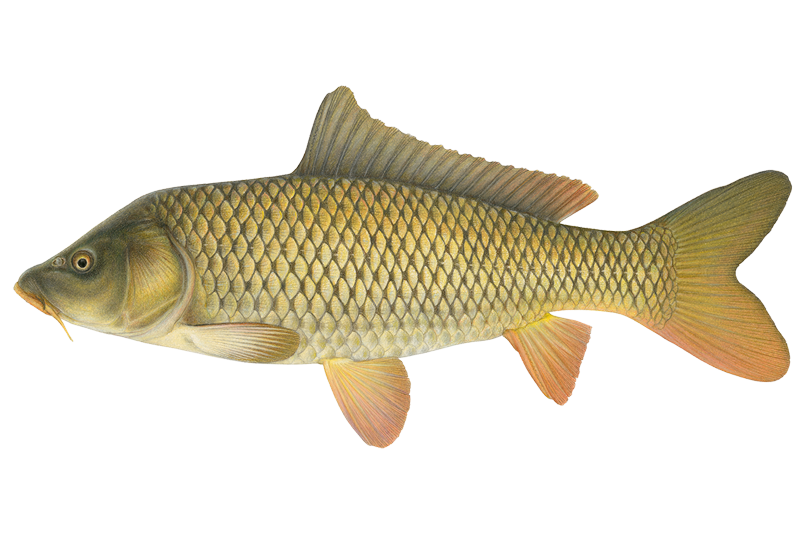
Common carp are Ireland's premier coarse-fishing target for specialist anglers. Introduced — possibly as far back as the 1600s — they're now established in ponds, small lakes, and purpose-built fisheries concentrated across south Leinster and north Munster.
Ireland's cooler water means fish don't reach continental European sizes, but a double-figure fish is a genuine achievement, and the fishing itself is every bit as technical and rewarding.
Scientific Name: Cyprinus carpio
Also known as Carp, Mirror carp, Leather carp, Linear carp
- Deep-bodied, bronze-to-olive fish with a long dorsal fin running most of the back and a thick-lipped, downward-pointing mouth with two pairs of barbels — unmistakable in hand.
- Scale pattern varies by variety: fully scaled (common), large scattered scales (mirror), scales only along the lateral line (linear), or nearly bare (leather).
- Colour runs from pale gold to dark brown, often with a brassy sheen on the flanks and reddish tints on the fins.
- In Irish waters a fish over 4.5 kg (10 lb) is considered a good one; the Irish record stands above 14 kg, set at Loughgall, Armagh.
What to know
Habitat Distribution
- Introduced, not native — present in Ireland since at least the 1600s and now established across a scatter of still waters, mainly in south Leinster and north Munster.
- Found in large ponds, small lakes, and put-and-take specialist fisheries; also recorded in some midland and western waters including Co. Westmeath, Co. Roscommon, Co. Clare, and Co. Monaghan.
- Prefer shallow, warm, weedy lakes and ponds with soft or silty bottoms — the kind of water that heats up quickly in summer.
- Tolerant of low oxygen and poor water quality, which lets them persist in enclosed fisheries where other species would struggle.
Key Locations
- Grange Glebe Fishery, Co. Meath — purpose-built specialist venue in the Boyne Valley near Kells, with dedicated carp lakes.
- Galmoylestown and Ballinafid Lakes, Co. Westmeath — established carp waters near Mullingar in the midlands.
- Lakeland Fishery, Rooskey, Co. Roscommon — one of the better-known coarse fisheries in the northwest with carp present.
- Gorteen Lake, Co. Clare — a noted carp venue in Munster.
- Oakland's Fishery, New Ross, Co. Wexford, and Loch Mahon, Co. Wexford — south Leinster fisheries in the heartland of Irish carp angling.
Specific Spots
- Silty, shallow bays with soft bottom — carp root through the sediment here, often giving away their position by clouding the water or sending up strings of bubbles.
- Weed-bed edges and lily-pad margins, where carp cruise and feed on invertebrates sheltering in the stems and roots.
- Overhanging trees and bankside cover, which drop terrestrial food into the water and give carp a sense of security.
- Deeper holes adjacent to shallow feeding areas — carp retreat here in cold weather and during bright midday light, then move up to feed at dusk and dawn.
Common Carp FAQ
Answers from onWater's species guide.
What are the best lures and bait for Common Carp?
Boilies, round, hardened paste baits in fishmeal, fruit, or nut flavours, are the go-to bait on Irish specialist fisheries; 15–18 mm sizes work well, and matching your hookbait to your free offerings is standard practice.
When is the best time to fish for Common Carp?
May to October, the main carp season in Ireland, when water temperatures are warm enough to trigger consistent feeding; summer evenings and overnight sessions through June–August tend to produce the most action.
How do you catch Common Carp?
Most Irish carp fishing is done from the bank on specialist still-water fisheries, with anglers setting up two or three rods on bite alarms and fishing boilies or particles hard on the bottom using bolt rigs.
What do Common Carp eat?
Bottom-dwelling invertebrates, bloodworms (midge larvae), snails, freshwater mussels, and worms, make up the bulk of natural feeding; this is why boilies, corn, and worm fished hard on the bottom account for most Irish carp.
Where do Common Carp live?
Introduced, not native, present in Ireland since at least the 1600s and now established across a scatter of still waters, mainly in south Leinster and north Munster. Found in large ponds, small lakes, and put-and-take specialist fisheries; also recorded in some midland and western waters including Co. Westmeath, Co.
See it in the app
Most maps show you water.
onWater shows you Common Carp.



- 01 · Species map filter
Map every Common Carp water
Pick Common Carp and the map zeroes in on the waters they call home. No more guessing which lake holds them.
- 02 · Waterbody species
Tap any water. See what lives there.
Species, behavior and seasonal patterns for every lake, river and pond, before you leave the driveway.
- 03 · Angler Intelligence
Ask how to catch Common Carp
Tactics, gear and timing from onWater's AI fishing guide, tuned to the species and the water you're on.
Stop guessing where Common Carp are.
Open the map, filter by Common Carp, and head to water that holds them. Download onWater and plan your next trip in minutes.
- Species map filter
- Angler Intelligence
- Fishing journal
Explore other species
Trout, bass, salmon, panfish and everything in between. Each guide unpacks the behavior, seasons, and tactics that put fish in the net.
No species information available.
Smarter Fishing Starts in the App.
onWater Fish gives you everything you need to plan smarter, fish better, and own every trip from first cast to last.