Brown Trout
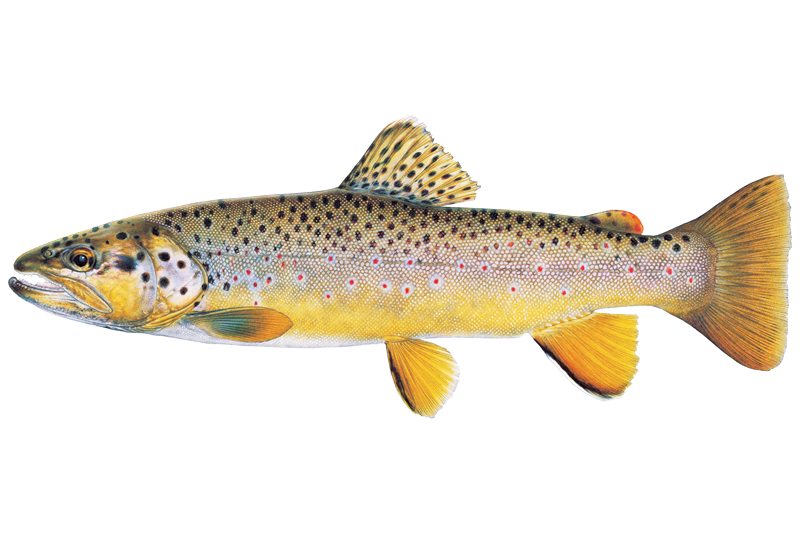
Brown trout are native to Ireland and the most widely distributed freshwater fish in the country — present in virtually every river, lake, and stream in every county.
They underpin Irish angling culture more than any other species, from small upland freestone streams to the great limestone loughs of the west.
Irish waters hold both resident freshwater fish and sea-run fish (sea trout), and the biggest lough specimens — known as ferox trout — can reach extraordinary sizes.
Scientific Name: Salmo trutta
Also known as An Breac Donn, ferox trout (large lough form), sea trout (migratory form), Croneen trout (Shannon system lake-migratory form)
- Brown back shading to lighter, yellowish sides covered in black and reddish spots; pale belly; reddish-brown fins — but colour varies widely with habitat and the fish can lighten or darken to match surroundings.
- Distinguished from Atlantic salmon by a more square or slightly convex tail (salmon tail is forked), a heavier, deeper body, and more prominent red spots often ringed with pale halos.
- River fish typically run 0.5–2 lb; large limestone lough fish regularly reach 5–10 lb; ferox trout on deep loughs can exceed 20 lb — the Irish record lake brown stands at 26 lb.
- Ferox form is noticeably deeper-bodied and more silver-flanked than typical river or shallower-lough fish, reflecting a diet that shifts heavily to other fish.
What to know
Habitat Distribution
- Native to Ireland; found in every county — from small upland acid streams to large alkaline limestone loughs and coastal estuaries where sea trout run.
- Rivers such as the Suir, Boyne, Moy, and Drowes hold healthy resident populations; the great western loughs — Corrib, Mask, Melvin, Sheelin, Arrow, and Erne — are the heartland of big-fish lake fishing.
- Thrive in cool, well-oxygenated water with clean gravel; limestone loughs produce the richest insect life and the largest average fish sizes.
- Sea trout (the migratory form) use the same rivers and estuaries as Atlantic salmon, returning from the sea to spawn in freshwater.
Key Locations
- Lough Corrib, Co. Galway — the top venue for specimen lake brown trout by submitted records; famous for its Mayfly hatch.
- Lough Mask, Co. Mayo/Galway — large limestone lough producing big fish; traditional wet-fly lough fishing at its best.
- Lough Melvin, Co. Leitrim/Fermanagh — holds all five Irish salmonid species; exceptional hatch fishing including Grey Drake, caenis, and caddis.
- Lough Sheelin, Co. Westmeath — midland limestone lough with some of Ireland's most reliable Ephemera danica hatches in May.
- River Suir, Co. Tipperary — a wide, wadeable freestone river known for wild, well-coloured browns and good nymph and dry-fly fishing; also holds large resident fish in its deeper pools.
- River Boyne, Co. Meath — popular river fishery with a long fly-fishing tradition and accessible wading.
Specific Spots
- In rivers, territorial fish hold at current breaks — behind boulders, at the edge of fast water entering a pool, or along undercut banks — where food is delivered without burning energy.
- On limestone loughs, shallow rocky shorelines and weed-fringed bays concentrate fish during mayfly hatches; fish move up from depth to feed at the surface when hatches are on.
- Deep open water on loughs like Corrib and Mask holds ferox trout that follow char and perch shoals — trolling over drop-offs and mid-lough humps targets these fish.
- On wadeable freestone rivers like the Suir and Boyne, the seam between fast and slow water at the tail of a pool is a reliable holding lie, especially in low summer flows.
Brown Trout FAQ
Answers from onWater's species guide.
What are the best lures and bait for Brown Trout?
Small spinners and wobblers (5–10 g) in silver or gold are the standard river approach; barbless hooks are widely used and increasingly expected on catch-and-release waters.
What flies work for Brown Trout?
Wet flies fished in a team of three on a floating line from a drifting boat, patterns like the Claret Bumble, Bibio, and Invicta, are the classic Irish lough method, imitating emerging insects and small fry.
When is the best time to fish for Brown Trout?
The main trout season on most Irish waters runs from late February or March through to October, with exact opening dates set by Inland Fisheries Ireland. May and June are the peak months on the limestone loughs, when the Mayfly (Ephemera danica) hatch brings the biggest fish to the surface.
How do you catch Brown Trout?
On the limestone loughs, most anglers fish from a drifting boat using traditional Irish wet-fly tactics, a team of three flies on a floating line, covering ground with the wind. River anglers wade and work upstream with nymphs or dry flies matched to whatever is hatching.
What do Brown Trout eat?
Smaller fish feed mainly on freshwater invertebrates, mayfly nymphs, caddis larvae, and midges. A Pheasant Tail or Hare's Ear nymph (both imitate mayfly nymphs) fished sub-surface covers this feeding year-round.
See it in the app
Most maps show you water.
onWater shows you Brown Trout.



- 01 · Species map filter
Map every Brown Trout water
Pick Brown Trout and the map zeroes in on the waters they call home. No more guessing which lake holds them.
- 02 · Waterbody species
Tap any water. See what lives there.
Species, behavior and seasonal patterns for every lake, river and pond, before you leave the driveway.
- 03 · Angler Intelligence
Ask how to catch Brown Trout
Tactics, gear and timing from onWater's AI fishing guide, tuned to the species and the water you're on.
Stop guessing where Brown Trout are.
Open the map, filter by Brown Trout, and head to water that holds them. Download onWater and plan your next trip in minutes.
- Species map filter
- Angler Intelligence
- Fishing journal
Explore other species
Trout, bass, salmon, panfish and everything in between. Each guide unpacks the behavior, seasons, and tactics that put fish in the net.
No species information available.

Smarter Fishing Starts in the App.
onWater Fish gives you everything you need to plan smarter, fish better, and own every trip from first cast to last.